
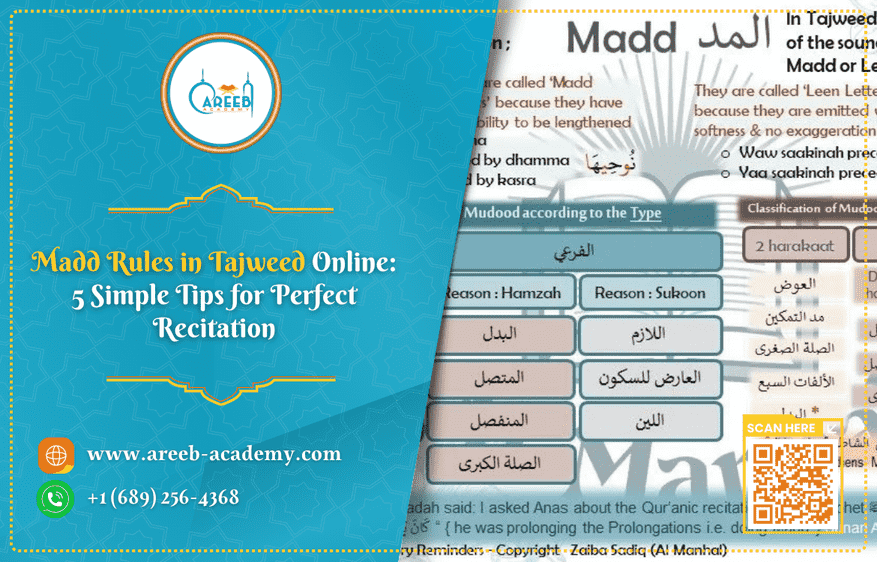
Madd Rules in Tajweed are essential guidelines that control how vowel sounds are elongated during Quran recitation. These rules determine how long a reader should stretch the sounds of the three Madd letters: Alif (ا), Waw (و), and Yaa (ي), ensuring accurate pronunciation and preserving the beauty of the Quran.
Understanding Madd Rules in Tajweed is not just about timing; rather, it is about maintaining the correct meaning, rhythm, and flow of the divine text. Moreover, even a small mistake in elongation can affect the clarity of recitation. Therefore, mastering these rules is a fundamental step for every Quran learner.
In addition, this guide will help you learn the different types of Madd. It will also explain how to measure them using Harakat, as well as highlight common mistakes learners make. Finally, you will discover practical tips that can significantly improve your recitation.
What Are Madd Rules in Tajweed?

Madd rules in Tajweed refer to the elongation (stretching) of specific vowel sounds during Quranic recitation. This elongation occurs using three main letters: Alif (ا), Waw (و), and Yaa (ي), and is measured in counts called harakat.
These rules are essential for maintaining the correct pronunciation, rhythm, and meaning of the Quran. Madd can be stretched for 2, 4, 5, or 6 counts, depending on the type and the letters that follow.
Madd is generally divided into two main categories:
- Madd Asli (Natural Madd) – basic elongation
- Madd Far’i (Secondary Madd) – extended elongation due to Hamza or Sukoon
Definition of Madd in Tajweed Rules
The word Madd (مَدّ) literally means “to extend” or “to lengthen.” In Tajweed, it refers to extending the sound of a vowel when one of the Madd letters appears under specific conditions.
For Madd to occur correctly:
- The letter must be sakin (without a vowel)
- It must be preceded by a matching vowel:
- Alif (ا) → comes after Fatha
- Waw (و) → comes after Dammah
- Yaa (ي) → comes after Kasrah
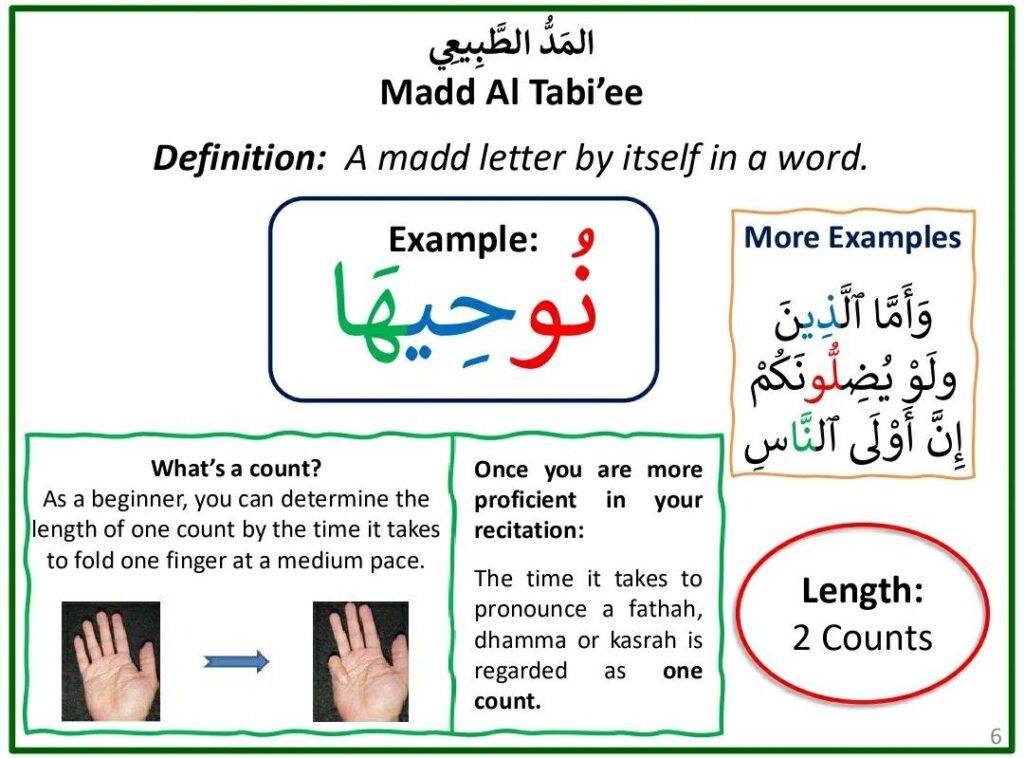
A helpful way to remember the Madd letters is the word: نُوحِيهَا
Understanding Madd becomes easier when you first master the basic Tajweed rules. For example, learning Noon Sakinah Rules and Meem Sakinah Rules helps you build a strong foundation for correct pronunciation.
What Does “Stretching” Mean in Tajweed?
“Stretching” in Tajweed means holding the vowel sound longer than usual for a specific number of counts (harakat).
Each count equals the natural duration of one short vowel. Depending on the type of Madd:
- 2 counts → short/natural stretch
- 4–5 counts → medium stretch
- 6 counts → long stretch
For example:
- قَالَ (Qaa-la) → the “aa” sound is stretched for 2 counts
This controlled stretching creates a smooth and rhythmic flow in recitation.
Why Madd Rules Are Important in Quran Recitation
Madd rules are crucial because they:
- Preserve the correct meaning
Changing the length of a vowel can completely alter a word’s meaning. - Enhance the beauty of recitation
Madd adds a natural rhythm and melody to Quran recitation. - Ensure proper Tajweed application
It helps reciters follow the exact way the Quran was revealed and transmitted. - Improve fluency and clarity
Correct elongation makes recitation clearer and easier to understand.
Letters of Madd in Tajweed Rules
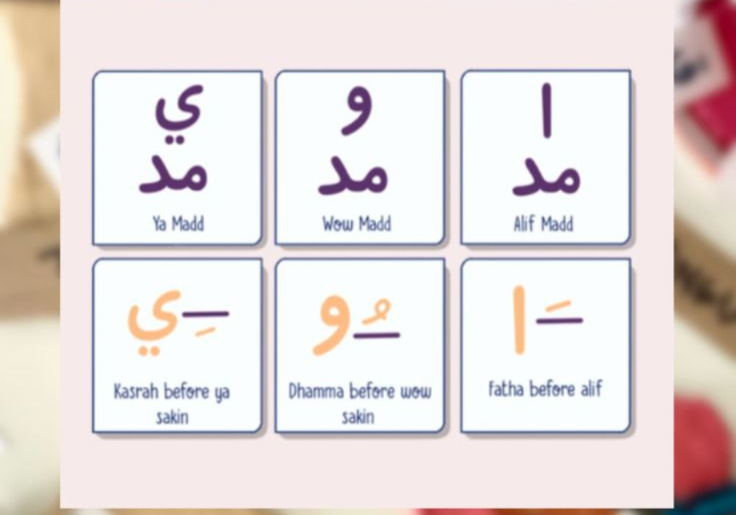
The letters of Madd (Huroof Al-Madd) are the foundation of elongation in Tajweed. They are three letters used to stretch vowel sounds during recitation:
Alif (ا), Waw (و), and Yaa (ي)
These letters are commonly grouped in the word: نُوحِيهَا, which makes them easier to remember.
When these letters meet specific conditions, they produce a natural elongation of 2 harakat. If followed by a Hamza (ء) or Sukoon (ْ), the elongation may extend further in advanced types of Madd.
The Three Madd Letters
ا (Alif)
- Comes after a Fatha (ـَـ)
- Always appears sakin (no vowel)
- Produces a stretched “aa” sound
- Example: قَالَ (Qaal)
و (Waw)
- Comes after a Dammah (ـُـ)
- Must be sakin (ـْو)
- Produces a stretched “oo” sound
- Example: يَقُول (Yaquul)
ي (Yaa)
- Comes after a Kasrah (ـِـ)
- Must be sakin (ـْي)
- Produces a stretched “ee” sound
- Example: قِيل (Qiil)
These pronunciation rules work alongside other essential Tajweed principles such as Qalqalah, which helps you understand echo sounds in Quran recitation.
Conditions for Madd Letters in Tajweed Rules

For any of these letters to function as true Madd letters, two essential conditions must be met:
- Sakin (Silent Letter)
The Madd letter itself must not carry any vowel (no Fatha, Dammah, or Kasrah). - Matching Preceding Vowel
The letter before it must match:- Fatha → Alif (ا)
- Dammah → Waw (و)
- Kasrah → Yaa (ي)
✔️ When both conditions are met → Natural Madd (2 counts)
❌ If not → it is not considered a Madd letter
💡 Note: If a Waw (و) or Yaa (ي) comes after a Fatha, it becomes a Līn letter, not a Madd letter.
Short Vowels vs Long Vowels
Understanding Madd starts with knowing the difference between short and long vowels:
Short Vowels (Harakat)
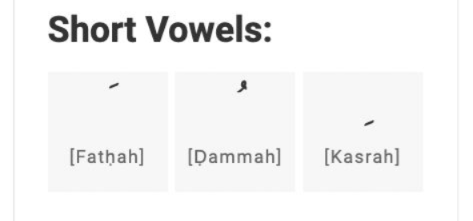
- Fatha (َ) → short “a”
- Dammah (ُ) → short “u”
- Kasrah (ِ) → short “i”
- Duration: 1 count
Long Vowels (Madd)
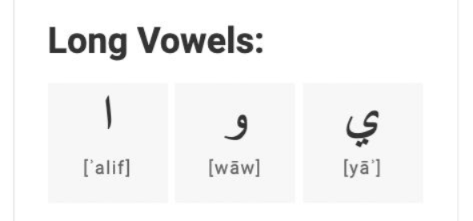
- Created using Madd letters (ا، و، ي)
- Duration: at least 2 counts
- Examples:
- قَالَ → “aa”
- يَقُول → “oo”
- قِيل → “ee”
Madd letters transform short sounds into smooth, extended sounds, which are essential for correct and beautiful Quran recitation.
Types of Madd in Tajweed (Main Categories)
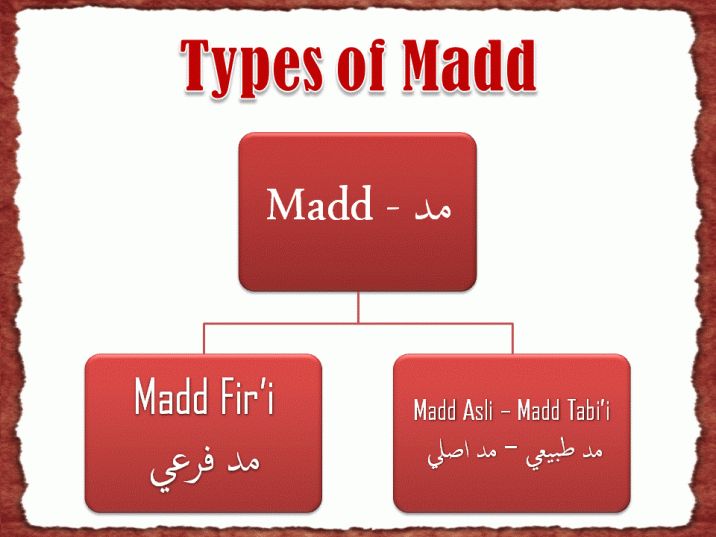
In Tajweed, Madd (elongation) is divided into two main categories based on its cause and length:
- Madd Asli (Natural Madd) → basic elongation
- Madd Far’i (Secondary Madd) → extended elongation due to a specific cause
This classification helps reciters understand when to stretch and how long to stretch each sound correctly.
Madd Asli (Natural Madd)
Madd Asli, also known as Madd Tabee’ee, is the simplest and most fundamental type of Madd.
- It occurs naturally when a Madd letter appears
- It has no Hamza (ء) or Sukoon (ْ) before or after it
- It is the foundation for all other types of Madd
✔️ Every reciter must master this first before moving to advanced types.
Madd Far’i (Secondary Madd)
Madd Far’i is an extended form of Madd that occurs because of an external factor.
- It happens when a Madd letter is followed by:
- Hamza (ء) OR
- Sukoon (ْ)
- The elongation becomes longer than 2 counts
- Duration ranges from 2 up to 6 harakat, depending on the type
✔️ This category includes multiple detailed types like Muttasil, Munfasil, and Laazim.
Quick Overview of All Types of Madd in Tajweed Rules
Here’s a simple summary to understand the main differences:
- Madd Asli → 2 counts → no cause
- Madd Muttasil → 4–5 counts → Hamza in same word
- Madd Munfasil → 4–5 counts → Hamza in next word
- Madd Laazim → 6 counts → permanent Sukoon
- Madd ‘Aarid → 2 / 4 / 6 → temporary Sukoon (when stopping)
- Madd Leen → 2 / 4 / 6 → soft letters at توقف
Madd Asli (Natural Madd) – 2 Counts
What Is Madd Asli?
Madd Asli is the foundation of all Madd rules. It occurs when one of the three Madd letters appears with its correct conditions without any Hamza or Sukoon nearby.
The word cannot be pronounced correctly without this natural elongation.
How Long to Stretch
Madd Asli is always stretched for:
➡️ 2 harakat (counts only)
A harakah is the time it takes to pronounce one short vowel.
✔️ Important:
- It cannot be shortened
- It cannot be extended beyond 2
Examples from the Quran
- قَالَ (Qāla) — Surah Al-Baqarah (2:30)
- يَقُولُ (Yaqūlu) — Surah Al-Baqarah (2:8)
- قِيلَ (Qīla) — Surah Al-Baqarah (2:11)
- فِيهَا (Fīhā) — Surah Al-Baqarah (2:25)
- نُوحٍ (Nūḥ) — Surah Hud (11:25)
In all these examples, the sound is stretched naturally for 2 counts.
Madd Far’i (Secondary Madd) Explained
What Makes Madd Far’i Different?
Madd Far’i is different because it does not occur naturally.
It only happens when there is an extra سبب (cause) that forces the elongation to be longer.
👉 This is why it’s called “secondary” Madd.
Main Causes (Hamza or Sukoon)
There are two main causes of Madd Far’i:
1. Hamza (ء)
When a Hamza comes:
- In the same word → Madd Muttasil (4–5 counts)
- In the next word → Madd Munfasil (4–5 counts)
- Before Madd letter → Madd Badal (2 counts
2. Sukoon (ْ)
When a Sukoon comes:
- Permanent → Madd Laazim (6 counts)
- Temporary (when stopping) → Madd ‘Aarid
- With soft letters → Madd Leen
Important Types of Madd Far’i
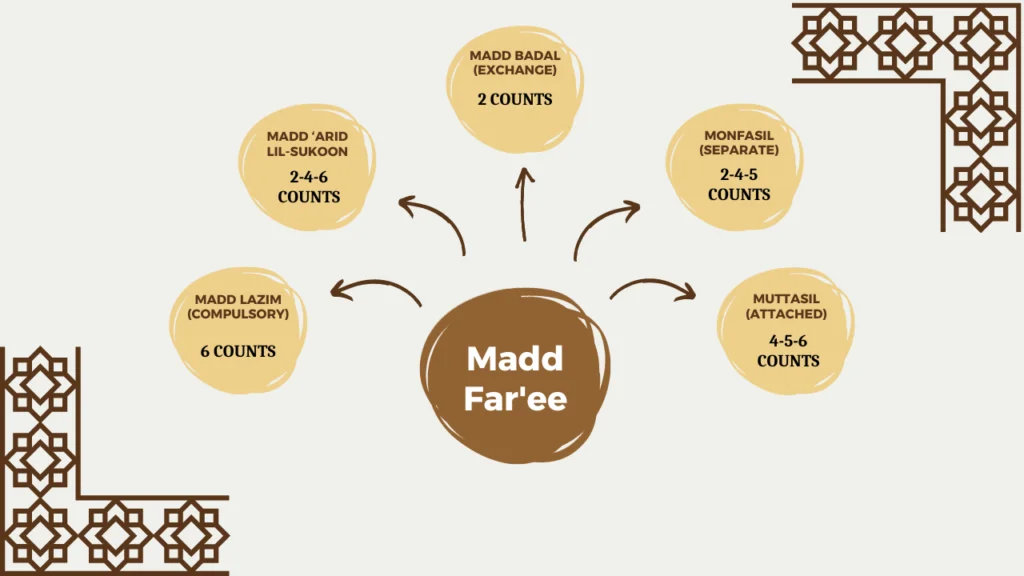
Madd Far’i includes several important types that extend the natural Madd beyond 2 counts due to a Hamza (ء) or Sukoon (ْ). Each type has a specific cause and fixed length that the reciter must follow carefully.
Madd Wajib Muttasil (4–5 Counts)
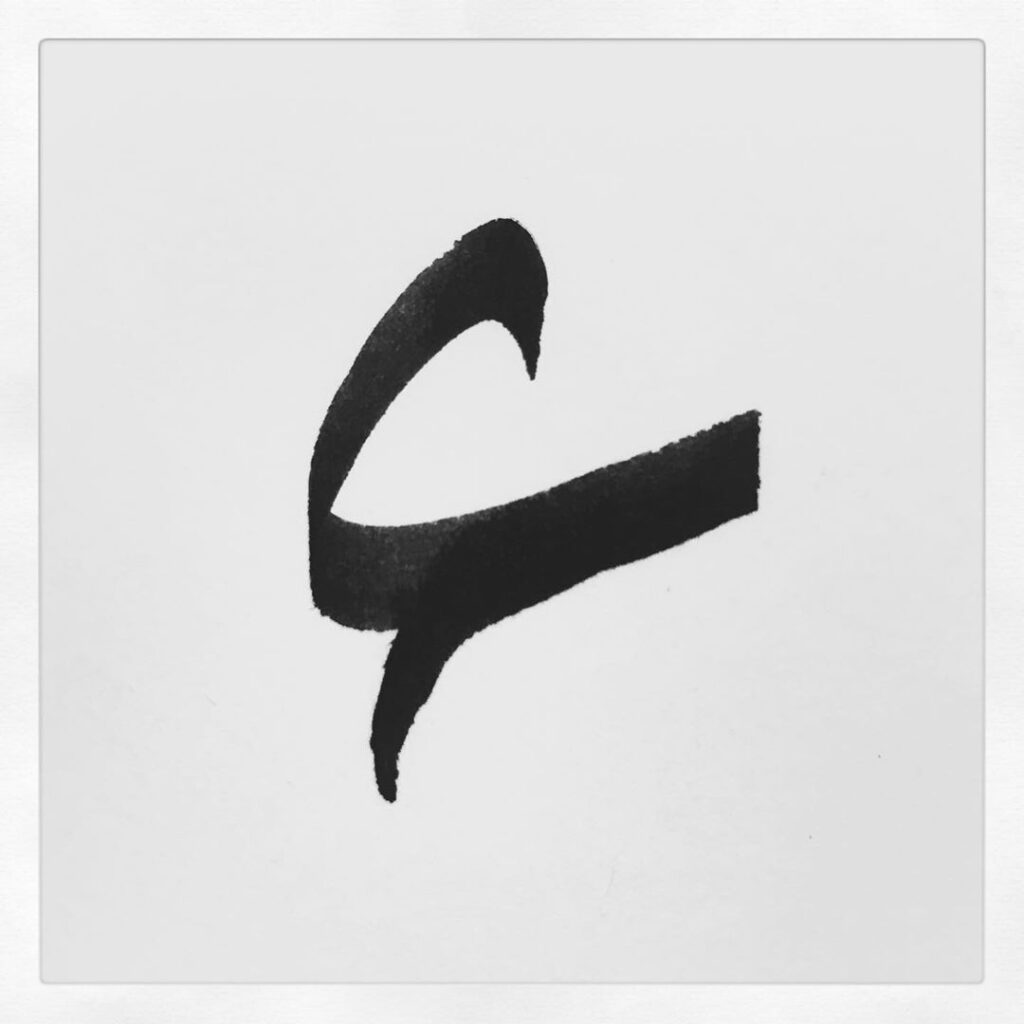
Madd Wajib Muttasil occurs when a Madd letter is followed by a Hamza in the same word.
The reciter must stretch this Madd because the Hamza directly connects to the Madd letter, making the sound heavier and more emphasized.
- Cause: Hamza in the same word
- Length: 4–5 harakat
- Rule: Obligatory (must be applied)
Examples:
- جَاءَ
- السَّمَاءُ
- سُوءٌ
👉 The reader must clearly extend the sound to maintain proper pronunciation.
Madd Jaiz Munfasil (2–5 Counts)
Madd Jaiz Munfasil occurs when a Madd letter appears at the end of a word and a Hamza comes at the beginning of the next word.
The reciter has flexibility in length, but consistency throughout recitation is important.
- Cause: Hamza in the next word
- Length: 2–5 harakat (commonly 4)
- Rule: Permissible (Jaiz)
Examples:
- فِي أَنْفُسِكُمْ
- إِنَّا أَعْطَيْنَاكَ
👉 The reader chooses a length and should keep it consistent while reciting.
Madd ‘Arid Lis-Sukoon (Stopping Madd)
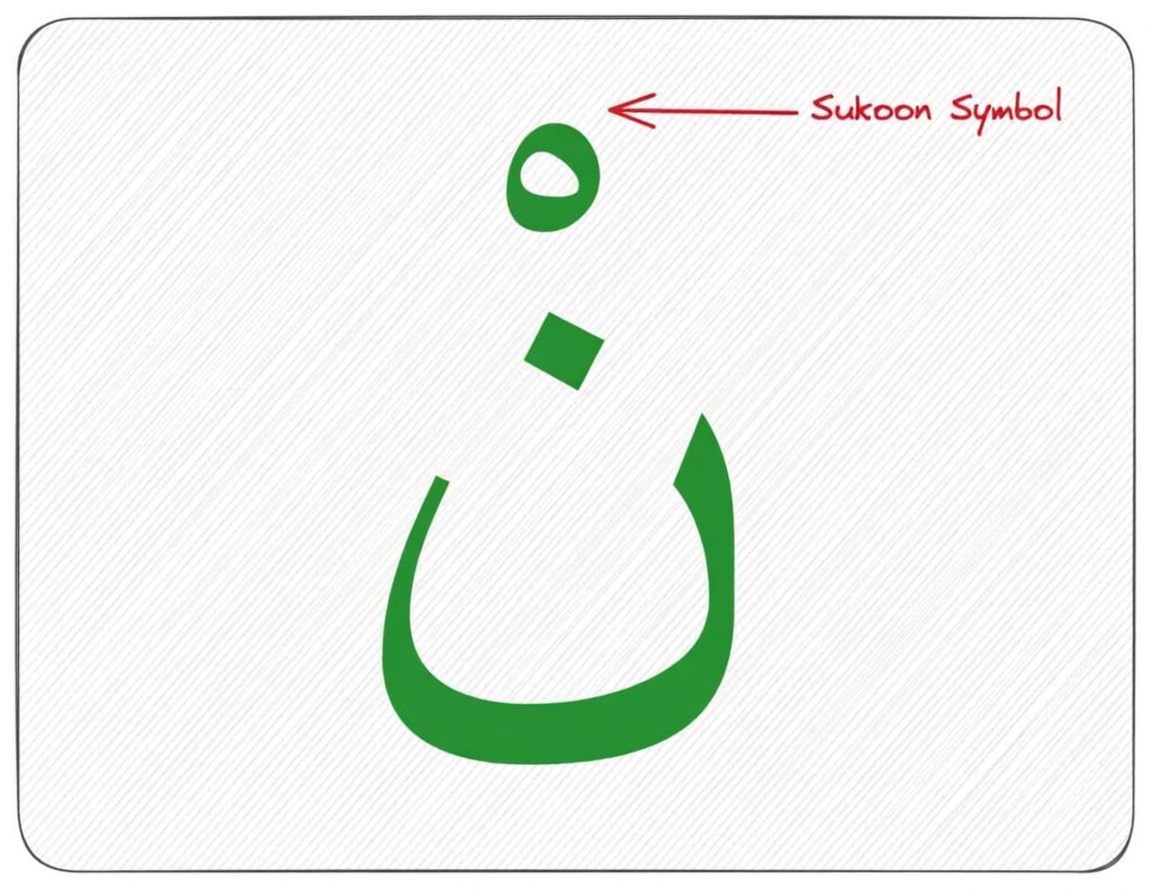
Madd ‘Arid Lis-Sukoon occurs when the reciter stops (waqf) on a word, causing the last letter to become sakin temporarily.
This temporary Sukoon allows different elongation lengths.
- Cause: Temporary Sukoon due to stopping
- Length: 2, 4, or 6 harakat
- Rule: Flexible
Example:
- الْعَالَمِينَ (when stopping)
👉 The reader can choose any of the three lengths but should maintain consistency in the same recitation.
Madd Lazim (Strong Madd – 6 Counts)
Madd Lazim occurs when a Madd letter is followed by a permanent Sukoon or Shaddah.
The reciter must always stretch this Madd fully because the Sukoon is permanent, not caused by stopping.
- Cause: Permanent Sukoon or Shaddah
- Length: 6 harakat
- Rule: Mandatory
Examples:
- الضَّالِّينَ
- الْحَاقَّةُ
👉 The reader must apply a full 6-count stretch every time without shortening.
💡 Quick Insight
- Muttasil → same word → stronger connection
- Munfasil → two words → lighter separation
- ‘Arid → depends on stopping
- Lazim → strongest and longest (fixed 6)
How to Measure Madd While Learning Tajweed Rules (Harakat Counts)
To recite Madd correctly, the reader must measure elongation using Harakat (counts). In fact, these counts act as a timing system that controls how long each sound should be stretched.
Accurate measurement helps maintain consistency, clarity, and proper Tajweed application during recitation.
What Is a Harakah?
A Harakah is the basic unit used to measure time in Tajweed.
- It equals the time needed to pronounce one short vowel:
- Fatha (َ) → “a”
- Dammah (ُ) → “u”
- Kasrah (ِ) → “i”
👉 In simple terms:
1 Harakah = the natural time to say “ba”, “bi”, or “bu”
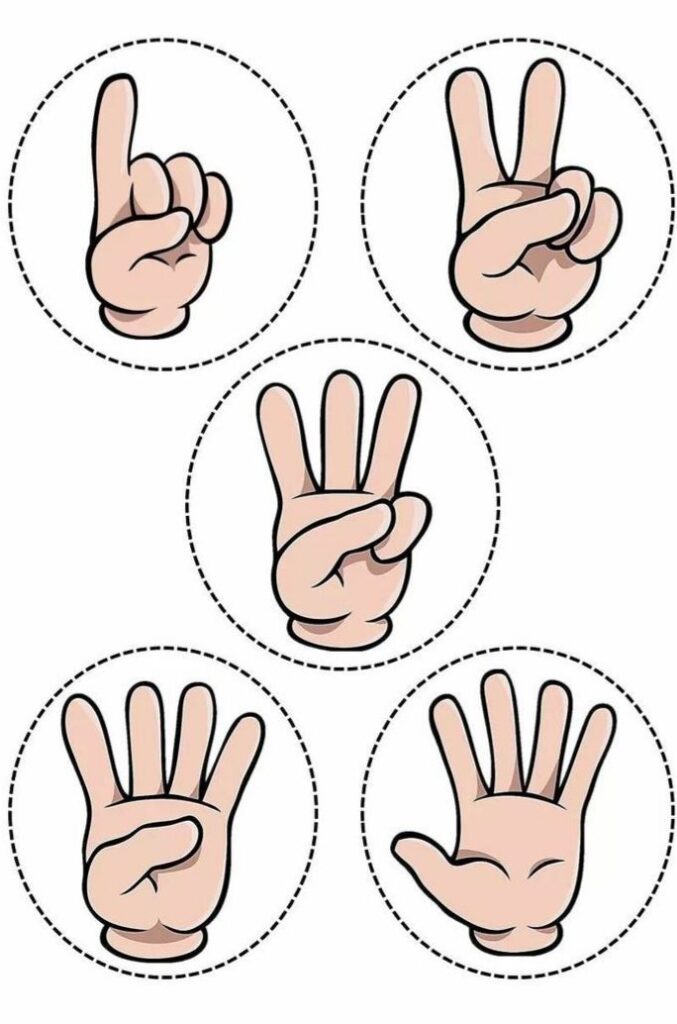
💡 Some learners use a physical reference:
- Opening or closing a finger at a natural pace
- Or a steady rhythmic beat
⚠️ Important:
The exact duration may vary depending on recitation speed, but the reader must keep it consistent throughout.
How to Count Madd Correctly While Practicing Madd Rules in Tajweed
The reader measures each type of Madd using a specific number of Harakat:
- 2 Harakat → Natural Madd (Madd Asli)
- 4–5 Harakat → Madd Muttasil & Madd Munfasil
- 6 Harakat → Madd Lazim
- 2, 4, or 6 Harakat → Madd ‘Arid (when stopping)
👉 Example:
- قَالَ → 2 counts
- جَاءَ → 4–5 counts
- الضَّالِّينَ → 6 counts
The reader must avoid guessing and instead follow clear, counted timing.
Practical Tips for Beginners
To master Madd measurement, beginners should actively train both their ear and timing:
- Use finger counting
Count slowly with your fingers (1… 2… 3…) while reciting - Listen to expert reciters
Focus on how long they hold each sound - Practice at a slow pace
Slow recitation helps control timing and accuracy - Stay consistent
Choose a counting rhythm and keep it steady throughout recitation - Learn with a teacher
A qualified teacher can correct timing mistakes instantly
Common Mistakes in Madd Rules in Tajweed
Many learners struggle with Madd because they focus on reading fluently without paying attention to exact timing and rules. As a result, these mistakes can affect both the rhythm and accuracy of Quran recitation.
Therefore, understanding these errors is the first step toward improving your Tajweed.
Stretching Too Much or Too Little

One of the most common mistakes is incorrect timing.
Some learners:
- Shorten Madd Asli instead of giving it the full 2 counts
- Overstretch sounds beyond their required length
Both errors distort the natural rhythm of recitation.
👉 Example:
- قَالَ should be 2 counts only, not shorter or longer
Ignoring Madd in Recitation
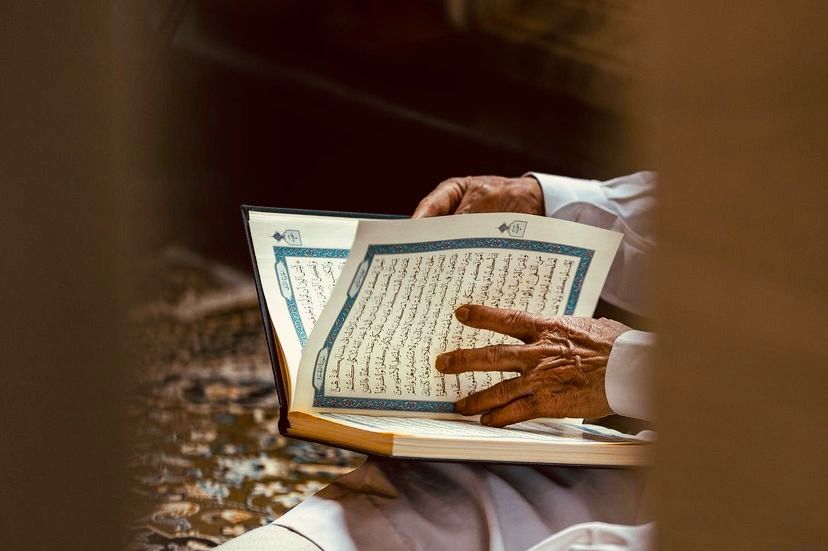
Some learners completely skip Madd elongation, especially when reading quickly.
This leads to:
- Weak pronunciation
- Loss of clarity
- Possible changes in meaning
👉 Madd is not optional—it is a core Tajweed rule that must be applied every time.
Confusing Between Types of Madd

Many learners mix up different types of Madd, especially:
- Madd Muttasil vs Madd Munfasil
- Madd Asli vs Madd Far’i
- Madd ‘Arid vs Madd Lazim
This confusion causes:
- Wrong elongation length
- Inconsistent recitation
👉 Each type has a specific cause and exact number of counts that the reader must follow.
Many of these mistakes are also related to misunderstanding Hamzatul Wasl and Hamzatul Qat’, which affect how words are connected and pronounced in recitation.
Madd Rules in Tajweed Chart (Quick Summary)
Madd rules control how long the reciter stretches vowel sounds using the three letters: Alif (ا), Waw (و), and Yaa (ي).
In addition, the length of each Madd is measured in Harakat (counts), where:
👉 1 Harakah = the time to pronounce one short vowel
Furthermore, mastering these counts helps the reader maintain accuracy, rhythm, and consistency in Quran recitation.
Easy Table for Revision
| Type of Madd | Sub-type | Cause | Duration (Harakat) |
|---|---|---|---|
| Madd Asli (Natural) | — | No Hamza or Sukoon | 2 |
| Madd Far’i | Muttasil (Connected) | Hamza in same word | 4–5 |
| Madd Far’i | Munfasil (Separated) | Hamza in next word | 4–5 |
| Madd Far’i | Badal | Hamza before Madd | 2 |
| Madd Far’i | ‘Arid Lil-Sukoon | Stop creates Sukoon | 2, 4, or 6 |
| Madd Far’i | Leen | Waw/Ya sakin after Fatha | 2, 4, or 6 |
| Madd Far’i | Lazim | Permanent Sukoon/Shaddah | 6 |
| Madd Far’i | Sila Sughra | Pronoun “Ha” (no Hamza) | 2 |
| Madd Far’i | Sila Kubra | Pronoun “Ha” + Hamza | 4–5 |
Memory Tricks to Remember Madd Types in Tajweed Rules
💡 1. “2-4-6 Rule” Shortcut
- 2 → Natural (Asli, Badal)
- 4–5 → Hamza-based (Muttasil, Munfasil, Sila Kubra)
- 6 → Strong Madd (Lazim)
💡 2. “Hamza vs Sukoon” Rule
- Hamza → usually 4–5 counts
- Sukoon → can reach 6 counts
💡 3. “Same vs Next Word” Trick
- Same word → Muttasil
- Next word → Munfasil
💡 4. “Stop = Flexible” Rule
- If you stop → (‘Arid / Leen)
👉 You can choose 2, 4, or 6, but stay consistent
💡 5. “Strong vs Light” Feeling
- Lazim → strongest → always 6
- Asli → lightest → always 2
Final Thought
Mastering Madd Rules in Tajweed is a journey that goes beyond memorizing counts—it is about developing precision, consistency, and love for the recitation of the Qur’an. Moreover, with regular practice and proper guidance, any learner can improve their Tajweed. As a result, they can recite the Qur’an beautifully and correctly.
Learning Tajweed and Arabic with Areeb Academy
If you want to take your recitation to the next level, learning with structured guidance makes a huge difference. At Areeb Academy, you get a complete learning experience that helps you apply Tajweed rules confidently and correctly.
- ⭐ Certified and experienced teachers who guide you step by step in Tajweed and Arabic
- 📖 Focus on both correct recitation (Tajweed) and Arabic fluency (Fusha) for a deeper understanding of the Qur’an
- 🕒 Flexible scheduling that fits your daily routine—learn at your own convenience
- 🎯 Personalized feedback to correct mistakes and improve your recitation in real time
- 🎁 Book your FREE trial lesson and start your journey with confidence
FAQs about Madd Rules in Tajweed
1. What are Madd Rules in Tajweed?
Madd Rules in Tajweed are guidelines that control how long vowel sounds are stretched during Quran recitation using the Madd letters: Alif (ا), Waw (و), and Yaa (ي).
2. How many types of Madd are there in Tajweed?
There are two main categories:
- Madd Asli (Natural Madd)
- Madd Far’i (Secondary Madd)
In addition, Madd Far’i includes several subtypes such as Muttasil, Munfasil, and Lazim.
3. How is Madd measured in recitation?
Madd is measured using Harakat (counts). One Harakah equals the time of one short vowel sound.
- 2 Harakat → Natural Madd
- 4–5 Harakat → Muttasil / Munfasil
- 6 Harakat → Lazim
4. What is the most common mistake in Madd?
One of the most common mistakes is either shortening Madd Asli or overstretching it beyond 2 counts, which affects rhythm and accuracy.
5. Why is learning Madd important in Tajweed?
Learning Madd is important because it preserves the correct pronunciation, meaning, and rhythm of the Qur’an, ensuring accurate and beautiful recitation.
6. Can beginners learn Madd easily?
Yes, beginners can learn Madd easily with consistent practice, listening to expert reciters, and learning under a qualified Tajweed teacher.
7. How can I improve my Madd pronunciation?
You can improve by practicing slowly, counting Harakat, listening to skilled Qaris, and correcting mistakes with a teacher.