

Ghunnah letters rules are essential principles in Tajweed that guide how the nasal sound (Ghunnah) is correctly produced when reciting the Quran. This sound is a natural characteristic of the letters Noon (ن) and Meem (م), and it appears in specific situations such as Noon Sakinah, Tanween, Meem Sakinah, and Mushaddad letters.
Understanding Ghunnah letters rules is not just about memorization, but about applying the correct pronunciation with proper timing, clarity, and beauty. Whether it is Idgham with Ghunnah, Ikhfa, or Iqlab, each rule ensures that the recitation remains accurate and faithful to the rules of Tajweed as taught by scholars.
What Are Ghunnah Letters Rules in Tajweed?
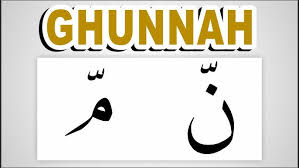
Ghunnah rules in Tajweed refer to the proper pronunciation of a nasal sound that occurs mainly with the letters Noon (ن) and Meem (م). This sound is an essential part of Tajweed, as it adds rhythm, clarity, and beauty to Quran recitation.
You do not apply ghunnah randomly; instead, it appears in specific rules such as:
In most cases, you hold the ghunnah sound for two counts (harakat) to maintain consistency and smooth flow during recitation.
Definition of Ghunnah

Ghunnah (الغُنّة) is a nasal sound that comes from the nasal passage (nose) when you pronounce the letters Noon (ن) and Meem (م).
It becomes obligatory and strongest when:
- Noon or Meem has a Shaddah (ّ) → e.g., إِنَّ ، ثُمَّ
- In these situations, you must hold the ghunnah clearly for two counts.
Ghunnah can also appear in other Tajweed rules like:
- Idgham with Ghunnah (ي، ن، م، و)
- Ikhfa
- Iqlab (before ب)
The strength of ghunnah varies depending on the rule, but its duration is usually constant (two counts).
What Is the Nasal Sound in Tajweed?
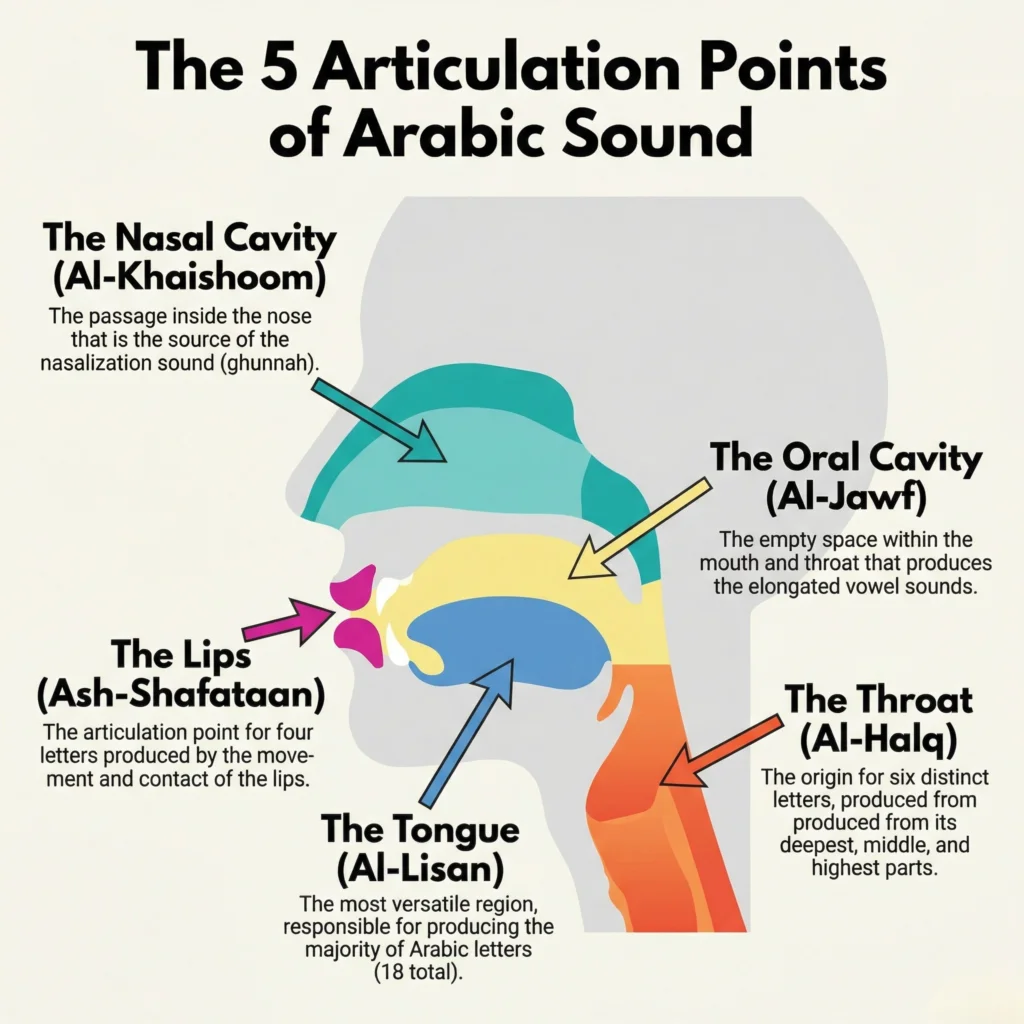
The nasal sound in Tajweed refers to the resonance that comes from the nose, not the mouth. It happens when airflow passes through the nasal cavity while pronouncing Noon (ن) or Meem (م).
To understand it practically:
- If you close your nose, you won’t be able to produce ghunnah correctly
- This shows that ghunnah is completely dependent on nasal airflow
The nasal sound appears in different levels:
- Strong (Complete) → with Shaddah (ّن / ّم)
- Medium → in Ikhfa and Iqlab
- Lighter → in some cases of Idgham or normal pronunciation
Also, the ghunnah sound can be:
- Heavy (tafkheem) or
- Light (tarqeeq)
depending on the letter that comes after it
Why Ghunnah Is Important in Quran Recitation

Ghunnah is essential because it:
- Preserves the correct pronunciation of Quranic words
- Maintains the rhythm and flow of recitation
- Enhances the beauty and melody of the Quran
- Helps avoid meaning distortion caused by incorrect pronunciation
Without applying ghunnah properly:
- The recitation may sound unnatural or rushed
- You may apply some Tajweed rules, such as Idgham or Ikhfa, incorrectly.
In short, mastering ghunnah is a key step toward accurate and beautiful Quran recitation, and it reflects proper adherence to Tajweed rules.
Ghunnah Letters in Tajweed Rules
Ghunnah letters in Tajweed are the letters that produce a nasal sound from the nose (al-khayshum) during recitation. This sound is an essential characteristic of proper Quran pronunciation and plays a key role in maintaining the beauty and flow of recitation.
The Two Main Ghunnah Letters in Tajweed Rules
The two primary ghunnah letters are:
- Noon (ن)
- Meem (م)
These letters naturally carry a nasal quality, which becomes more emphasized in certain situations.
Ghunnah becomes strongest and obligatory when:
- Noon or Meem has a Shaddah (ّ)
- Examples: إِنَّ ، ثُمَّ
- In this case, the ghunnah must be clearly pronounced for two counts
Additionally, ghunnah appears when:
- Noon Sakinah or Tanween is followed by ي، ن، م، و (Idgham with Ghunnah)
- Before ب (Ba) → Iqlab (converted into a Meem sound with ghunnah)
- In Ikhfa → when the sound is partially hidden with nasalization
When Ghunnah Occurs Naturally
Ghunnah is an intrinsic (natural) characteristic of Noon and Meem, meaning:
- It exists in these letters even without Tajweed rules
- However, it becomes clearly noticeable and required in specific cases
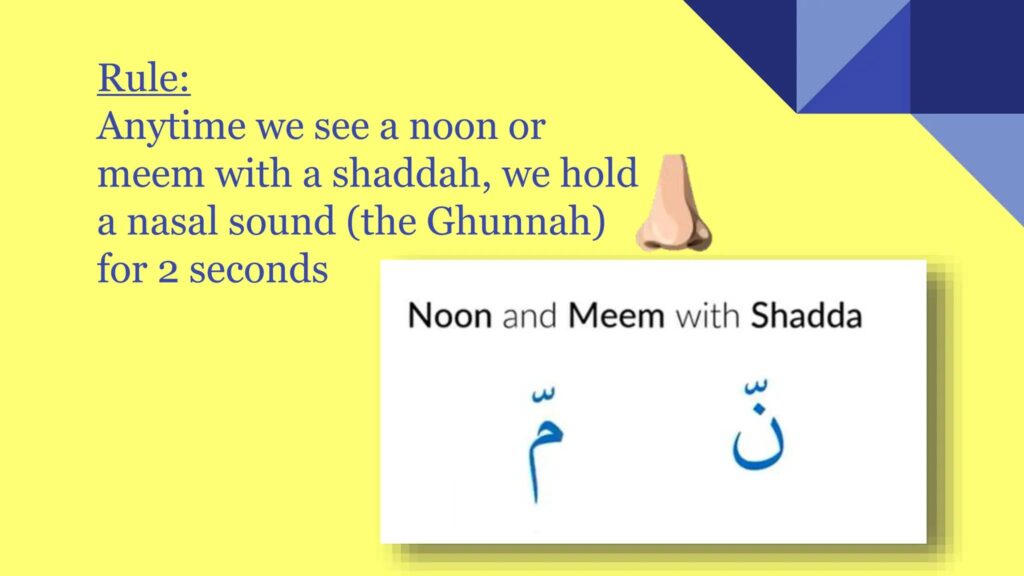
Natural ghunnah occurs:
- In every pronunciation of Noon (ن) and Meem (م)
- But it is fully applied and prolonged (2 counts) in:
- Mushaddad letters (نّ / مّ)
- Idgham with Ghunnah
- Ikhfa
- Iqlab
Important note:
Ghunnah is produced only from the nose, without relying on:
- Tongue
- Lips
- Throat
A practical tip:
If you close your nose while reciting, the ghunnah sound will stop—this confirms its nasal origin.
Strong vs Light Ghunnah Letters in Tajweed Rules
Ghunnah varies in strength and heaviness depending on the context:
1. Strength Levels (Ranks of Ghunnah)
- Strongest (Most Complete)
- Noon/Meem with Shaddah (مّ / نّ)
- Complete
- In Ikhfa and Iqlab
- Less Complete
- In Idgham (depending on type)
- Lightest (Natural)
- In normal Noon and Meem without special rules
2. Light vs Heavy (Tarqeeq & Tafkheem)
Ghunnah also changes in tone:
- Heavy (Thick) → when followed by heavy letters
- Light (Thin) → when followed by light letters
This means the ghunnah follows the letter after it, not just the Noon or Meem itself.
Ghunnah in Noon and Meem Mushaddadah
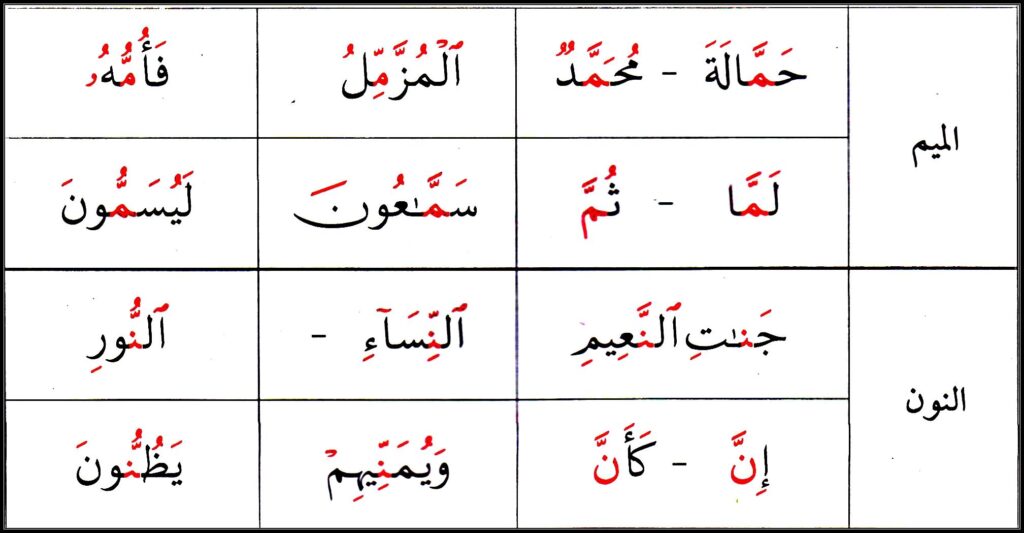
Ghunnah in Noon (نّ) and Meem (مّ) Mushaddadah is one of the most emphasized and essential rules in Tajweed. This type of ghunnah produces a complete nasal sound from the nasal cavity (Al-Khayshum), and you must hold it clearly without rushing. Scholars consider it the strongest and most perfect form, and you apply it whenever a Noon or Meem carries a Shaddah.
You should hold the sound for two counts (harakat) whether you continue or stop, so you maintain clarity, rhythm, and correct pronunciation in Quran recitation.
What Is a Mushaddadah Letter?
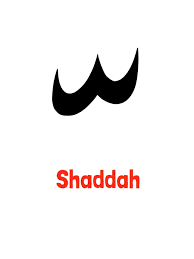
A Mushaddadah letter is a letter that has a Shaddah (ّ) on it, which means the letter is actually doubled. In other words, it consists of:
- A first letter with sukoon (silent)
- Followed by the same letter with a vowel (harakah)
These two letters are merged into one stressed letter with Shaddah.
For example:
إِنْ + نَ = إِنَّ
ثُمْ + مَ = ثُمَّ
In Tajweed, when this Shaddah appears on Noon (نّ) or Meem (مّ), it automatically requires a clear and prolonged ghunnah.
Rule: Always Apply Full Ghunnah (2 Counts)
Whenever Noon or Meem is Mushaddadah, applying ghunnah is obligatory, not optional. The sound must be held for exactly two counts, without shortening or exaggerating it.
The ghunnah must come entirely from the nose, not from the mouth. For correct pronunciation:
- In Noon Mushaddad (نّ), the tongue touches the upper palate while maintaining nasal airflow
- In Meem Mushaddad (مّ), the lips are closed while the sound resonates through the nose
This rule represents the highest level of ghunnah, so it should always be clear, steady, and well-pronounced.
Examples from the Quran
Common examples of Noon and Meem Mushaddadah in the Quran include:
- إِنَّ (Inna)
- الْجَنَّةِ (Al-Jannah)
- النَّاسِ (An-Naas)
- عَمَّ (Amma)
- ثُمَّ (Thumma)
- فَأَمَّا (Fa-amma)
In all these examples, the ghunnah must be held for two counts with a clear nasal sound, reflecting the beauty and precision of proper Tajweed.
Ghunnah Letters in Noon Sakinah and Tanween Rules
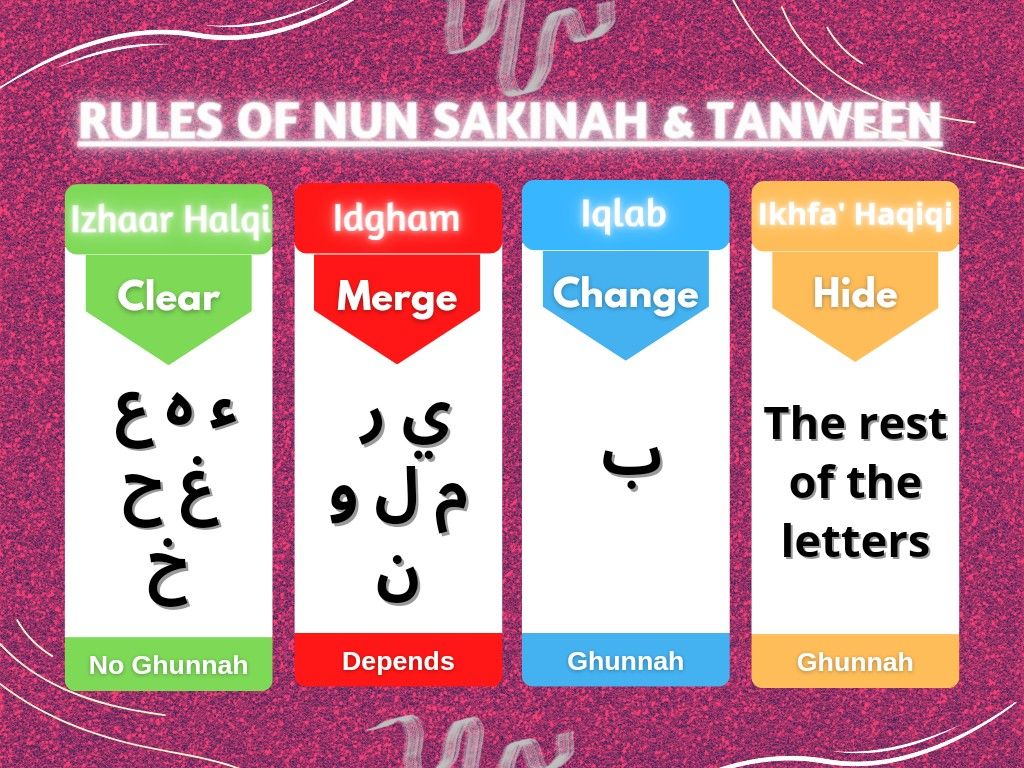
You produce a two-count nasal ghunnah from the nasal cavity (Al-Khayshum) when a silent Noon or Tanween appears before specific letters in Noon Sakinah (نْ) and Tanween (ً ٍ ٌ), which form a fundamental Tajweed rule. This nasalization is not optional; you must treat it as an essential part of proper Quranic recitation, and it directly affects the accuracy, flow, and beauty of pronunciation.
The application of ghunnah in these cases depends entirely on the letter that follows the Noon Sakinah or Tanween. Based on this, the rule may require merging, concealment, conversion, or clear pronunciation, each with its own effect on the presence or absence of ghunnah.
Idgham with Ghunnah (يرملون)
Idgham with Ghunnah occurs when a Noon Sakinah or Tanween is followed by one of the letters (ي، ن، م، و). In this case, you do not pronounce the Noon separately; instead, you merge it into the following letter while holding a nasal ghunnah for two counts.
This merging creates a smooth, connected pronunciation where the Noon no longer appears as a separate sound, and the following letter becomes stronger. For example, in a phrase like مَنْ يَقُولُ, the Noon merges into the Ya, and the reciter produces a flowing sound with clear nasal resonance.
Ikhfa and Its Ghunnah Sound
Ikhfa occurs when a Noon Sakinah or Tanween is followed by one of the fifteen specific letters (such as ت، ث، د، س، ف، ق, etc.). In this case, you do not pronounce the Noon clearly and you do not fully merge it. Instead, you partially hide the sound while producing a light nasal ghunnah.
The sound becomes softer and less defined than Izhar, but it still carries a nasal quality held for approximately two counts. For example, in مِنْ ثَمَرَةٍ, you conceal the Noon sound before the letter ث, creating a smooth transition supported by ghunnah.
When Ghunnah Is Required
Ghunnah is required whenever Noon Sakinah or Tanween enters specific Tajweed rules that involve nasalization. It is mandatory in Idgham with Ghunnah, Ikhfa, and Iqlab, as well as in cases where Noon or Meem carries a Shaddah.
However, you do not apply ghunnah in Izhar, where you pronounce the Noon clearly without any nasal sound, nor in Idgham without Ghunnah, where you merge the letters without nasalization.
In all cases where ghunnah is required, you consistently hold it for two counts and produce it exclusively from the nasal passage to ensure correct and beautiful recitation.
Ghunnah Letters in Meem Sakinah Rules
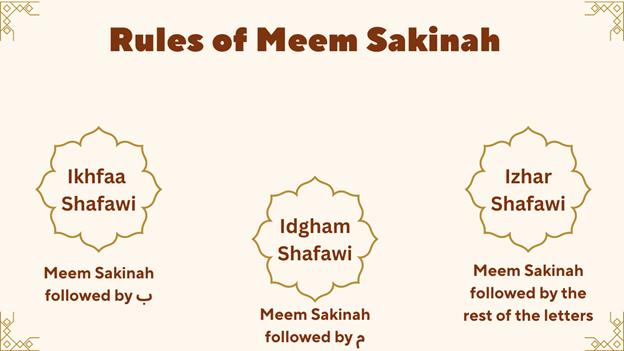
You pronounce a two-count nasal ghunnah from the nasal cavity (Al-Khayshum) when a silent Meem is followed by specific letters in Meem Sakinah (مْ) rules.
This nasalization is an essential part of Tajweed that ensures smooth pronunciation and preserves the melodic flow of Quran recitation.
In Meem Sakinah rules, ghunnah appears mainly in two situations: Idgham Shafawi and Ikhfa Shafawi, while you pronounce the Meem clearly without emphasizing ghunnah in Izhar Shafawi.
Ikhfa Shafawi (with Ghunnah)
Ikhfa Shafawi occurs when a Meem Sakinah (مْ) is followed by the letter ب (Ba). In this case, you partially hide the Meem sound and produce a soft nasal ghunnah for two counts before moving to the next letter.
- The lips come together gently without strong pressure
- The Meem is not fully pronounced or merged
- A light nasal sound is held for 2 counts
- The transition into Ba remains smooth and subtle
This rule creates a delicate balance between concealment and clarity, preserving the beauty of recitation.
Idgham Shafawi (with Ghunnah)
Idgham Shafawi happens when a Meem Sakinah is followed by another Meem (م). In this case, you merge both Meems into one stressed Meem with Shaddah and apply a complete 2-count ghunnah during the merging.
- The two Meems become one emphasized Meem (مّ)
- You hold a strong and clear nasal ghunnah for two counts (harakat), ensuring proper timing and flow in recitation.
- You articulate the letter Meem (م) using the lips, while the ghunnah comes from the nasal cavity (Al-Khayshum), not from the lips alone.
- The sound becomes smooth, connected, and unified
This is the strongest application of Meem Sakinah rules because both merging and ghunnah happen together.
Practical Examples
Meem Sakinah rules appear frequently in the Quran, and you must apply them carefully to maintain correct recitation.
- عَلَيْهِمْ سَلامٌ
The Meem is followed by a non-Ba, non-Meem letter, so it is pronounced clearly with no ghunnah (Izhar Shafawi). - تَرْمِيهِمْ بِحِجَارَةٍ
The Meem is followed by Ba, so Ikhfa Shafawi is applied with a soft 2-count ghunnah and light lip contact. - لَكُمْ مَا
The Meem is followed by another Meem, so Idgham Shafawi occurs with full merging and a strong 2-count ghunnah.
How Long Do Ghunnah Letters Take in Tajweed Rules? (Harakat Counts)
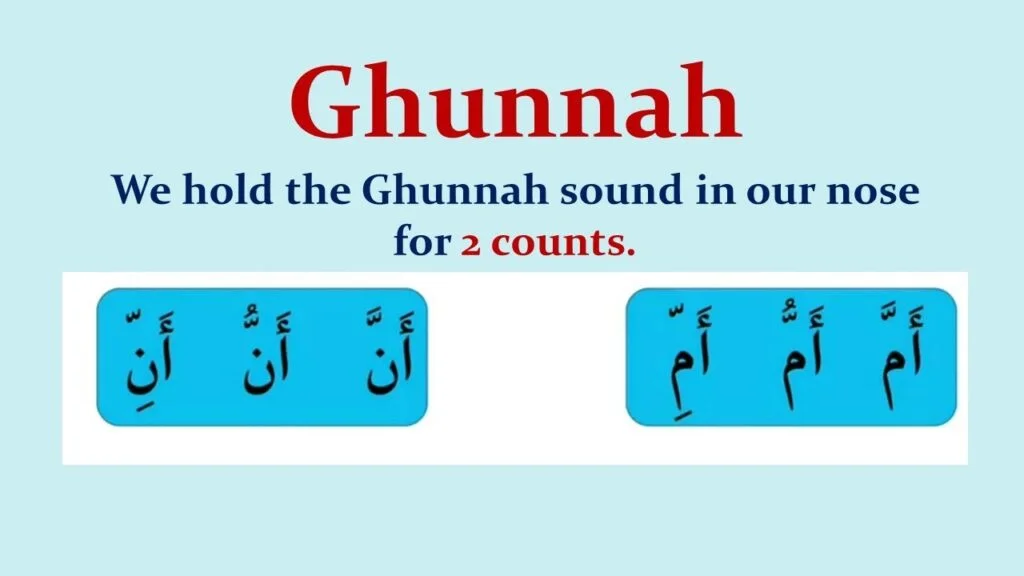
The duration of Ghunnah in Tajweed is a fixed nasal sound lasting two Harakat (two counts or beats). This timing is an essential rule that ensures proper pronunciation and balance in Quranic recitation. A Harakah generally refers to the time it takes to pronounce a short vowel sound, or, in practical terms, the duration of a single measured movement in recitation.
You must always maintain ghunnah at a consistent length, whether you are reading quickly or slowly. You apply it most clearly in cases such as Noon or Meem with Shaddah (نّ / مّ), as well as during Idgham with Ghunnah, Ikhfa, and Iqlab, where you produce nasalization.
Standard Length (2 Counts)
The standard and obligatory duration of Ghunnah is always two counts, making it the most important timing rule in Tajweed for nasal sounds.
- Applies to Noon and Meem with Shaddah (نّ / مّ)
- Applied in Idgham with Ghunnah (ي، ن، م، و)
- Applied in Ikhfa and Iqlab cases
- Considered the most complete and correct form of Ghunnah
- Must not be shortened or extended beyond two counts
This fixed duration ensures consistency in recitation and preserves the rhythmic structure of Tajweed rules.
How to Practice the Timing

Practicing Ghunnah timing requires developing a sense of steady rhythm and controlled nasal airflow. The goal is to maintain a smooth nasal sound that naturally lasts for two measured counts without rushing.
- Use a slow, steady recitation pace to feel the duration clearly
- Count mentally as “1–2” while holding the nasal sound
- Practice with a metronome or consistent beat for accuracy
- Focus on allowing the sound to resonate from the nose, not the mouth
- Repeat examples like إِنَّ and ثُمَّ to internalize timing
With regular practice, the two-count duration becomes natural and automatic in recitation.
Tips for Consistency
You maintain consistent ghunnah timing to ensure correct Tajweed application, and you achieve this through awareness and repetition.
- Always associate Ghunnah with a clear mental “two-beat” rule
- Avoid rushing, especially in fluent or fast recitation
- Ensure the sound is nasal, not oral, for proper resonance
- Listen to skilled reciters to internalize correct timing
- Practice repeatedly on Mushaddad Noon and Meem to build control
You achieve consistency when you apply the same two-count ghunnah naturally across all relevant rules without variation.
Common Mistakes in Ghunnah Letters Rules

Common mistakes in Ghunnah rules often occur when learners either misunderstand the concept of nasalization or fail to apply it consistently during recitation. Since Ghunnah is a two-count nasal sound that comes from the nasal cavity (Khayshum), any mistake in timing, placement, or application can affect the correctness and beauty of your Tajweed recitation. These mistakes usually appear in cases such as Noon and Meem Mushaddadah, Ikhfa, and Iqlab, where ghunnah is mandatory.
Skipping the Nasal Sound in Ghunnah Letters Rules
One of the most frequent mistakes is completely skipping the Ghunnah sound, especially in words containing Noon or Meem with Shaddah (نّ / مّ). In these cases, learners may pronounce the letters clearly without nasalization, which is incorrect.
- Omitting Ghunnah in Mushaddadah letters like إِنَّ
- Ignoring nasalization in Ikhfa or Iqlab situations
- Treating all Noon sounds as clear pronunciation (Izhar)
To fix this, you must always remember that ghunnah is mandatory in specific rules, and you must produce it clearly from the nose for two counts, not from the mouth or throat.
Over-Exaggerating Ghunnah in Tajweed Rules
Another common issue is extending the Ghunnah beyond its correct duration, making it longer than two counts. This disrupts the balance of Tajweed and affects the natural flow of recitation.
- Holding the nasal sound too long (more than 2 counts)
- Applying strong nasalization in cases of Izhar where it is not required
- Overemphasizing the sound, making recitation sound unnatural
The correct approach is to keep Ghunnah balanced and fixed at two counts only, without exaggeration or reduction.
Incorrect Mouth and Nose Coordination
Some learners struggle with proper articulation and end up producing Ghunnah incorrectly from the mouth instead of the nasal passage. This leads to a weak or distorted sound that does not meet Tajweed standards.
- Producing the sound from the throat or mouth instead of the nose
- Blocking nasal airflow, which weakens Ghunnah
- Not distinguishing between oral and nasal sounds during recitation
Correct Ghunnah should always come from the nasal cavity (Khayshum) with a natural vibration, while the mouth simply supports the articulation of the letter without interfering with the nasal sound.
Tips to Master Ghunnah Letters Rules

Practice with Short Surahs
- Start with short Surahs such as Al-Fatihah, Al-Ikhlas, Al-Falaq, and An-Nas to focus on repeated Ghunnah examples.
- Read slowly at first to identify where Ghunnah occurs (نّ، مّ، Ikhfa, Idgham, and Iqlab).
- Gradually increase speed while maintaining the correct two-count nasal sound.
- Repetition helps train the tongue and nose to work together naturally.
Listen and Repeat Technique
- Listen carefully to skilled Qaris and focus specifically on how they produce the nasal sound.
- Pause after each verse and repeat exactly as you hear it.
- Pay attention to timing (two counts) and the smoothness of the nasal resonance.
- Repetition with listening builds strong auditory memory for correct Tajweed application.
Learn with a Qualified Tajweed Teacher
- A qualified teacher can immediately correct subtle mistakes that are hard to notice alone.
- Live feedback helps ensure the Ghunnah is coming from the correct nasal position and with correct timing.
- Structured guidance speeds up mastery and prevents forming incorrect habits.
- Regular correction ensures consistent and accurate application of Ghunnah rules.
Ghunnah Rules Chart (Quick Summary)
Easy Table for Revision
Ghunnah is a nasal sound that comes from the nasal cavity and is an inherent characteristic of Noon (ن) and Meem (م). You apply it in different Tajweed contexts depending on the letter that follows Noon Sakinah or Tanween. You can summarize the main rules as follows:
| Context | Condition | Action |
|---|---|---|
| Noon/Meem Mushaddad | نّ / مّ | Mandatory Ghunnah (2 counts) |
| Idgham with Ghunnah | ن/تنوين + (ي، ن، م، و) | Merge + Ghunnah |
| Ikhfa | ن/تنوين + 15 letters | Hide + Ghunnah (2 counts) |
| Iqlab | ن/تنوين + ب | Convert to Meem + Ghunnah |
| Ikhfa Shafawi | مْ + ب | Hide Meem + Ghunnah (2 counts) |
| Idgham Shafawi | مْ + م | Merge + Ghunnah (2 counts) |
Memory Tips for Beginners
Remember: Any Shaddah on Noon or Meem = strongest Ghunnah (always 2 counts).Group the rules mentally:
- Ghunnah present: Idgham (with Ghunnah), Ikhfa, Iqlab, Mushaddad
- No Ghunnah: Izhar + Idgham without Ghunnah
Think of Ghunnah as a “nose sound switch”: it turns ON in most merging/hiding cases and turns OFF in clear pronunciation (Izhar).Practice by always asking: “What comes after Noon or Meem?” → that determines the rule immediately. Train your ear by listening to reciters and focusing only on the nasal sound, not the full word meaning at first.
Final Thoughts on Ghunnah Letters Rules
Mastering Ghunnah letters rules is a key step toward achieving beautiful, accurate Quranic recitation. Once you understand when and how to apply the nasal sound, your recitation becomes smoother, more rhythmic, and closer to the way Allah revealed the Quran.
Learn Tajweed and Arabic Fusha with Areeb Academy
Learning Tajweed and Arabic Fusha becomes much easier when guided by the right teacher and structured learning environment. At Areeb Academy, students are supported step by step to master correct pronunciation and build confidence in recitation.
- Certified and experienced teachers who specialize in Tajweed and Quran recitation
- Personalized learning approach to match each student’s level and pace
- Flexible scheduling to fit your availability and daily routine
- Interactive lessons that make learning Tajweed and Arabic Fusha simple and engaging
- Free trial class available so you can start your journey with confidence
✨Start your journey today and experience learning Quran and Arabic in a structured, supportive, and flexible way with Areeb Academy.