
Learning to recite the Quran correctly takes patience, practice, and an understanding of Tajweed. Many learners develop common mistakes in Quran recitation without realizing it, from mispronouncing Arabic letters to shortening long vowels or stopping in the wrong place. Over time, these habits become harder to correct without proper guidance.
In this guide, you will learn the most frequent recitation mistakes, why they happen, how serious they are, and how to fix them step by step.
Why Is Correct Quran Recitation Important?
Reciting the Quran means pronouncing each letter from its correct articulation point (makharij al-huruf) and applying the rules that govern elongation, nasalization, and stopping. Allah says in Surah Al-Muzzammil (73:4): “And recite the Quran with measured recitation.”
Accuracy matters because Arabic contains letters that sound similar to beginners but are distinct. Confusing two letters or changing a vowel can sometimes alter a word’s meaning, while other errors only affect the quality of recitation. Knowing the difference helps you focus on the corrections that matter most.
Making mistakes while learning is normal. The Prophet Muhammad (peace and blessings be upon him) taught that a person who recites the Quran while struggling with it receives a double reward. What matters is continuing to learn and correcting errors once they are identified.
What Are the Most Common Mistakes in Quran Recitation?
Some mistakes come from unfamiliar Arabic sounds, others from reading too fast or practicing without feedback. Here are 12 common ones.
1. Mispronouncing Arabic Letters
Beginners often struggle with letters like ح (Haa) and ع (Ayn), which come from the throat and have no equivalent in many languages. Incorrect articulation reduces clarity and can change a word.
How to improve: Learn each letter’s articulation point and practice difficult sounds individually before using them in words.
Want to improve your Arabic pronunciation? Read our guide, Arabic Letter Makharij Step-by-Step – Fix Your Quran Recitation, to learn how to pronounce Arabic letters correctly and strengthen your Quran recitation.
2. Confusing Similar-Sounding Letters
Common pairs include س (Seen) and ص (Saad), ت (Ta) and ط (Taa), ك (Kaf) and ق (Qaf), and ه (Ha) and ح (Haa). Seen and Ta are light, while Saad and Taa are heavy.
How to improve: Practice each pair side by side, noticing where the sound originates and whether it is heavy or light.
3. Mixing Up Short and Long Vowels
Some learners stretch a short vowel (fatḥah, kasrah, ḍammah) or rush through a long one. For example, لَكَ (laka) should not become “laa-ka.”
How to improve: Watch the vowel marks and read slowly until each sound has its proper length.
4. Ignoring Madd (Elongation) Rules
Madd is held for two, four, five, or six counts in the commonly taught Hafs recitation, depending on its type. Learners often shorten a required Madd or over-extend it, as in الضَّالِّينَ at the end of Al-Fatihah.
How to improve: Learn the types of Madd and practice them with a teacher who can model the correct length.
Want to master Madd rules in Tajweed? Explore our guide, Madd Rules in Tajweed Online: 5 Simple Tips for Perfect Recitation, for practical tips to help you apply elongation rules correctly and improve your Quran recitation.
5. Misapplying Ghunnah (Nasalization)
Ghunnah is the nasal sound linked to ن (Noon) and م (Meem) in rules like Ikhfa and Idgham with ghunnah. It is often cut short, skipped, or held too long.
How to improve: Listen closely to examples and focus on the quality and duration of the sound, not its volume.
Want to understand Ghunnah rules better? Read our guide, Ghunnah Letters Rules: Simple Guide Every Quran Learner Needs, to learn the rules of Ghunnah and practice nasalization correctly in your Quran recitation.
6. Errors in Noon Sakinah and Tanween Rules
These follow four rules: Izhar, Idgham, Iqlab, and Ikhfa, depending on the following letter. Students often memorize the names but cannot recognize the rules in real verses.
How to improve: Master one rule at a time using short passages.
7. Incorrect Meem Sakinah Rules
Ikhfa Shafawi applies before ب (Baa), Idgham Shafawi before another Meem, and Izhar Shafawi before other letters.
How to improve: Practice with short examples and focus on the transition into the next letter.
Need help mastering Meem Sakinah rules? Read our guide, Meem Sakinah Rules: Perfect Your Quran Recitation in Minutes, to understand Ikhfa Shafawi, Idgham Shafawi, and Izhar Shafawi and learn how to apply them correctly in your recitation.
8. Mispronouncing Heavy and Light Letters
Tafkhim (heavy) and Tarqiq (light) determine the quality of letters, including ر (Raa) and the ل (Lam) in the name of Allah. Heavy letters are often pronounced too lightly, or light ones too heavily.
How to improve: Listen to contrasting examples and avoid exaggeration, since heaviness does not mean adding a vowel.
9. Pronouncing Shaddah Incorrectly
Shaddah doubles a letter. Rushing it makes the letter sound single, which affects clarity and sometimes meaning. Shaddah on Noon and Meem also requires Ghunnah.
How to improve: Slow down and give the doubled letter its full articulation.
10. Incorrect Pauses and Stops
Waqf (stopping) and Ibtida (resuming) preserve the meaning of the verse. Stopping mid-phrase or restarting from an unsuitable word can make a verse sound incomplete or misleading.
How to improve: Learn the pause signs in your Mushaf and plan your breathing.
11. Reciting Too Quickly
Rushing to finish a page causes vowels to disappear and rules to be overlooked.
How to improve: Recite a short passage slowly, focusing on accuracy. Increase your pace only once your pronunciation is consistent.
12. Focusing on Melody Instead of Accuracy
Imitating a reciter’s voice before mastering pronunciation can hide basic errors. A beautiful tone cannot replace correct articulation.
How to improve: Prioritize makharij and Tajweed first, then work on style.
Lahn Jali and Lahn Khafi: Two Types of Recitation Mistakes
Scholars of Tajweed classify errors into two categories.
Lahn Jali (clear error) involves replacing a letter, changing a vowel, or adding or omitting a letter in a way that affects pronunciation, grammar, or meaning. For example, replacing Qaf with Kaf in قُلْ (Qul, “Say”) produces a different word.
Lahn Khafi (subtle error) involves the finer rules and characteristics of letters, such as incorrect Madd, weak Ghunnah, or wrong heaviness and lightness. It generally does not change the word’s basic meaning but reduces the precision of recitation.
| Feature | Lahn Jali | Lahn Khafi |
|---|---|---|
| Effect | May change meaning or grammar | Generally does not change meaning |
| Examples | Replacing a letter, changing a vowel | Incorrect Madd, weak Ghunnah, Tafkhim/Tarqiq errors |
| Detection | Often noticeable to ordinary listeners | May need a trained ear |
Not every mistake fits neatly into one category, and the effect depends on the word and the rule involved. As a rule, correct Lahn Jali first, then refine the subtler details.
Arabic Letter Pronunciation Mistakes
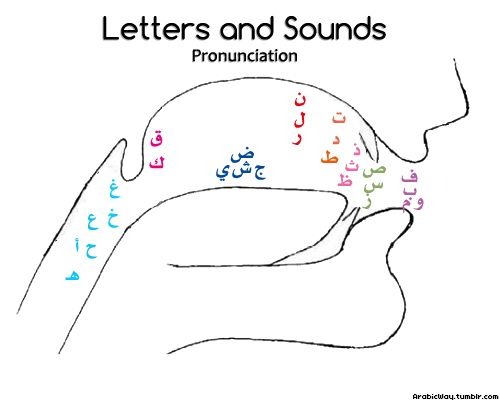
Some letter confusions are especially common among non-Arabic speakers:
- ح (Haa) vs. ه (Ha): Haa comes from the middle of the throat with a breathy friction, while Ha comes from the deepest part and is softer.
- ع (Ayn) vs. ء (Hamzah): Ayn is articulated from the middle of the throat, while Hamzah is a glottal stop. Learners often replace Ayn with a plain vowel or Hamzah.
- س (Seen) vs. ص (Saad): Saad is heavy letter. A typical error is reading الصِّرَاطَ in Al-Fatihah with a Seen.
- ق (Qaf) vs. ك (Kaf): Qaf comes from farther back on the tongue. The difference is real: قَلْب (qalb) means “heart,” while كَلْب (kalb) means “dog.”
- ذ (Dhal), ز (Zay), and ظ (Dha): Dhal is a voiced sound with the tongue tip at the front teeth, Zay is a buzzing sound, and Dha is the heavy, emphatic version of Dhal.
How to improve: Practice each letter alone, then in simple words, then in verses. Repeating a sound incorrectly can turn it into a habit, so early correction matters.
Madd Mistakes in Quran Recitation
The three Madd letters are Alif (ا), Waw (و), and Ya (ي), each paired with a matching short vowel. Natural Madd (Madd Asli) is held for two counts. Secondary Madd (Madd Far’i) occurs when a cause such as Hamzah or Sukoon is present:
- Madd Muttasil: The Madd letter and Hamzah occur in the same word, as in جَاءَ (Jaa’a).
- Madd Munfasil: The Madd letter ends one word, and Hamzah begins the next, as in فِي أَنْفُسِكُمْ (Fee anfusikum).
- Madd Laazim: The Madd is held for six counts in the standard Hafs recitation, as in الضَّالِّينَ (Ad-daaalleen).
Practice with these words, keeping the long vowel clear and steady: قَالَ (qaala), يَقُولُ (yaquulu), and قِيلَ (qiila). Be consistent: the same rule should get the same length every time. Start with Natural Madd and add other types gradually. Recording yourself and comparing with a measured reciter such as Sheikh Mahmoud Khalil Al-Husary can help.
Common Mistakes in Stopping and Starting
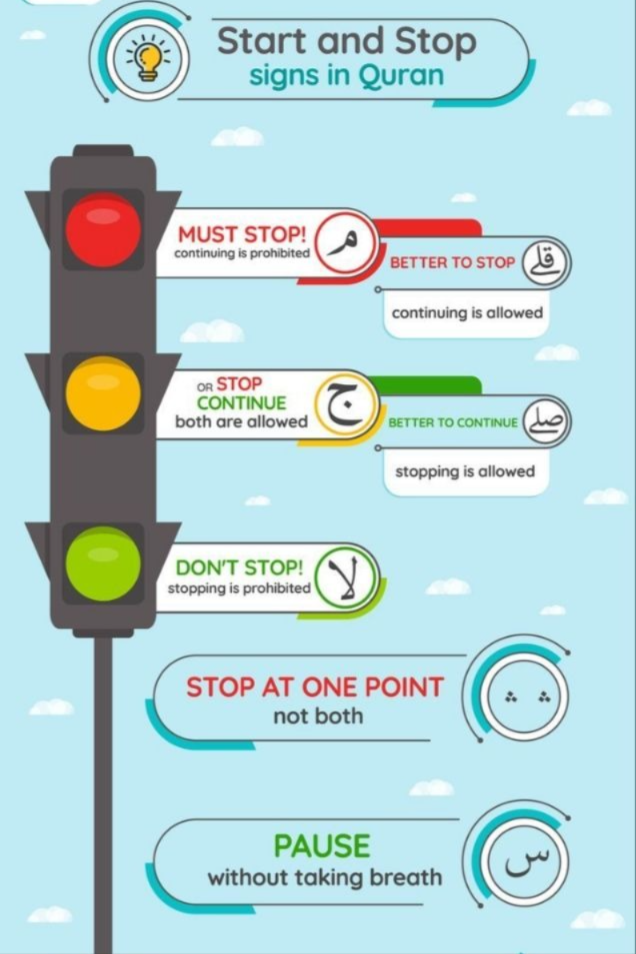
Stopping in the middle of closely connected words, such as between a preposition and the word it relates to, is one of the common mistakes in Quran recitation because it can leave the meaning incomplete. Running out of breath and stopping at an unsuitable point can also affect the flow and meaning of a verse.
The common pause signs in the Mushaf include:
- م: a necessary stop
- لا: do not stop here
- قلى: stopping is preferable
- ج: stopping or continuing are both permissible
Signs can vary between Mushaf editions, so study the ones in your copy with a teacher. If you must stop unexpectedly, go back to a suitable earlier point so the meaning stays clear. There is no fixed rule of going back a set number of words.
How to Avoid Recitation Mistakes During Salah
Surah Al-Fatihah is essential in every prayer, so review it verse by verse outside Salah, paying attention to Shaddah, vowel lengths, and difficult letters. Avoid rushing through short surahs, and revise any verse you forget rather than relying on shaky memorization.
If you make a mistake during prayer, stay calm. Correct a mispronounced word if you notice it, and if you forget a verse, move to another one you know. Minor Tajweed slips can be worked on during practice. Rulings on recitation errors vary by circumstance and scholarly opinion, so ask a qualified scholar if you are unsure, especially about errors in Al-Fatihah.
How to Fix Common Mistakes in Quran Recitation
- Identify your most frequent errors. Review a passage you know well, note the letters or rules that give you trouble, and focus on one or two at a time.
- Study makharij and sifaat. Learn where each letter originates and its qualities, such as heaviness and airflow. A mirror can help with visible movements, but many sounds need a teacher’s correction.
- Listen to qualified reciters. Follow the same passage in your Mushaf, repeat it aloud, then listen again focusing on one point.
- Record yourself. Compare your recording with a reliable reciter and review one type of mistake at a time. This is a useful supplement, but it will not catch every subtle error.
- Practice slowly with short surahs. Even 10 to 15 focused minutes a day builds consistency. Increase speed only when accuracy holds.
- Get feedback from a qualified teacher. Some mistakes are almost impossible to hear in your own voice. A teacher can identify them, demonstrate the correct sound, and set targeted exercises.
Looking for more ways to improve your recitation? Read our guide, How to Improve Quran Recitation: 9 Tips + 25-Minute Daily Routine, for practical tips and a daily routine to help you build accuracy, fluency, and consistency in your Quran recitation.
Tips for Parents to Help Kids Avoid Quran Recitation Mistakes
- Start with correct sounds. Introduce letters like س/ص and ح/ه gradually, and prioritize accuracy over the number of verses completed.
- Use listening and repetition. Play a short passage and let your child repeat it verse by verse while following the Mushaf.
- Correct gently. Let your child finish the verse, then address one or two mistakes, demonstrate the right sound, and praise effort. Avoid comparing with siblings.
- Work with an experienced teacher who can assess your child’s level and give individual feedback.
Choosing the right Quran teacher for your child matters. Read our guide, Quran Teacher for Kids Online: 7 Things to Check Before You Book, to learn what to look for in a teacher who can help your child improve pronunciation and recitation with personalized guidance.
How Long Does It Take to Correct Quran Recitation Mistakes?
It can take from a few weeks to several months. The timeline depends on:
- The type of mistake: vowel and stopping errors often improve faster than articulation problems.
- Your reading level: beginners need to build basics first.
- Existing habits: long-standing errors take longer to replace.
- Quality of guidance and regularity of practice.
A realistic month-long plan might be: Week 1, identify two or three difficult letters. Week 2 focuses on practicing the letters in words. During Week 3, introduce one Tajweed rule, such as Madd or Ghunnah. By Week 4, review the material and reinforce what you have learned. Adjust the pace to your level, and track progress through regular teacher feedback.
Final Thoughts
Avoiding common mistakes in Quran recitation starts with correct pronunciation, basic Tajweed, and steady practice. Focus on your most frequent errors, review regularly, and seek feedback when unsure. Recognizing a mistake is an opportunity to improve, so do not let it discourage you.
Learn Correct Quran Recitation with Areeb Academy
If you want to improve your Quran reading and correct recurring pronunciation or Tajweed mistakes, Areeb Academy offers personalized online lessons designed around each learner’s needs and current level.
With one-to-one instruction, students receive individual attention and practical feedback to help them build accuracy and confidence. Our online Quran lessons are available for both children and adults, with qualified Arabic-speaking teachers who can communicate in English.
At Areeb Academy, you can benefit from:
- Flexible Online Quran Classes: Find a schedule that fits your routine and commitments.
- Personalized One-on-One Tajweed Lessons: Learn at your own pace with lessons tailored to your reading level and goals.
- Quran Recitation Correction for Kids and Adults: Build stronger reading skills and address common pronunciation mistakes through guided practice.
- Experienced Male and Female Quran Teachers: Choose a teacher who suits your learning preferences and needs.
- Individual Feedback on Makharij and Tajweed: Work on letter articulation, vowel sounds, elongation, and other recitation rules.
Ready to improve your Quran recitation? Book a 30-minute FREE trial class with Areeb Academy and take the first step toward more accurate and confident recitation.
Frequently Asked Questions
1. What are the most common mistakes in Quran recitation?
Mispronouncing or confusing Arabic letters, shortening or stretching vowels, misapplying Tajweed rules, stopping in unsuitable places, and reciting too fast.
2. Can Quran recitation mistakes change the meaning?
Yes. Replacing a letter or changing a vowel may alter a word’s meaning, while mistakes such as weak Ghunnah usually affect only the precision of Tajweed.
3. How can I correct my Quran recitation mistakes?
Identify your frequent errors, practice slowly, listen to qualified reciters, record yourself, and get feedback from a qualified teacher.
4. Can I improve without a teacher?
Self-practice helps, but it is hard to notice your own pronunciation errors. A teacher provides correction you cannot give yourself.
5. Should I focus on speed or accuracy first?
Accuracy. Fluency comes naturally once correct habits are established.