
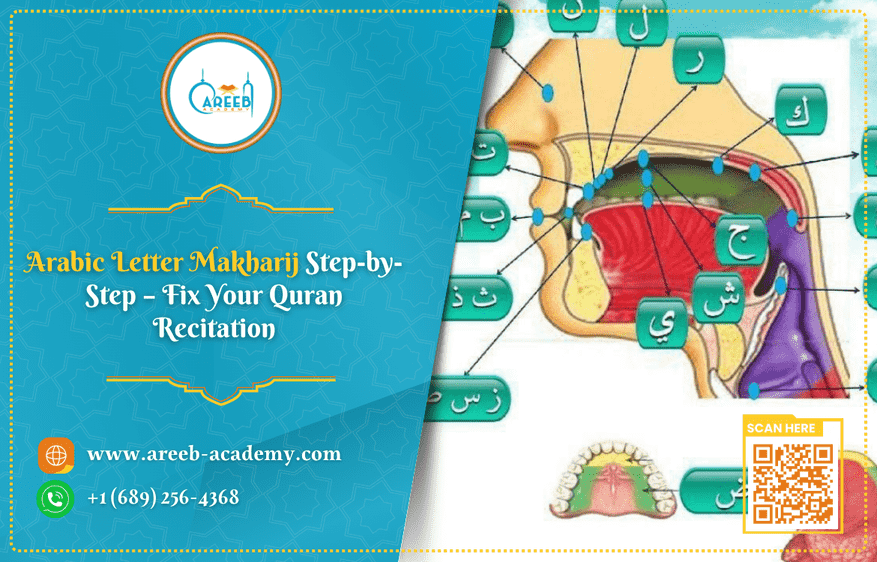
Arabic Letter Makharij in Tajweed refers to the precise articulation points from which Arabic letters are pronounced when reciting the Quran. In fact, mastering these points is the foundation of correct recitation, as even a slight misplacement of the tongue, lips, or throat can change both the sound and meaning of words.
Moreover, from the deep sounds of the throat to the delicate flow of the lips and nasal cavity, each Makhraj plays a vital role in preserving the beauty, accuracy, and authenticity of Quranic recitation. Therefore, understanding Makharij is not just a technical skill—it is the first step toward reciting the Quran as it was revealed.
What Are Arabic Letter Makharij?
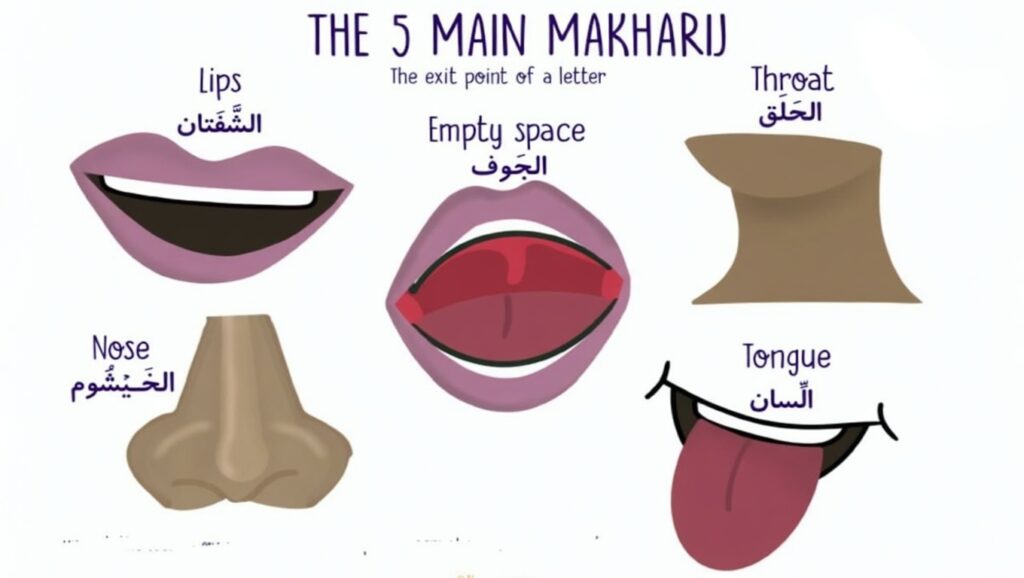
Arabic letter Makharij (مخارج الحروف) refer to the exact articulation points where each Arabic sound is produced inside the throat, mouth, lips, tongue, or nasal cavity. These points determine how every letter is pronounced correctly and are a core foundation of both Arabic pronunciation and Quranic recitation.
In simple terms, a makhraj is the “exit point” of a letter’s sound—where the sound begins and is shaped before it is heard.
Definition of Makharij (Articulation Points)
Makharij Al-Huruf are the specific physical points in the vocal system where Arabic letters originate. Each letter has a fixed place of pronunciation:
- From the throat: like ع (middle throat) and خ (upper throat)
- From the lips: like ب (both lips) and ف (bottom lip with upper teeth)
- From the tongue: like ق (back of tongue) or ت (tip of tongue)
- From the nose: nasal sound (ghunnah) in ن and م
This precision ensures that every Arabic letter remains distinct in sound, preventing confusion between similar letters.
Why Arabic Letter Makharij Are Important in Tajweed
Learning makharij is essential in Tajweed (correct Quranic recitation) because even small pronunciation mistakes can change meanings completely.
For example:
- قَلْب (qalb = heart) vs كَلْب (kalb = dog)
Correct articulation also helps to:
- Distinguish between similar letters (like س vs ص or ت vs ط)
- Preserve the original meaning of Quranic words
- Strengthen accuracy and fluency in recitation
- Build a strong foundation for all Tajweed rules
Makharij form the first step in Tajweed, while other rules like Sifaat focus on how the letter is pronounced.
How Makharij of The Arabic Letter Improve Quran Recitation

Understanding and practicing makharij improves Quran recitation by training the tongue, lips, and throat to produce each letter exactly as it was revealed.
When applied correctly, it helps you:
- Pronounce every letter clearly and independently
- Avoid blending or mispronouncing similar sounds
- Develop a natural, accurate rhythm in recitation
- Gain confidence in reading the Quran with proper Tajweed
With consistent practice, learners move from approximate pronunciation to precise, confident, and beautiful recitation, closely matching native Arabic articulation.
How Many Makharij Are There?
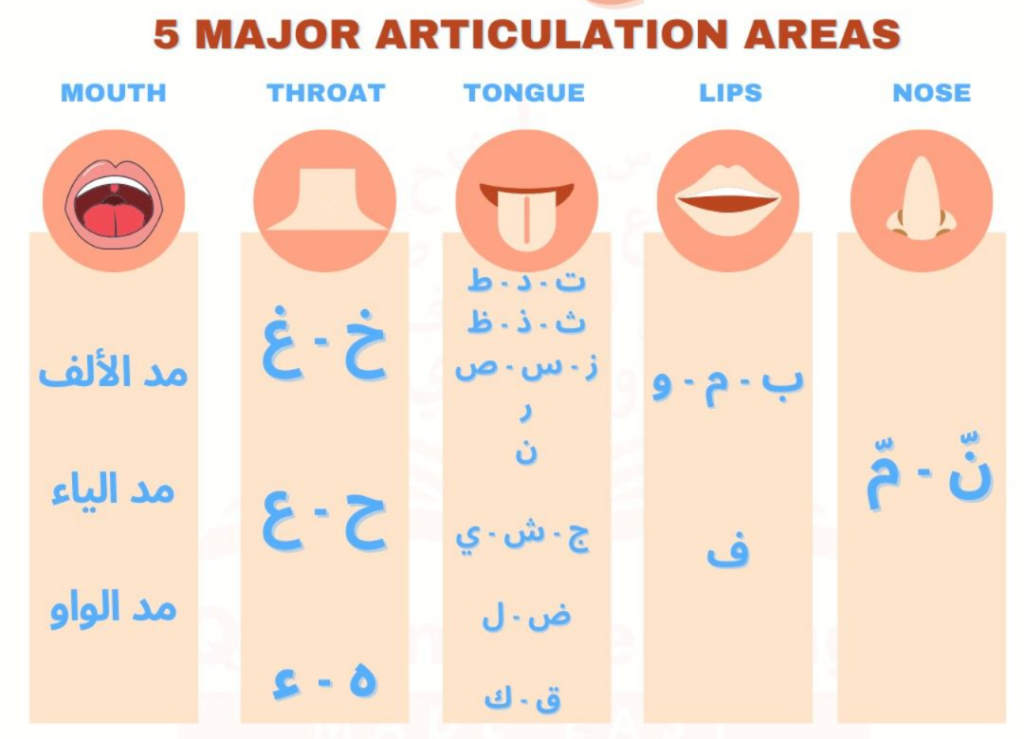
According to the most widely accepted opinion in Tajweed science, there are 17 detailed Arabic letter makharij (articulation points) for the Arabic letters. These are the precise locations in the throat, tongue, lips, mouth, and nasal cavity where each sound is produced.
Furthermore, these 17 points are organized under 5 main regions (general makharij), which makes it easier to understand and learn pronunciation step by step.
However, while some scholars may differ slightly in classification, the view of 17 makharij (commonly associated with Imam Ibn Al-Jazari) remains the most widely taught and accepted in Tajweed studies.
The Five Main Areas of Articulation
Al-Jawf (The Oral Cavity / Empty Space)
Al-Jawf refers to the empty space inside the mouth and throat, where sound flows freely without a specific physical contact point.
- Used for Madd letters (elongation sounds)
- Letters: ا (Alif), و (Waw), ي (Yaa) when used as long vowels
- Key idea: the sound is produced by extension of breath, not tongue or lip contact
Al-Halq (The Throat)
The throat contains three articulation levels, producing six letters in total. These are deep, middle, and upper throat sounds.
- Deep throat: ء (Hamzah), هـ (Haa)
- Middle throat: ع (‘Ayn), ح (Haa soft)
- Upper throat: غ (Ghayn), خ (Khaa)
Key idea: these are guttural sounds in Arabic letter makharij, requiring control of airflow from deep inside the throat.
Al-Lisan (The Tongue)
The tongue is the largest and most complex articulation area, producing the majority of Arabic letters through different positions.
It includes multiple points such as:
- Back of tongue: ق (Qaf), ك (Kaf)
- Middle tongue: ج (Jeem), ش (Sheen), ي
- Sides of tongue: ض (Dhad)
- Tip of tongue: ت، د، ط، ن، ر، ل, ث، ذ، ظ، س، ز، ص
Key idea: small shifts in tongue placement in Arabic letter makharij create completely different letters and meanings.
Ash-Shafatan (The Lips)
This area involves the movement and shaping of both lips.
- Upper teeth + lower lip: ف (Faa)
- Both lips together: ب (Baa), م (Meem), و (Waw)
Key idea: lip control affects clarity and distinction of soft sounds.
Al-Khayshum (The Nasal Passage)
This is the nasal cavity, responsible for producing a special sound known as Ghunnah (nasal sound).
- Appears with: ن (Noon), م (Meem) in specific Tajweed rules
- Key idea: sound resonates through the nose, not just the mouth
Arabic Letter Makharij from the Oral Cavity (Al-Jawf)
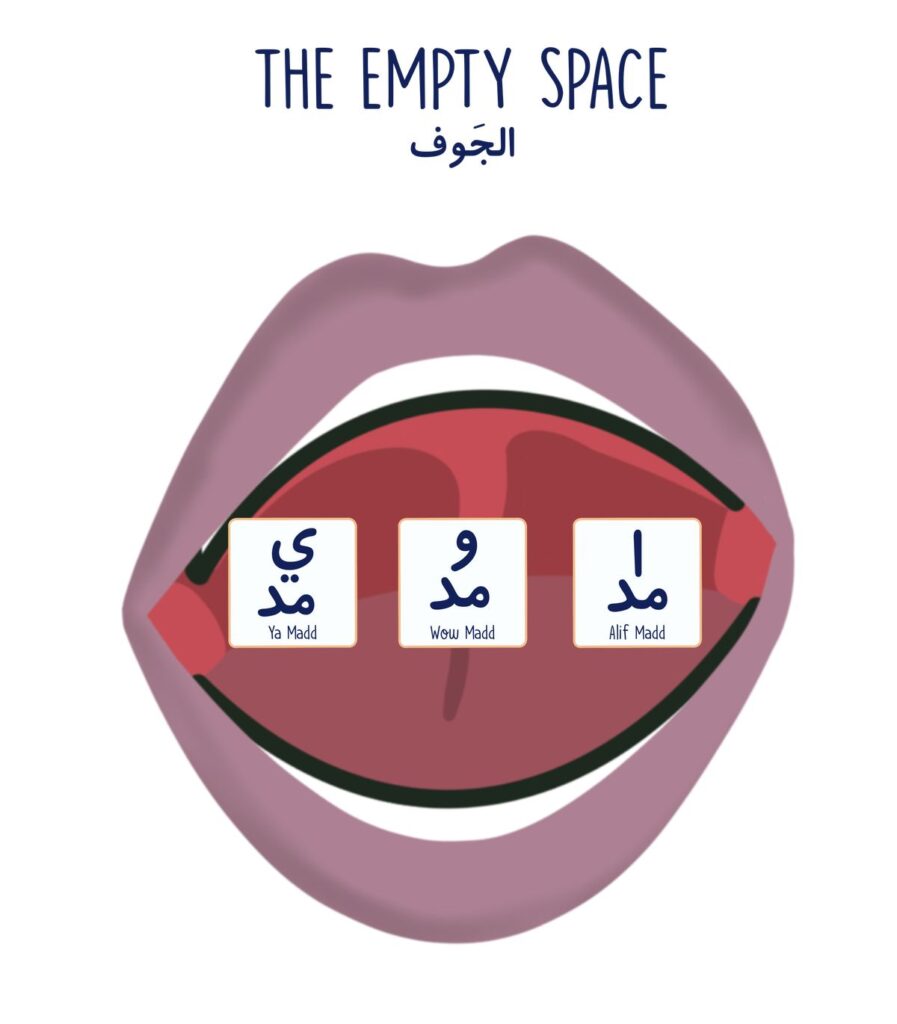
Al-Jawf (الجوف) is one of the five main articulation areas in Tajweed and refers to the open, hollow space inside the mouth and throat. Unlike other makharij, it does not have a fixed physical point like the tongue or lips. Instead, it is a general cavity where sound flows freely without obstruction.
As a result, this makhraj is essential for the beauty and melody of Quranic recitation, because it produces the elongated vowel sounds (Madd) that give recitation its rhythm and flow.
Letters of Madd (ا، و، ي)
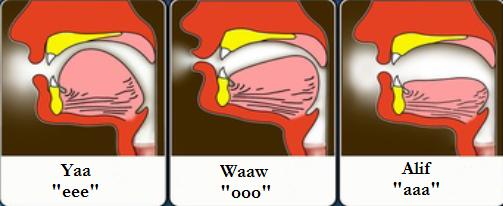
Al-Jawf produces the three Madd letters, also known as the long vowel letters:
- ا (Alif) → when preceded by a Fatha (e.g., قَالَ)
- و (Waw) → when preceded by a Dammah (e.g., يَقُولُ)
- ي (Yaa) → when preceded by a Kasrah (e.g., قِيلَ)
These letters in Arabic letter makharij are not pronounced with a strong blockage in the mouth. Instead, they are extended sounds that depend on airflow and timing, forming the foundation of Tajweed’s rules of elongation.
How These Arabic Letter Makharij Sounds Are Produced

The production of Al-Jawf sounds is unique because it relies on continuous airflow rather than specific articulation contact:
- The tongue stays relaxed and neutral
- The mouth opens naturally depending on the vowel
- The sound flows smoothly from the chest and throat
- There is no stopping point or tongue/lip closure
This is why Al-Jawf is often called a “general makhraj”, because it covers a wide open space rather than a single fixed point.
Its key feature is:
continuity of sound without interruption
Arabic Letter Makharij from the Throat (Al-Halq)
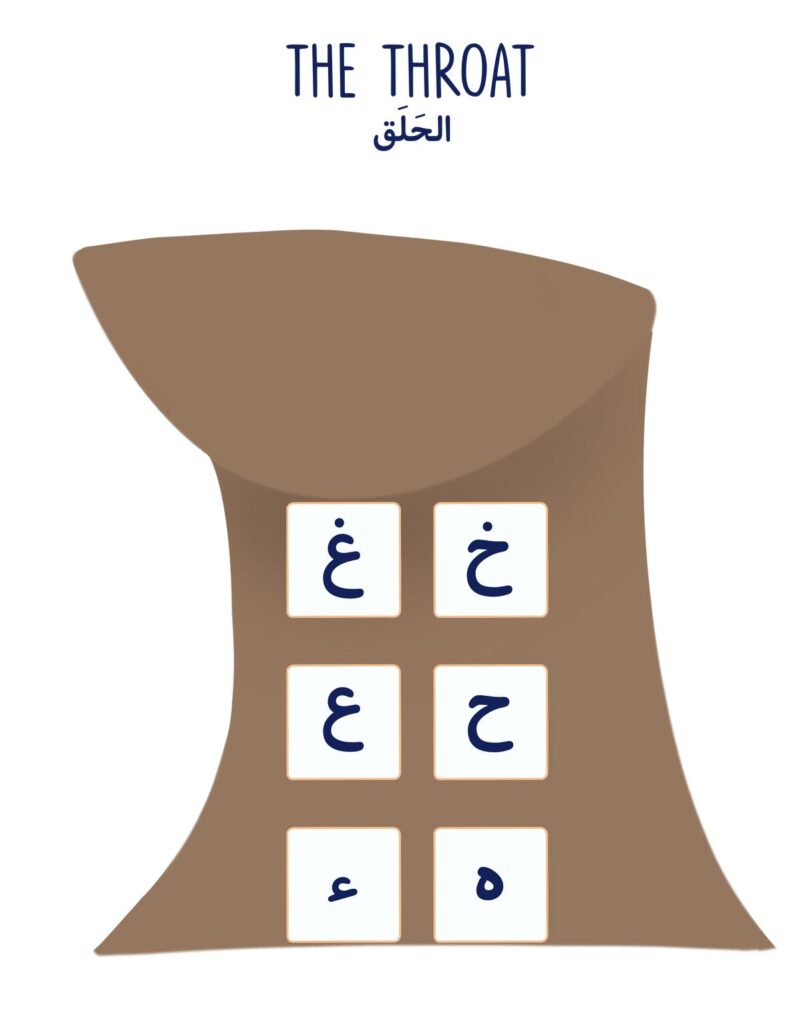
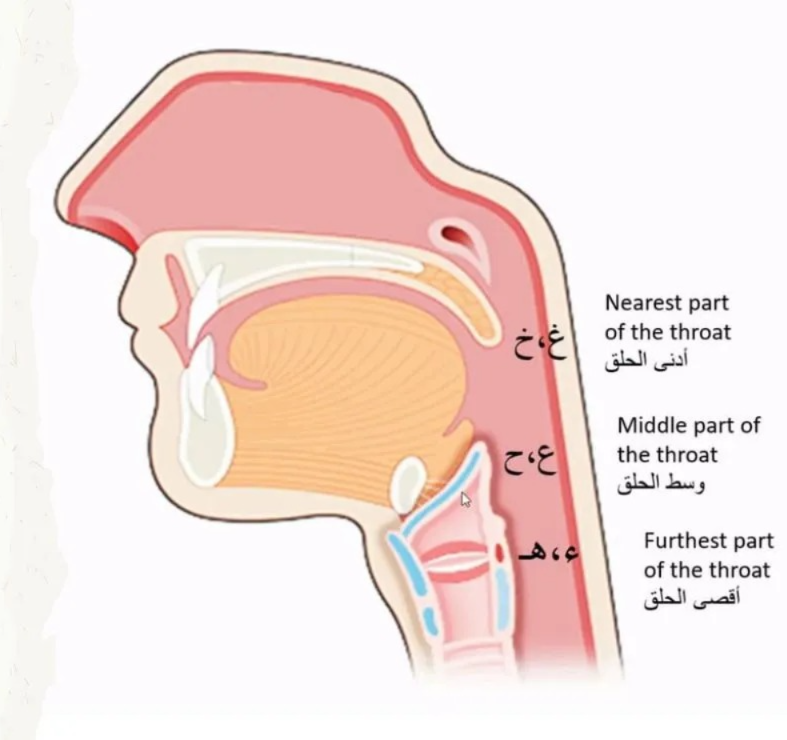
Al-Halq (الحلق) is one of the five main articulation areas in Tajweed and refers to the throat region, where six Arabic letters are produced. In fact, these Arabic letter Makharij are pronounced without involvement of the tongue or lips, making the throat the sole source of articulation.
Furthermore, the throat is divided into three levels, each producing two letters, based on how deep or close to the mouth the sound originates. Therefore, understanding these levels helps learners control their pronunciation more accurately. As a result, mastering Al-Halq is essential for producing correct and clear throat sounds in Quranic recitation.
Correct pronunciation of throat letters is essential because even small mistakes can change meanings and affect the accuracy of Quranic recitation.
Deep Throat Letters (ء، هـ)
These letters in Arabic letter makharij come from the lowest part of the throat, closest to the chest.
- ء (Hamzah)
A sharp, sudden stop in sound (glottal stop). It is produced with a quick closure and release of airflow.
Example: أَحَدٌ - هـ (Haa)
A soft, airy breath sound similar to “h” in English but lighter and purely from the throat.
Example: هُوَ
🌟Key idea:
Hamzah is strong and abrupt, while Haa is soft and breathy.
Middle Throat Letters (ع، ح)
These letters originate from the middle part of the throat and are considered among the most challenging for non-native speakers.
- ع (‘Ayn)
A deep, voiced sound produced with slight throat tightening. It has no exact English equivalent.
Example: عَلَيْهِمْ - ح (Haa)
A soft but voiceless breathy sound, deeper than the English “h”.
Example: مُحَمَّد
🌟Key idea:
Both require controlled airflow in Arabic letter makharij from the throat without tongue involvement.
Upper Throat Letters (غ، خ)
These letters come from the upper part of the throat, closer to the mouth.
- غ (Ghayn)
A voiced, heavy sound with vibration, similar to a gargling tone.
Example: غَيْرِ - خ (Khaa)
A raspy, unvoiced sound like a soft throat clearing.
Example: خَلَقَ
🌟Key idea:
These sounds are heavier and more textured, requiring stronger airflow from the upper throat.
Pronunciation Tips
To master Al-Halq letters, consistent practice is essential:
- Practice slow recitation focusing on one letter at a time
- Listen to expert Qaris and imitate pronunciation
- Focus on airflow control from the throat, not the tongue
- Avoid mixing throat letters with similar-sounding sounds (e.g., ح vs هـ or خ vs ح)
- Use mirror or recording practice for self-correction
Correct articulation of throat letters in Arabic letter makharij ensures:
- Clear distinction between similar words
- Preservation of Quranic meaning
- Beautiful and accurate Tajweed recitation
Arabic Letter Makharij from the Tongue (Al-Lisan)
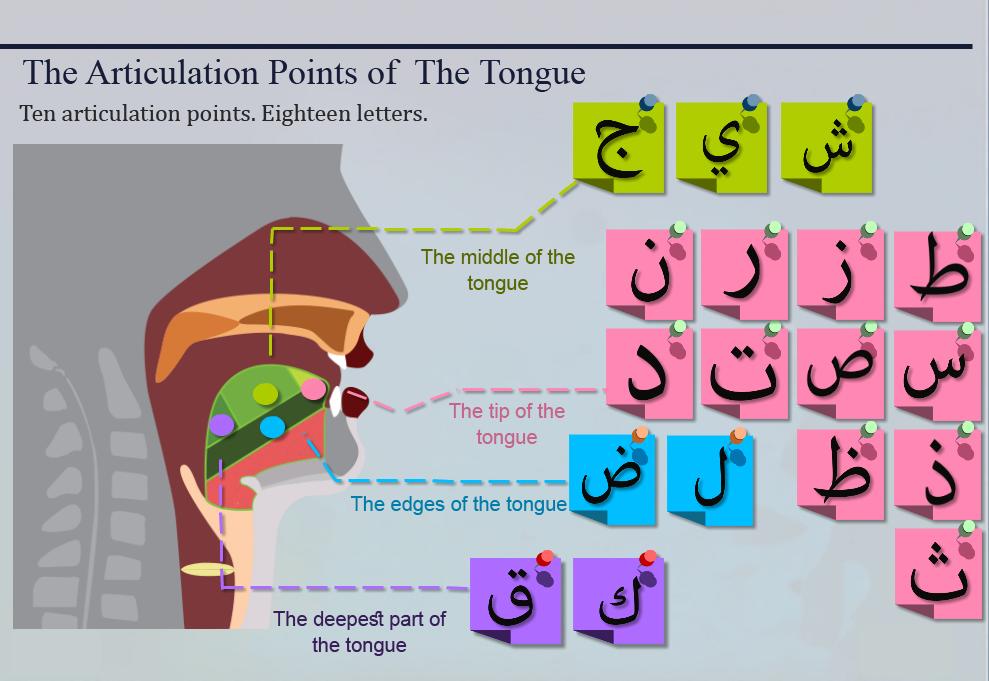
Al-Lisan (اللسان) is the largest and most complex articulation area in Tajweed within Arabic Letter Makharij. It produces the majority of Arabic letters (around 18 letters) through different positions of the tongue against various parts of the mouth.
Unlike other makharij, the tongue has multiple articulation zones, which are divided into four main regions:
- Back of the tongue (Aqsa al-Lisan)
- Middle of the tongue (Wasat al-Lisan)
- Sides of the tongue (Haafah al-Lisan)
- Tip of the tongue (Ra’s al-Lisan)
Each region creates completely different sounds, making this area essential for accurate Quranic recitation.
Back of the Tongue Letters (ق، ك)
This area is called Aqsa al-Lisan (أقصى اللسان) and refers to the deepest part of the tongue near the throat and soft palate.
- ق (Qaaf)
Produced in Arabic letter makharij from the very back of the tongue against the soft palate, it is a heavy, strong sound.
Example: قَالَ - ك (Kaaf)
Slightly forward compared to Qaaf, lighter in pronunciation.
Example: كِتَاب
Key idea:
- Qaaf = deeper + stronger
- Kaaf = lighter + more forward
Middle Tongue Letters (ج، ش، ي)
This area is called Wasat al-Lisan (وسط اللسان) and involves the middle part of the tongue touching the hard palate.
- ج (Jeem) → “j” sound (soft Arabic j)
Example: جَمِيل - ش (Sheen) → “sh” sound
Example: شَمْس - ي (Yaa – consonant) → when not used as a long vowel
Example: يَفْعَلُ
Key idea:
These letters are produced by raising the middle tongue toward the roof of the mouth, creating clear palatal sounds.
Side and Tip of the Tongue Letters
This section includes two important articulation zones:
1. Side of the Tongue (Haafah al-Lisan)
- ض (Dhaad)
One of the most unique Arabic letters, produced by pressing the side of the tongue against upper molars.
Example: ضَوْء
Key idea:
This letter is often called the “hardest Arabic letter” due to its precise side-tongue placement.
2. Tip of the Tongue (Ra’s al-Lisan)
This includes multiple letters depending on exact placement:
- ل (Laam) → tip touches upper gums
Example: لَيْل - ن (Noon) → tip with nasal sound support
Example: نُور - ر (Raa) → vibrating tip
Example: رَحْمَة - ت، د، ط → tip touches upper teeth/gums
Example: تِين، دِين، طِين
Key idea:
Small shifts in the tongue tip create completely different letters and meanings.
Makharij from the Lips (Ash-Shafatan)
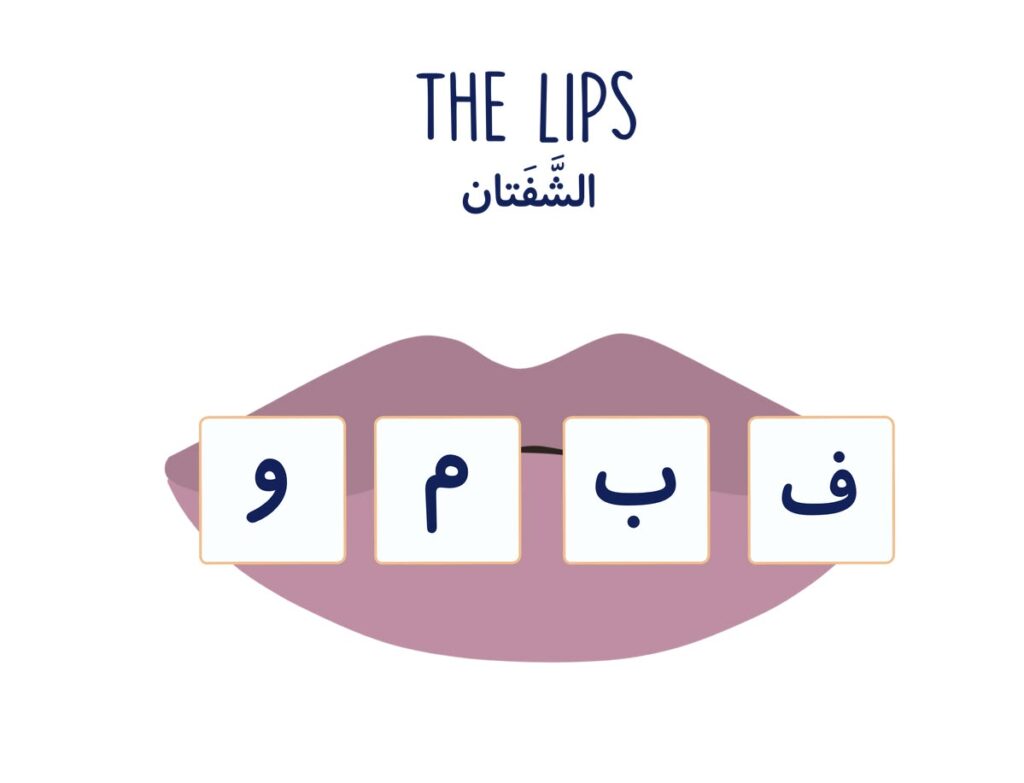
Ash-Shafatan (الشفتان) refers to the lip articulation point in Tajweed, one of the five main Arabic Letter Makharij areas. In fact, it includes all sounds produced using the movement, contact, or shaping of the lips.
Moreover, these movements play a key role in distinguishing between similar sounds. Therefore, understanding how the lips function in articulation helps improve clarity in pronunciation. As a result, mastering this makhraj is essential for accurate and fluent Quranic recitation.
There are four Arabic letters that originate from this area:
ب (Ba), م (Meem), و (Waw), ف (Fa)
These letters are divided into two main sub-areas depending on how the lips are used.
Letters Produced by Both Lips (ب، م)
This group includes letters produced using both lips together or shaped without teeth involvement.
ب (Ba)
- Produced by pressing both lips together firmly
- Sound is released with a slight burst of air (stop sound)
- Example: بِسْم
Key idea:
A clear lip closure + quick release
م (Meem)
- Produced by closing both lips gently
- Air flows through the nose (with ghunnah in Tajweed rules)
- Example: مُحَمَّد
Key idea:
A soft lip closure with nasal resonance
و (Waw – consonant)
- Produced by rounding the lips without full closure
- Lips form a small circle
- Example: وَصَلَ
Key idea:
A rounded lip shape with smooth airflow
Letters Involving Teeth and Lips (ف)
ف (Fa)
- Produced by placing the inner lower lip against the upper front teeth
- Air passes through causing a soft friction sound
- Example: فَتْح
Key idea:
A labiodental sound (lip + teeth contact) with controlled airflow
Examples and Tips

To master Ash-Shafatan, focus on lip precision and airflow control:
Practical Tips:
- Practice in front of a mirror to check lip shape
- Avoid over-pressing lips (especially for Ba and Meem)
- Keep Waw rounded, not flat or stretched
- Let Fa flow gently—don’t bite the lip too hard
- Listen to expert reciters and imitate carefully
Quick Summary:
- ب → firm lip closure + release
- م → soft closure + nasal sound
- و → rounded lips + smooth airflow
- ف → lower lip + upper teeth
Makharij from the Nasal Passage (Al-Khayshum)
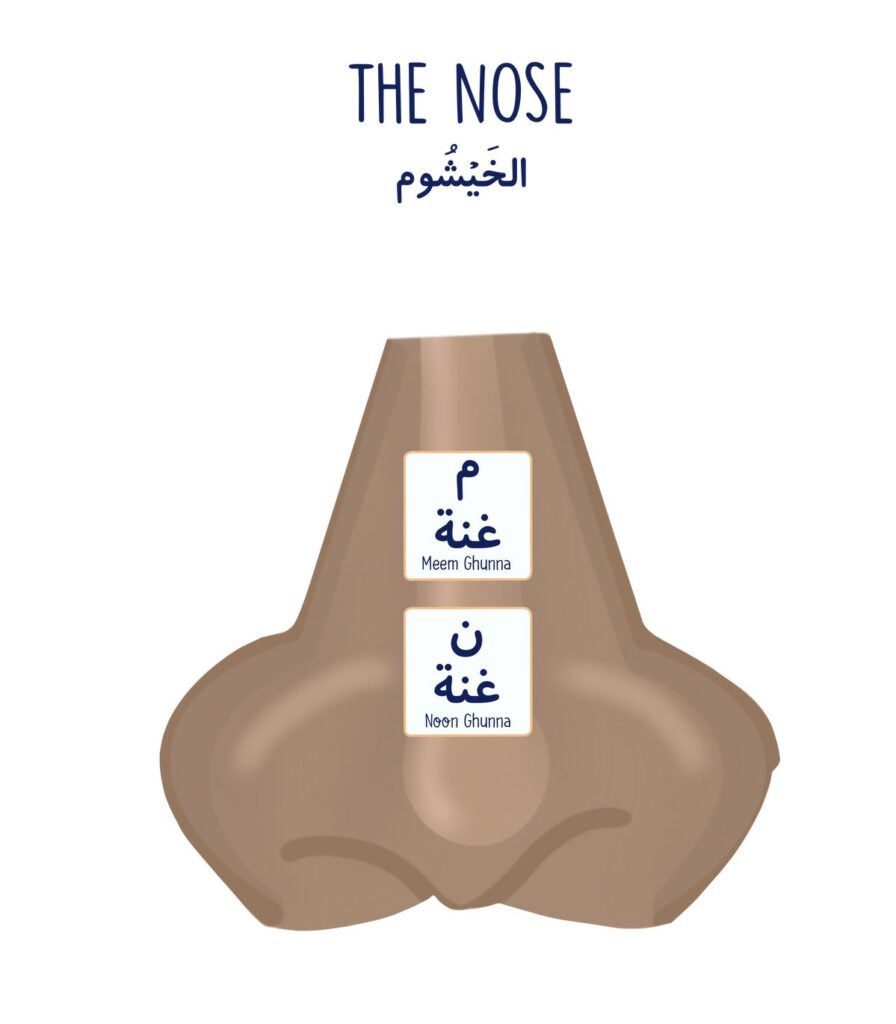
Al-Khayshoom (الخيشوم) refers to the nasal cavity, and it is one of the five main articulation areas in Tajweed. However, unlike other Makharij, it does not produce independent letters. Instead, it produces a characteristic sound known as Ghunnah (الغنة).
Moreover, this nasal sound plays a crucial role in the pronunciation of certain letters. Therefore, understanding how Ghunnah is produced helps learners apply Tajweed rules correctly. As a result, mastering this makhraj enhances both the accuracy and beauty of Quranic recitation.
The Ghunnah is a nasal resonance sound that naturally accompanies certain pronunciations, especially with the letters Noon (ن) and Meem (م).
Role of the Nose in Ghunnah
The main function of Al-Khayshoom is producing the Ghunnah sound, which is:
- A soft humming sound
- Produced entirely through the nose, not the mouth
- A natural quality (sifah) of Noon and Meem, not a separate letter
Key point:
The tongue does NOT participate in Ghunnah — it is purely a nasal airflow vibration.
Ghunnah is always present in Noon and Meem, but it becomes stronger and more noticeable in Tajweed rules like:
Letters That Use the Nasal Sound
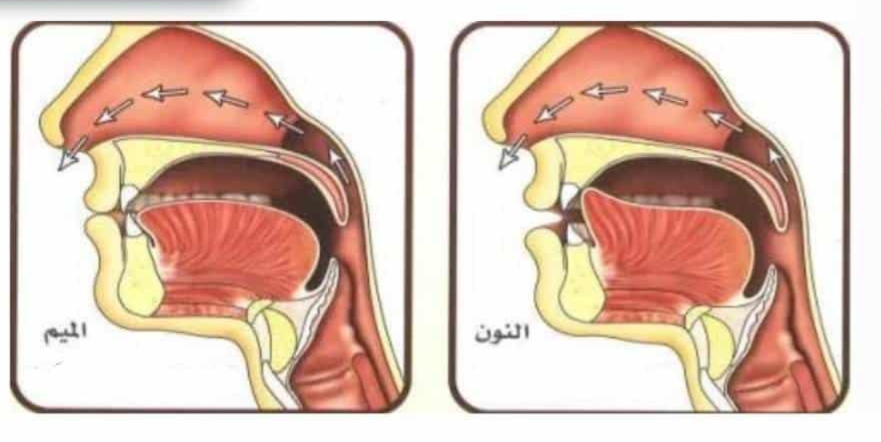
The nasal sound is directly connected to:
ن (Noon)
- Carries Ghunnah in all states (with vowel, sukoon, or shaddah)
- Example: إِنَّ
م (Meem)
- Also carries Ghunnah in all states
- Example: ثُمَّ
Important note:
- Ghunnah is not a separate letter
- It is a built-in quality of Noon and Meem
Practical Examples of Arabic Letter Makharij
To understand Al-Khayshoom, try this simple practice:
Pinch Test:
- Pinch your nose and say: إِنَّ or أَمْ
- You will notice the sound becomes blocked or unclear
👉 This proves the sound is coming from the nasal cavity
Quran Examples:
- إِنَّ → strong Ghunnah due to shaddah
- مِمَّا → nasal sound in Meem
- مَنْ يَقُولُ → Ghunnah in Noon
- أَنْبِئْهُمْ → Ikhfa nasalization
✔ Key Practice Tip:
- Let the sound resonate gently in the nose
- Do NOT push air from the throat or tongue
- Keep the sound smooth, not forced
Summary:
- Al-Khayshoom = nasal cavity
- Produces Ghunnah (nasal sound)
- Applies to Noon and Meem only
- Essential in rules like Ikhfa, Idgham, Iqlab
Common Mistakes in Learning Makharij
Learning Makharij (Arabic articulation points) is one of the most important steps in Tajweed, but also one of the most challenging for non-native speakers. Many mistakes happen because learners rely on their native language sound system, which does not contain many Arabic phonetic distinctions.
These mistakes can lead to:
- Changing the meaning of words
- Weak or unclear pronunciation
- Loss of Tajweed accuracy
Most errors come from incorrect tongue placement, throat misuse, or ignoring sound heaviness (Tafkhim).
Mispronouncing Similar Letters (e.g., س vs ص)
One of the most common issues is confusing letters that share the same articulation point but differ in sound quality (Sifaat).
Common confusing pairs:
- س (Seen) vs ص (Saad)
- ت (Ta) vs ط (Taa heavy)
- د (Dal) vs ض (Dhaad)
- ذ (Thal) vs ظ (Zaa)
Why this happens:
- Learners focus on placement only, not heaviness/lightness
- Lack of awareness of Tafkhim (heaviness) and Tarqeeq (lightness)
- Native language does not distinguish similar sounds
Result:
Words may completely change meaning, such as:
- صَدْر vs سَدْر
- طِين vs تِين
Ignoring Tongue Position in Arabic Letter Makharij
Many Makharij mistakes come from incorrect tongue placement, especially in tongue-heavy letters (Al-Lisan).
Common issues:
- Pronouncing ق (Qaf) like a soft “k”
- Using tongue tip instead of sides for ض (Dhad)
- Not differentiating between ج، ش، ي properly
- Misplacing ر (Raa) causing weak or unclear sound
Why this happens:
- Learners rely on English pronunciation habits
- Lack of awareness of precise tongue zones (back, middle, sides, tip)
Result:
Letters sound flattened or incorrect, losing their Arabic identity.
Weak or Incorrect Sounds
Another common issue is producing letters without their proper strength, airflow, or resonance.
Examples:
- ع (Ayn) pronounced like a simple vowel
- ح (Haa) softened into English “h”
- غ (Ghayn) confused with “q” or “r” sounds
- Missing Ghunnah (nasal sound) in ن and م
Why this happens:
- Lack of throat control
- Weak airflow management
- Not practicing sound vibration (especially nasal sounds)
Result:
Recitation becomes flat, unclear, and sometimes meaning-changing.
Tips to Master Arabic Letter Makharij
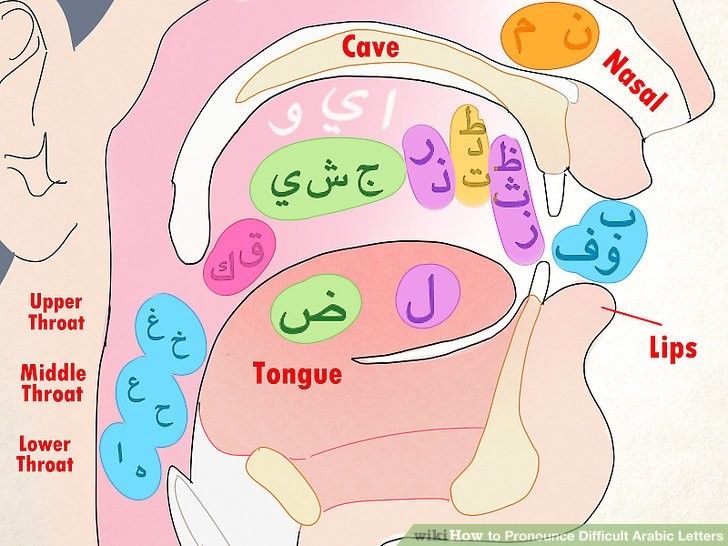
Correcting Makharij mistakes requires consistent practice + guided correction.
Practice Arabic Letter Makharij in Front of a Mirror
- Watch tongue, lips, and jaw movement
- Ensure correct placement (especially for tongue and lip letters)
- Helps identify hidden pronunciation mistakes early
Listen and Repeat After Skilled Reciters
- Choose expert Qaris with strong Tajweed
- Focus on how letters are formed, not just the melody
- Repeat slowly before increasing speed
Learn with a Qualified Tajweed Teacher
- Direct correction is essential for fixing hidden mistakes
- Teachers can identify errors you cannot hear yourself
- Prevents wrong habits from becoming permanent
📝Final Note:
Mastering Makharij is not about speed — rather, it is about precision, awareness, and repetition. In fact, even small corrections in tongue or throat placement can completely transform your recitation quality and accuracy.
Therefore, focusing on proper articulation is essential for improvement. As a result, consistent practice with attention to detail leads to clearer and more accurate Qur’anic recitation.
Final Thoughts on Arabic Letter Makharij
Mastering Makharij is a journey that requires patience, repetition, and consistent guided practice. It is not a skill that develops overnight, but rather one that grows through continuous listening, correction, and application. Every letter you refine brings you closer to a more accurate, beautiful, and heartfelt recitation of the Quran.
If you are serious about improving your Tajweed and correcting your pronunciation in a structured and effective way, then this is your next step:
- Join Areeb Academy for guided Tajweed learning
- Learn Makharij step by step with qualified instructors
- Get personalized feedback on your recitation
- Build a strong foundation in Quranic pronunciation with confidence
- Start your journey with a FREE trial session
Begin today with Areeb Academy and take your Qur’anic recitation to a clearer, more accurate, and more confident level.
FAQs About Arabic Letter Makharij
1. What are Arabic letter makharij in Tajweed?
Arabic letter makharij are the specific articulation points from which each Arabic letter is pronounced. In other words, they define where the sound originates in the mouth, throat, or nose. Therefore, mastering them is essential for correct Qur’anic recitation.
2. Why are makharij important in Tajweed?
Makharij are important because they ensure each letter is pronounced correctly without confusion. For example, mixing similar sounds can completely change meanings. As a result, proper makharij help preserve both accuracy and the beauty of recitation.
3. How many makharij are there in Tajweed?
According to the most widely accepted opinion, there are 17 detailed makharij. Furthermore, these are grouped into five main areas: the mouth, throat, tongue, lips, and nasal cavity. Thus, this structure makes learning them more organized.
4. What is the hardest makhraj to learn?
Many learners find throat letters and some tongue positions challenging. This is because these sounds do not exist in many languages. However, with consistent practice and guidance, they can be mastered over time.
5. How can I improve my makharij quickly?
Improving makharij requires regular practice and proper feedback. For instance, using a mirror, listening to skilled reciters, and recording yourself can help. Most importantly, learning with a qualified Tajweed teacher will speed up your progress significantly.