
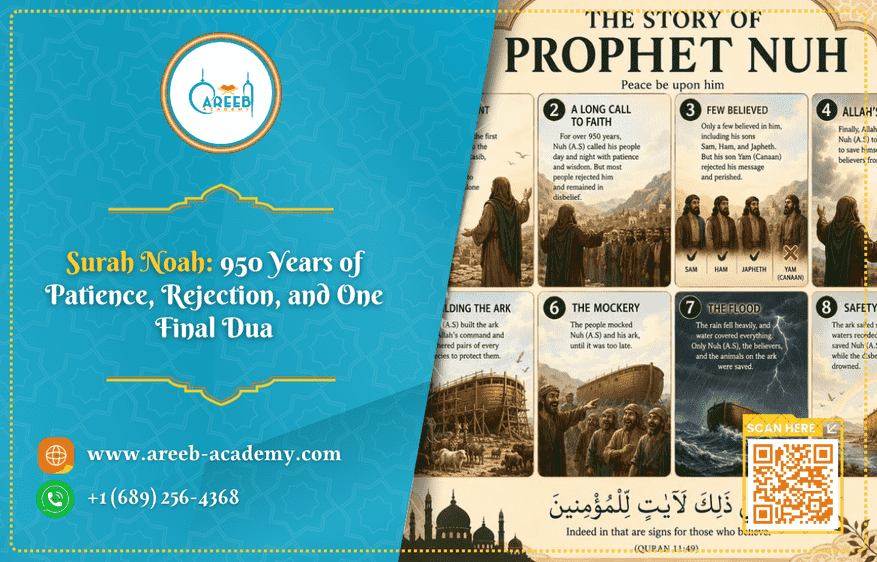
Surah Nuh, also known as Surah Noah, tells the story of Prophet Nuh (Noah) and his long struggle to call his people to worship Allah alone. Despite centuries of rejection, mockery, and resistance, Nuh continued to deliver Allah’s message with patience and perseverance.
The surah highlights Allah’s power through the creation of the heavens, earth, sun, and moon. It also emphasizes seeking forgiveness and returning to Allah. Finally, it warns against the consequences of persistent disbelief.
In this guide, we will explore the story, message, major themes, important verses, and lessons of Surah Nuh, and see how its teachings can guide Muslims in faith, patience, repentance, and reliance on Allah.
What Is Surah Noah?
Surah Noah is the 71st chapter of the Quran and contains 28 verses. It is a Makki surah that focuses on the mission of Prophet Nuh, who called his people to worship Allah alone and turn away from idolatry.
The surah presents Nuh’s long and difficult journey of da’wah. He called his people day and night, openly and privately, yet they continued to reject his message. Through his story, Surah Nuh highlights the importance of patience, sincere da’wah, repentance, and trust in Allah. It also draws attention to Allah’s signs in creation, including the heavens, the sun, the moon, and the earth, and ends with Nuh’s powerful supplication for himself, his parents, and the believing men and women.
Where Is Surah Noah in the Quran?
Surah Nuh is Surah 71 of the Quran. It is located in Juz 29, between Surah Al-Ma’arij (70) and Surah Al-Jinn (72).
Why Is It Called Surah Nuh?
The surah is named after Prophet Nuh (Noah), whose mission is the central subject of the chapter. It recounts his call to his people, their persistent rejection, and his final supplication to Allah.
What Is Surah Noah About?
Surah Noah takes us into the heart of Prophet Nuh’s long struggle with his people. Allah sent him as a warner, calling them to leave false worship and return to their Creator. Despite his repeated efforts, they continued to reject his message and hold firmly to their idols.
The surah presents this struggle as more than a story of rejection. It shows the patience required to call others to Allah. It also highlights the danger of following false traditions and turning away from clear guidance. Nuh’s message combined warning with hope. He urged his people to seek forgiveness and reminded them that Allah is Most Forgiving. He also taught them that sincere repentance can bring blessings and mercy.
Tawheed and the Call to Worship Allah Alone
The foundation of Nuh’s message was Tawheed — the belief that Allah alone deserves worship. He called his people to abandon the idols they had inherited from their forefathers. Rather than reconsidering their beliefs, they clung to their idols and followed influential figures who encouraged them to remain on the same path. Surah Noah presents Tawheed as more than a belief to profess. It calls people to turn away from anything that comes between them and sincere worship of Allah.
The Story of Prophet Noah
The story of Prophet Nuh is a powerful example of patience and perseverance in calling people to Allah. In Surah Noah, Allah describes how He sent Nuh to a community that had turned away from His worship and become deeply attached to idols. His mission was to call them back to Tawheed and warn them about the consequences of rejecting His guidance.
Who Were Nuh’s People, and What Did They Worship?
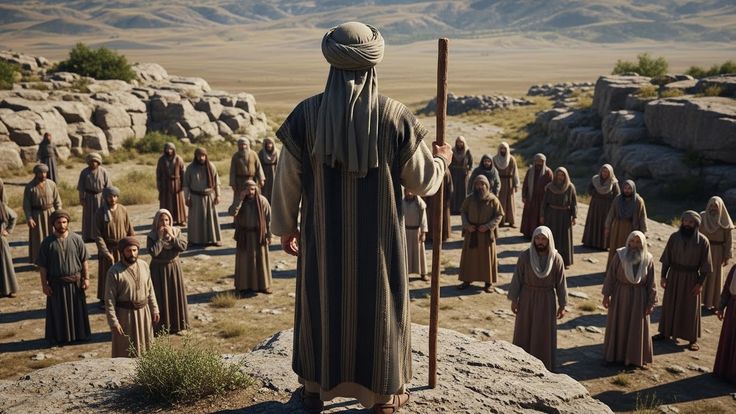
The Quran does not name Nuh’s people or their location directly, but Surah Nuh itself names the idols they worshipped instead of Allah. In verse 23, their leaders urge one another:
“urging ˹their followers˺, ‘Do not abandon your idols—especially Wadd, Suwâ’, Yaghûth, Ya’ûq, and Nasr.’1” (Surah Nuh 71:23)
These were five idols — Wadd, Suwa’, Yaghuth, Ya’uq, and Nasr — that scholars describe as originally righteous men from earlier generations. After their deaths, people began venerating their images, and over generations this veneration turned into full idol worship. This is exactly the false worship Nuh was sent to confront.
How Nuh Began His Mission
Allah sent Prophet Nuh to his people when they had fallen into this idol worship. His message combined both warning and hope:
- Tawheed: return to Allah and worship Him alone.
- Warning: caution against punishment if they persisted in disbelief.
- Hope: encouragement to seek Allah’s forgiveness and return to Him, with the promise of mercy and blessings.
Noah Calls His People Day and Night
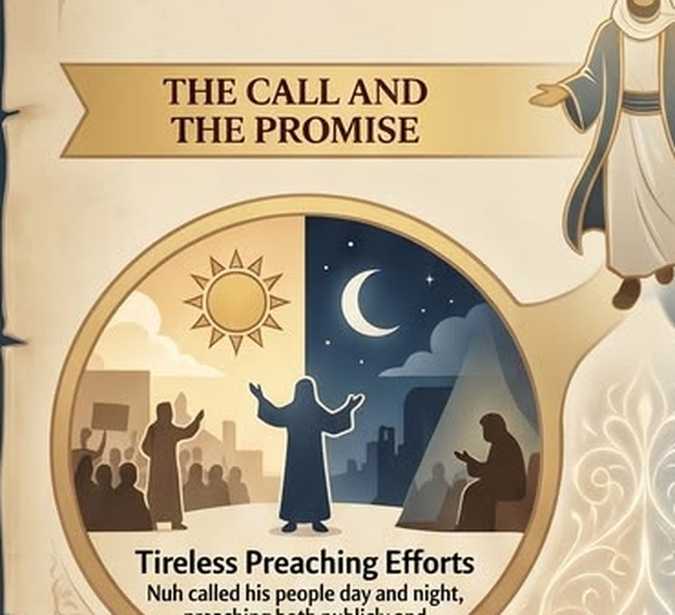
Nuh’s commitment to his mission was extraordinary. He continued calling his people for 950 years, using different ways to reach them. Surah Noah describes his efforts as a continuous call:
“My Lord, indeed I invited my people to You night and day.”
He called them:
- Publicly and privately
- Day and night
- Through reminders of Allah’s mercy and forgiveness
- By warning them of the consequences of rejecting His guidance
Despite all these efforts, only a small number of people accepted his message.
How His People Responded to His Message
Despite Nuh’s persistent efforts, his people responded with rejection and arrogance:
- Some avoided his message altogether.
- Others openly mocked him.
- Their leaders questioned his prophethood because he was a human being like them.
- They covered their ears to avoid hearing him.
- Their influential leaders encouraged others to remain attached to their inherited beliefs and idols.
Their response shows how strongly pride, social influence, and attachment to inherited beliefs can stand in the way of accepting guidance.
Prophet Noah’s Persistence Despite Rejection
The most striking part of Nuh’s story is that he continued his mission despite seeing very little response. For 950 years, he remained committed to calling his people to Allah, even though only a small group believed. His story teaches that sincere effort should not be measured only by visible results — he continued to fulfill his responsibility even when his people rejected and mocked him, making him a lasting example of patience, steadfastness, and perseverance in da’wah.
The Ark, the Flood, and the Aftermath
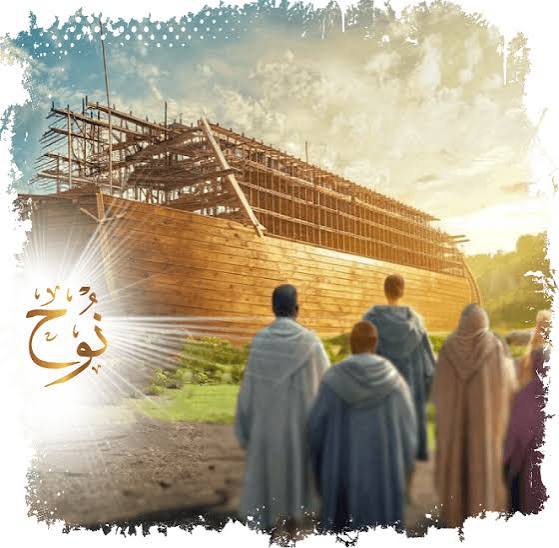
While Surah Nuh focuses on Nuh’s call and his people’s rejection, the Quran narrates what happened next — the ark, the flood, and the fate of his people — in more detail elsewhere, most fully in Surah Hud (11:25–49).
After centuries of rejection, Nuh prayed to Allah, and Allah commanded him to build an ark. Allah revealed to him:
“And construct the ship under Our observation and Our inspiration and do not address Me concerning those who have wronged; indeed, they are to be drowned.” (Surah Hud 11:37)
Nuh built the ark as his people watched, mocking him for building a ship far from any sea. When Allah’s command came and water began to burst forth from the earth and pour down from the sky, Nuh was instructed to bring aboard a pair from every kind of creature, along with his family and the small number who believed.
The flood overtook the disbelievers, including one of Nuh’s own sons, who refused to board the ark and was drowned along with the rest of his people. When the flood subsided, the ark came to rest on Mount Judi, and Nuh was told:
“O Noah, disembark in security from Us and blessings upon you.” (Surah Hud 11:48)
This part of the story — the ark, the pairing of animals, and the flood itself — is not detailed in Surah Nuh. Surah Nuh only refers to the drowning briefly, in verse 25: “Because of their sins they were drowned and put into the Fire.” The fuller narrative belongs to Surah Hud and is echoed in Surah Al-A’raf, Ash-Shu’ara, Al-Qamar, and Al-Mu’minun.
Seeking Forgiveness in Surah Noah
Seeking forgiveness, or istighfar, is one of the important themes in Surah Nuh. Prophet Nuh encouraged his people to turn back to Allah and seek His forgiveness, reminding them that Allah is always ready to forgive those who sincerely repent.
In verses 10–12, Nuh urged his people to seek Allah’s forgiveness because He is Al-Ghaffar, the One who forgives repeatedly:
“Ask forgiveness of your Lord; indeed, He is ever Forgiving. He will send down abundant rain from the sky upon you, and give you increase in wealth and children, and provide you with gardens and rivers.” (Surah Nuh 71:10–12)
These verses connect istighfar with a range of blessings that reach both a person’s spiritual life and worldly affairs:
- Forgiveness — istighfar brings a person back to Allah and allows them to seek His pardon.
- Rain — Allah can send abundant rain, bringing life and nourishment to the land.
- Wealth — turning to Allah is connected with increased provision and material blessings.
- Children — an increase in children and progeny.
- Gardens and rivers — flourishing gardens and flowing rivers, representing abundance and prosperity.
Rather than presenting repentance as separate from daily life, Surah Noah connects turning back to Allah with His mercy and provision. It encourages believers to look beyond immediate difficulties and remember that Allah is the ultimate source of forgiveness and provision.
Lessons from Istighfar in Surah Nuh
These verses offer several practical lessons. Istighfar is an act of returning to Allah and reflects humility. Allah’s forgiveness gives believers hope because He is repeatedly forgiving. Repentance is also connected to Allah’s mercy and blessings. For this reason, istighfar should be a regular practice, not something reserved for difficult times. The surah later ends with Nuh making a powerful dua for forgiveness. This shows that seeking forgiveness remains important even after a lifetime of serving Allah.
The meaning and importance of istighfar go beyond these verses. Learn more about why Muslims say “Astaghfirullah,” what it means, and how seeking Allah’s forgiveness can become part of your daily life in our complete guide.
Signs of Allah’s Power in Surah Nuh
Surah Nuh invites people to reflect on Allah’s power in creation. Prophet Nuh points to the heavens, the sun, the moon, and the earth as clear signs of a Creator worthy of worship.
- The creation of human beings: Prophet Nuh reminds his people that Allah created them in stages, and that the One who brought human life into existence by His power is fully capable of bringing it back after death:
“What is the matter with you that you are not in awe of the Majesty of Allah, when He truly created you in stages ˹of development˺?1
(Surah Nuh 71:13–14)
Allah causes people to grow from the earth, return to it after death, and rise again:
“Allah ˹alone˺ caused you1 to grow from the earth like a plant. Then He will return you to it, and then simply bring you forth ˹again˺.“ (Surah Nuh 71:17–18)
This cycle reminds believers that life has a purpose, and that resurrection is completely within Allah’s power.
What the Heavens and Earth Reveal
- The seven heavens, sun, and moon: Prophet Nuh directs his people’s attention upward, explaining that Allah created seven heavens in layers, each reflecting the precision and greatness of His creation:
“Do you not see how Allah created seven heavens, one above the other, placing the moon within them as a ˹reflected˺ light, and the sun as a ˹radiant˺ lamp?” (Surah Nuh 71:15–16)
For Nuh’s people, these were visible signs that could not be explained by the idols they worshiped. - The earth and Allah’s mercy: Allah spread the earth out and made it suitable for human life, allowing people to travel across it freely: “And Allah ˹alone˺ spread out the earth for you, to walk along its spacious pathways.“ (Surah Nuh 71:19–20)
This connects to the blessings mentioned earlier in the surah — rain, gardens, wealth, and children.
Prophet Noah’s Dua
After describing Nuh’s long struggle with his people, Surah Noah ends with one of the most moving moments in the chapter: his final supplication to Allah. His dua reflects both justice and mercy. Nuh spent centuries calling his people to the truth, yet they continued to reject his message. He eventually entrusted their fate to Allah. Despite their prolonged rejection, his final words turn toward forgiveness for himself, his parents, and the believers.
Nuh’s Final Supplication
Nuh did not turn to Allah after a short period of difficulty. He spent 950 years calling his people day and night, openly and privately. At this point, he turned to Allah because he had fulfilled his responsibility as a messenger and exhausted every effort to guide his people. His dua was not simply an emotional reaction to rejection—it came after an extraordinary lifetime of patience, preaching, and sincere effort.
His final supplication contains two sides. First, he asks Allah to deal with those who persistently rejected the truth and continued leading others away from it. Then, in the final verse, his prayer takes a completely different tone as he asks for forgiveness and mercy:
“My Lord, forgive me and my parents, and whoever enters my house as a believer, and all believing men and women. And do not increase the wrongdoers except in destruction.” (Surah Nuh 71:28)
Mercy and Justice in Nuh’s Dua
Notice how widely his prayer extends. He begins with himself, then his parents, those who enter his home in faith, and finally all believing men and women. Despite his people’s rejection, Nuh did not forget the believers. His final prayer is filled with mercy for those who turn to Allah, alongside justice for those who persisted in wrongdoing.
Lessons from Prophet Noah’s Dua
The ending of Surah Nuh offers several lessons about how believers respond to hardship and injustice:
- Dua comes after sincere effort: Nuh spent centuries fulfilling his mission before turning to Allah with his final plea.
- Patience does not mean ignoring injustice: He remained patient for generations but also recognized when his people’s persistent rejection had reached its final point.
- Justice belongs to Allah: Nuh entrusted the final outcome of his people’s actions to Allah rather than taking matters into his own hands.
- A believer should continue to ask for forgiveness: His final dua begins by asking Allah to forgive him, his parents, and the believers.
- Mercy should extend beyond oneself: His prayer ultimately includes all believing men and women.
Final Thoughts on Surah Noah
Surah Nuh is a powerful reminder that sincere faith requires patience, perseverance, and trust in Allah. Prophet Nuh continued calling his people to the truth despite their repeated rejection, showing that a believer’s responsibility is to remain sincere and steadfast while leaving the outcome to Allah.
The surah also encourages us to reflect on Allah’s signs, seek His forgiveness, and turn to Him through sincere dua. Its final verses remind us of the importance of praying for ourselves, our parents, and fellow believers.
These themes of faith, devotion, and submission to Allah also appear throughout Surah Al-Hajj, which explores them through worship, sacrifice, accountability, and commitment to Allah. To explore these themes further, read our guide to 6 Key Themes That Shape a Believer’s Faith in Surah Al-Hajj.
Learn Surah Noah and Tafsir with Areeb Academy
Reading that Nuh’s people worshipped Wadd, Suwa’, Yaghuth, Ya’uq, and Nasr is one thing — understanding why those five names mattered enough to be preserved in the Quran, or what classical scholars say about how veneration turned into idolatry, is another. That’s the kind of depth a translation alone can’t give you.
At Areeb Academy, a qualified teacher walks you through surahs like this one verse by verse — not just what the words mean, but the tafsir behind them: why Nuh’s dua in verse 28 names his parents before all other believers, what “Al-Ghaffar” implies that “forgiving” alone doesn’t capture, why the ordering of Allah’s signs in verses 13–20 moves from the human body outward to the heavens.
Classes are one-on-one, scheduled around your week, and built for non-Arabic speakers — whether you’re starting from scratch or already reading Quran and want to go deeper into meaning.
[→Book a free trial class with Areeb Academy]
FAQs About Surah Noah
1. What is Surah Noah about? Surah Noah focuses on the mission of Prophet Nuh and his call to his people to worship Allah alone. It also discusses their rejection, the signs of Allah’s power in creation, the importance of seeking forgiveness, and the consequences of persistent disbelief.
2. How many verses are in Surah Nuh? Surah Nuh contains 28 verses and is the 71st chapter of the Quran.
3. Is Surah Nuh Makki or Madani? Surah Nuh is a Makki surah, revealed before the migration of Prophet Muhammad ﷺ to Madinah.
4. How long did Prophet Nuh preach to his people? The Quran states that Prophet Nuh remained among his people for 950 years, calling them to Allah and warning them against disbelief.
5. What is the main message of Surah Nuh? The call to worship Allah alone, paired with patience in calling others to faith, sincere repentance, seeking forgiveness, and recognizing Allah’s signs in creation.
6. What can Muslims learn from the story of Prophet Nuh? The story teaches important lessons about patience, perseverance, sincere da’wah, trusting Allah, seeking forgiveness, and remaining committed to the truth even when others reject it.