
Surah Al-Hajj is a unique chapter of the Quran that brings together powerful reminders about faith, worship, the Hereafter, and submission to Allah. From its opening verses describing the terrifying reality of the Final Hour to its discussion of Hajj, sacrifice, and the Sacred House, the surah connects outward acts of worship with the condition of the believer’s heart.
In this guide, we will explore the main themes of Surah Al-Hajj, the lessons behind its verses, its connection to Hajj and sacrifice, and some of its most important verses and messages for Muslims today.
What Is Surah Al-Hajj?
Surah Al-Hajj (The Pilgrimage) is the 22nd chapter of the Quran and contains 78 verses. It is located in Juz 17 and takes its name from the discussion of Hajj and the pilgrimage to the Sacred House. Scholars have differed over whether the surah is entirely Makki or Madani, as it contains characteristics associated with both periods of revelation. It is also distinctive for containing two verses of prostration (Sajdah), in verses 18 and 77.
The surah brings together several major themes, including faith in Allah, the Day of Judgment, resurrection, Tawheed, Hajj, sacrifice, and sincere worship.
The Main Themes of Surah Al-Hajj
Surah Al-Hajj brings together several important themes related to faith, the Hereafter, worship, and submission to Allah. It addresses the certainty of the Day of Judgment, Allah’s power to resurrect the dead, the significance of Hajj and the Sacred House, and the importance of sincere worship and obedience.
The following themes highlight some of the main messages and lessons found throughout Surah Al-Hajj.
The Day of Judgment
Surah Al-Hajj opens with a powerful warning about the Day of Judgment. Allah says:
“O humanity! Fear your Lord, for the ˹violent˺ quaking at the Hour is surely a dreadful thing.”
(Surah Al-Hajj 22:1)
The next verse describes the overwhelming fear that will spread among people on that Day:
“The Day you see it, every nursing mother will abandon what she is nursing, and every pregnant woman will deliver her burden ˹prematurely˺. And you will see people ˹as if they were˺ drunk, though they will not be drunk; but the torment of Allah is ˹terribly˺ severe.”
(Surah Al-Hajj 22:2)
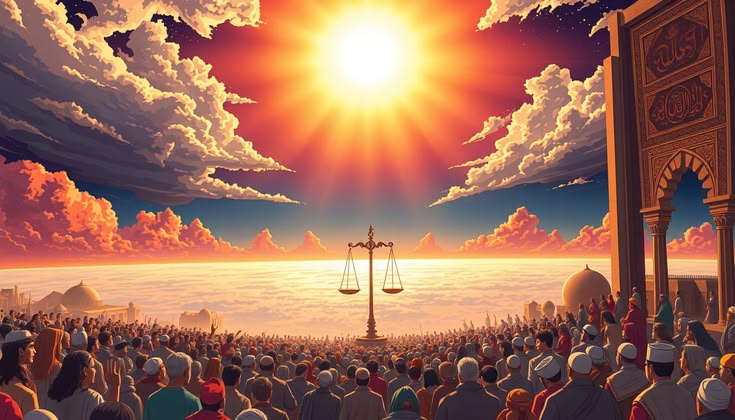
These verses present the Day of Judgment as an event of unimaginable terror. The image of a nursing mother becoming distracted from her own child shows how overwhelming the fear will be. A mother naturally gives her child her full attention and protection, yet the terror of that Day will be so great that even this instinctive bond will be overcome. Likewise, the sight of people appearing intoxicated, although they are not drunk, emphasizes the intensity of their shock, confusion, and fear.
The opening verses also remind us that the Day of Judgment is not a distant possibility. It is a certain reality for which every person should prepare. The surah therefore begins by calling humanity to fear Allah, strengthen their faith, and remain conscious of their accountability.
The surah then connects the terrifying reality of the Final Hour with the certainty of resurrection. It calls people to reflect on Allah’s power to create life in the first place. The One who created human beings through different stages and brings barren land back to life through rain is fully capable of resurrecting people after death.
Resurrection After Death
Surah Al-Hajj presents human creation and the revival of the earth as clear signs of Allah’s power to resurrect the dead. In verse 5, Allah asks people to reflect on how human beings are created and how life develops through different stages.
“O humanity! If you are in doubt about the Resurrection, then ˹know that˺ We did create you1 from dust, then from a sperm-drop,2 then ˹developed you into˺ a clinging clot,3 then a lump of flesh4—fully formed or unformed5—in order to demonstrate ˹Our power˺ to you. ˹Then˺ We settle whatever ˹embryo˺ We will in the womb for an appointed term, then bring you forth as infants, so that you may reach your prime. Some of you ˹may˺ die ˹young˺, while others are left to reach the most feeble stage of life so that they may know nothing after having known much. And you see the earth lifeless, but as soon as We send down rain upon it, it begins to stir ˹to life˺ and swell, producing every type of pleasant plant.”
(Surah Al-Hajj, 22:5)
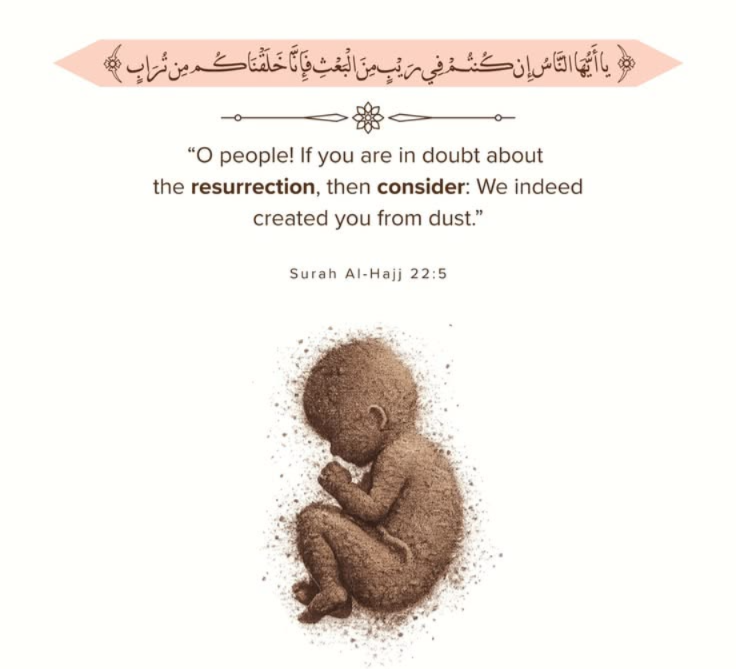
The verse draws attention to the stages of human creation. A person begins from a simple origin and gradually develops until birth and maturity. This is a reminder that human life itself is a sign of Allah’s unlimited power.
Allah then reminds us that some people live to old age, while others may die before reaching it. The changes that occur throughout human life show that Allah controls every stage of creation. Therefore, the One who created a person from the beginning is certainly able to bring that person back to life after death.
The same verse also points to another sign: the revival of the earth. Allah sends down rain to land that appears dry and lifeless, and it begins to move, swell, and produce different kinds of plants.
This provides a simple example of resurrection. Just as Allah brings life back to barren land after rain, He is able to resurrect people from their graves.
Hajj and the Sacred House
Hajj is one of the central themes of Surah Al-Hajj. The surah connects the pilgrimage to Prophet Ibrahim (Abraham, peace be upon him) and the Sacred House in Makkah. Allah commanded Ibrahim to establish and purify the Kaaba for those who worship Him, bow, prostrate, and perform Tawaf around the House.
The Sacred House was established for the worship of Allah alone. Its connection to Prophet Ibrahim also highlights the importance of Tawheed and rejecting all forms of shirk.
The Call to Hajj
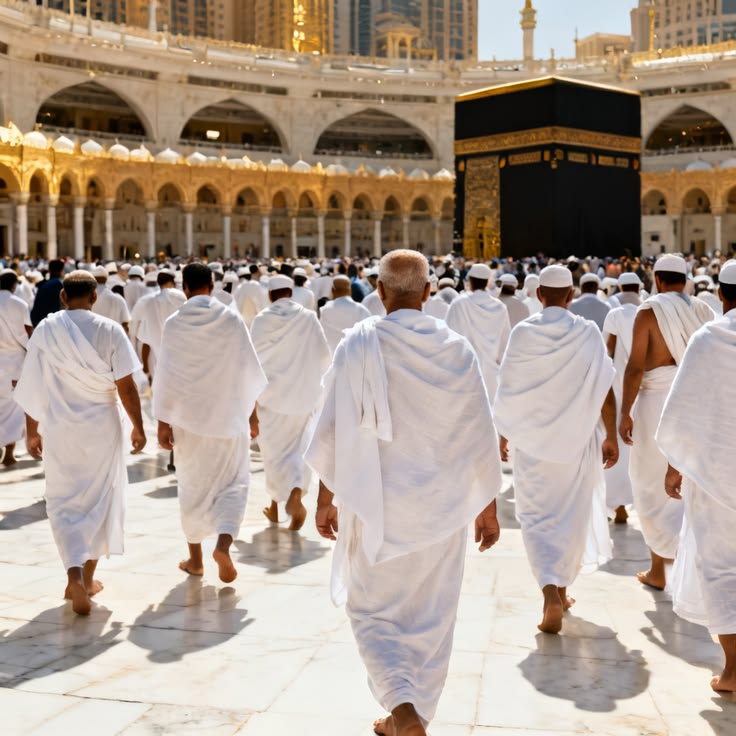
After establishing the Sacred House, Allah commanded Prophet Ibrahim to proclaim Hajj to humanity. The call was universal, inviting people from distant places to come to the Sacred House and fulfill the pilgrimage.
Surah Al-Hajj describes pilgrims coming:
- On foot, traveling long distances to reach Makkah.
- On lean camels, coming from distant roads and regions.
- From different parts of the world, gathering at the Sacred House to worship Allah.
This shows that Hajj is a universal act of worship, bringing Muslims together regardless of their background or place of origin.
The Purpose of Hajj
The Kaaba holds a central place in Muslim worship, and Hajj brings believers together to fulfill an obligation established by Allah. Surah Al-Hajj explains that pilgrims come to witness benefits for themselves and remember Allah during the appointed days.
Hajj is more than a physical journey to Makkah. Its rituals are acts of worship that strengthen a believer’s relationship with Allah. During Hajj, Muslims remember Allah, perform Tawaf, fulfill their vows, observe the sacred rites, and offer sacrifices as an act of obedience.
Lessons from Prophet Ibrahim
The connection between Prophet Ibrahim and Hajj highlights the importance of sincere submission to Allah. His role in establishing the Sacred House and proclaiming the pilgrimage reflects obedience to Allah’s commands and dedication to pure worship.
By performing Hajj, Muslims follow an Abrahamic tradition centered on Tawheed, obedience, sacrifice, and devotion to Allah.
Sacrifice and Taqwa
Sacrifice is another important theme in Surah Al-Hajj. Verses 34–37 explain that sacrificial animals are part of worship and remind believers that the purpose of sacrifice is not simply the act itself, but sincere devotion, gratitude, and obedience to Allah.
The Meaning of Sacrifice in Surah Al-Hajj
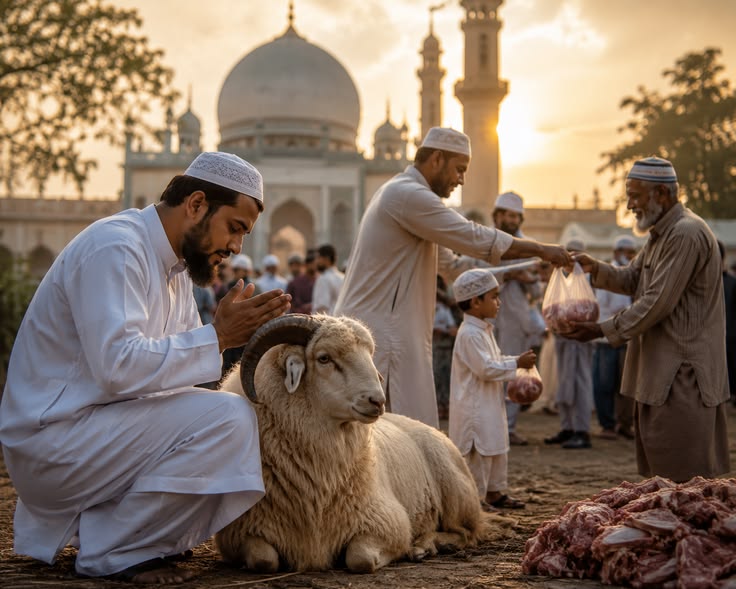
Allah instructs believers to mention His name over the sacrificial animals and to eat from their meat and feed those who are in need. In this way, sacrifice combines worship with gratitude and generosity.
Surah Al-Hajj, verse 37, gives the deeper meaning of this act:
“Neither their meat nor blood reaches Allah. Rather, it is your piety that reaches Him. This is how He has subjected them to you so that you may proclaim the greatness of Allah for what He has guided you to, and give good news to the good-doers.”
(Surah Al-Hajj, 22:37)
The verse makes clear that Allah does not need the meat or blood of the animal. What matters is the Taqwa, sincerity, and obedience behind the sacrifice.
This teaches Muslims that an outward act of worship should always be accompanied by a sincere heart. The sacrifice becomes an expression of gratitude to Allah, obedience to His command, and willingness to give for His sake.
The Story of Prophet Ibrahim and Ismail
The meaning of sacrifice is also connected to the story of Prophet Ibrahim and his son Ismail (peace be upon them). The Quran describes how Ibrahim saw in a dream that he was sacrificing his son and told Ismail about it.
Ismail responded with complete submission:
“O my father, do what you have been commanded. You will find me, if Allah wills, among the steadfast.”
(Surah As-Saffat, 37:102)
When Ibrahim was about to fulfill the command, Allah stopped him and provided a sacrifice instead. The Quran describes this as a great test that Ibrahim successfully passed through his obedience and submission.
This story is closely connected to the meaning of Qurbani during Eid al-Adha. Muslims remember Ibrahim’s willingness to obey Allah and recognize that true sacrifice requires faith, submission, and trust in Allah.
Tawheed and Sincere Worship

Tawheed is another central message of Surah Al-Hajj. The surah repeatedly calls people to worship Allah alone and rejects the worship of idols and false gods.
This theme is closely connected to Hajj and sacrifice. The Sacred House is presented as a place dedicated to the worship of Allah, while the rituals of Hajj are acts of obedience and remembrance directed toward Him.
The surah therefore teaches believers to:
- Worship Allah alone.
- Reject all forms of shirk.
- Keep acts of worship sincere.
- Recognize Allah as the Creator and the only One worthy of worship.
The rituals described in the surah are not simply outward practices. Their true value comes from the believer’s faith, sincerity, and Taqwa.
Striving and Steadfastness
Surah Al-Hajj also addresses the challenges faced by the early Muslim community and grants believers permission to defend themselves against oppression. Alongside this, it emphasizes perseverance, worship, and unity.
Believers are encouraged to:
- Remain steadfast during hardship.
- Defend themselves against oppression.
- Establish prayer and give charity.
- Support one another as a united Muslim community.
- Hold firmly to Allah and His guidance.
Together, these themes show that Surah Al-Hajj is not only about the pilgrimage itself. It connects faith, the Hereafter, Tawheed, Hajj, sacrifice, worship, and steadfastness, reminding Muslims that sincere submission to Allah should shape both their acts of worship and their daily lives.
Final Thoughts on Surah Al-Hajj
Surah Al-Hajj brings together powerful reminders about the purpose of faith and worship. Its descriptions of the Day of Judgment encourage believers to take the Hereafter seriously, while its discussion of Hajj and sacrifice shows that worship is not limited to outward actions.
The surah repeatedly directs attention toward the heart. Whether through honoring Allah’s sacred rites, offering a sacrifice, or responding to His guidance, true worship requires sincerity and Taqwa.
Its message remains deeply relevant: believe in Allah, worship Him sincerely, honor His commands, remain steadfast through trials, and prepare for the day when everyone will return to Him.
Learn Quran and Islamic Studies Online with Areeb Academy
Would you like to understand the Quran beyond simply reading its translation? Areeb Academy offers personalized online Quran and Islamic Studies classes designed to help children and adults build a stronger connection with their faith.
With one-on-one online classes, students can learn at their own pace with qualified teachers and receive guidance suited to their individual level and goals.
Whether you want to improve your Quran recitation, study Tajweed, memorize the Quran, or explore Islamic Studies, Areeb Academy can help you build a consistent and meaningful learning journey.
Book a free trial session with Areeb Academy today and take the next step toward understanding and connecting with the Quran.
Frequently Asked Questions About Surah Al-Hajj
What is Surah Al-Hajj about?
Surah Al-Hajj covers several major themes, including the Day of Judgment, resurrection, Tawheed, Hajj, sacrifice, and sincere worship. It also discusses Prophet Ibrahim’s connection to the Sacred House and the universal call to Hajj.
What does Surah Al-Hajj say about sacrifice?
Surah Al-Hajj explains that Allah does not receive the meat or blood of sacrificial animals. Rather, what reaches Him is the Taqwa of the believer. This teaches that sincerity and God-consciousness are the true purposes behind the act of sacrifice.
What does Surah Al-Hajj say about the Day of Judgment?
The surah opens with a vivid description of the terror of the Final Hour. It also presents signs of resurrection, including human creation and the revival of barren land after rain, reminding people of Allah’s power to bring the dead back to life.
What is the main lesson of Surah Al-Hajj?
One of its central lessons is that true faith requires sincere submission to Allah. The surah connects belief with worship, Taqwa, perseverance, and obedience to Allah’s commands.