
Quran classes for beginners online are live, structured lessons that help you learn the Quran step by step, even with little or no previous experience in Arabic or Quran reading. These classes suit children, adults, and new Muslims who want to read the Quran correctly from the start. Lessons focus on Arabic letters, pronunciation, letter connections, vowels, and basic reading before gradually introducing Tajweed. You learn from home with direct teacher guidance, building confidence through regular practice at a comfortable pace.
If you’ve ever opened a Quran and wished you could read it, or felt you were too old to start or that Arabic sounds were too hard, you’re not alone and you’re not too late.
👉 Want to see how it feels first? Book your free 30-minute trial class with no commitment.
Who Can Join Quran Classes
Anyone can join without being an Arabic speaker or having prior Quran experience. Quran classes for beginners online are especially useful for:
- Adults who never learned Arabic and want to start from the alphabet.
- Children beginning their Quran journey.
- New Muslims seeking to read the Quran and strengthen their connection to it.
- Returning students who studied before but need to rebuild foundations and correct pronunciation.
- Busy learners who need flexible schedules around work, school, or family.
The pace adjusts to the student’s age, current level, and goals. Complete beginners spend more time on letters and pronunciation, while those who already recognize letters can progress faster toward word reading and basic Tajweed.
Starting Quran Classes for Beginners from Zero
You can begin even if you cannot read Arabic at all, because beginner courses are designed for exactly this. Lessons typically start with:
- Recognizing the 28 Arabic letters and their shapes (beginning, middle, and end positions).
- Correct pronunciation of each letter, including basic Makharij (points of articulation).
- Understanding how letters connect to form words.
- Learning short vowels (Fathah, Kasrah, Dammah) and long vowels.
- Practicing simple Arabic words, then Quranic words and short passages.
- Gradually introducing essential Tajweed rules.
Many teachers use Noorani Qaida or a similar structured beginner method. The focus is accuracy and understanding each step before moving forward. With consistent lessons and practice, students progress from individual letters to fluent reading of verses.
Learning Path in Quran Classes for Beginners Online
The early goal is a strong foundation, not speed. Students first master how Arabic letters and vowel signs work and how to pronounce each letter correctly. Once these become familiar, they move into Quran reading and Tajweed.
| Stage | Focus | What it feels like |
|---|---|---|
| 1. Letters | Names, shapes, and sounds | “I recognize the alphabet.” |
| 2. Harakat | Short and long vowels | “I can read letters with sounds.” |
| 3. Connections | Joining letters into words | “I can sound out words.” |
| 4. Quranic words | Simple words and short passages | “I’m reading real Quran.” |
| 5. Basic Tajweed | Core rules applied while reading | “My reading sounds clearer.” |
| 6. Fluent recitation | Longer passages with accuracy | “I read with confidence.” |
A Typical Lesson in Quran Classes for Beginners Online
- Warm-up (5 min): Quick review of the last lesson.
- New skill (15–20 min): The teacher introduces one new letter group, vowel, or rule.
- Guided reading (10 min): You read aloud while the teacher corrects pronunciation in real time.
- Wrap-up (5 min): A short recap and a light practice task.
Focusing on Accuracy
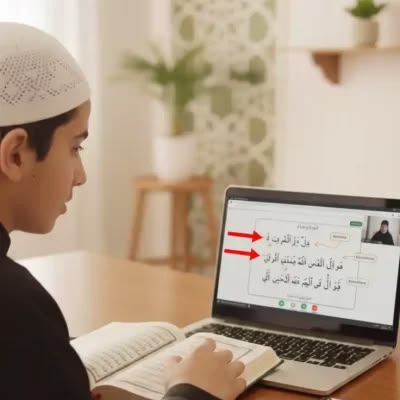
Slow, careful reading is normal at the beginning. Teachers give immediate feedback to prevent incorrect habits, especially with Arabic sounds that do not exist in the student’s native language.
The Role of the Teacher in Quran Classes
In one-to-one lessons the teacher adjusts the pace, corrects pronunciation on the spot, introduces basic Tajweed gradually, and reviews weak areas. This personal guidance is especially helpful for non-Arabic speakers.
Building Fluency Step by Step
Fluency develops through structured lessons, regular correction, and short practice between classes. Progress happens gradually rather than overnight, and each stage prepares you for the next.
Tajweed in Quran Classes
Tajweed is the set of rules that guides correct pronunciation and recitation of the Quran. It is introduced gradually, not all at once, and teachers apply rules directly while you read, so the concepts are easier to understand and remember.
What Tajweed Includes
It covers articulation points (Makharij), letter characteristics, elongation, nasal sounds, and rules for clear, merged, or concealed sounds.
Why Correct Pronunciation Matters
Similar-looking letters (such as ق and ك, or س and ص) have distinct sounds. Early correction stops mistakes from becoming habits.
Basic Tajweed Rules for New Learners
| Rule | What it covers | In simple terms |
|---|---|---|
| Noon Sakinah & Tanween | Izhar, Idgham, Ikhfa, Iqlab | The “n” sound is clear, merged, partially concealed with Ghunnah, or changed to Meem before ب |
| Meem Sakinah | Ikhfa Shafawi, Idgham Shafawi, Izhar Shafawi | How a silent “m” behaves before the next letter |
| Madd | Natural elongation and other types | How long a vowel sound is held |
| Ghunnah | Nasal sound | A correct nasal sound without exaggeration |
Teachers introduce one or two areas at a time using examples from the Quran.
Benefits of Quran Classes for Beginners Online
Online classes remove the need to travel. You learn from a quiet place at home with only a device and stable internet. Key advantages include:
- Flexible scheduling: Lessons fit around work, school, family, or different time zones.
- Personalized pace: Spend time on difficult areas without pressure to keep up with a group.
- Immediate correction: The teacher hears you in real time, demonstrates the correct sound, and has you repeat it.
- One-on-one focus: The entire lesson addresses your needs, questions, and progress.
These features make Quran classes for beginners online practical for busy adults, parents with children, and students living far from traditional centers.
One-on-One vs Group Quran Classes for Beginners Online
When choosing Quran classes for beginners online, the learning format makes a real difference. Both give you a qualified teacher, but the experience differs in how the teacher’s attention is shared.
| One-on-One | Group | |
|---|---|---|
| Teacher attention | Entirely on you | Shared among students |
| Pronunciation correction | Immediate and detailed | More limited |
| Pace | Set by you | Set by the group |
| Scheduling | Highly flexible | Fixed times |
| Best for | Complete beginners, shy adults, specific goals | Confident learners, friends or siblings, children who like a classroom feel |
Which Format Is Better?
For most complete beginners, one-on-one classes are the stronger choice. The early stages involve many small skills that need close guidance and repeated practice. Group classes can still work if you’re confident, already know the alphabet, or prefer learning with others.
👉 Not sure which suits you? Try a free class and talk it through with a teacher.
How Long Do Quran Classes for Beginners Online Take?

There is no single answer, since every student starts from a different point, practices at a different rhythm, and has different goals. Many complete beginners develop basic Quran reading skills over several months of consistent lessons. Becoming comfortable with longer passages and applying Tajweed accurately takes additional time. Instead of asking “how many months?”, ask whether you are improving from one stage to the next.
Factors That Affect Learning Speed
- Starting level: Knowing the alphabet means faster progress.
- Consistency: Regular lessons and short practice help you retain letters, sounds, and patterns.
- Pronunciation challenges: Sounds that don’t exist in your native language need extra time.
- Individual pace: Some students need more repetition, and that is completely normal.
- Quality of feedback: Early, clear correction avoids habits that slow progress later.
- Learning goals: Reading, mastering Tajweed, and memorizing each need different amounts of time.
How Often Should You Take Classes?
Most beginners benefit from two or three lessons per week. That keeps the material fresh without becoming hard to maintain alongside work, school, or family. A busy adult may prefer two solid lessons, while a child or motivated student might manage three. Choose a routine you can keep for months, not just weeks.
Why Regular Practice Matters More Than Long Sessions
Learning to read the Quran involves connected skills: letter recognition, pronunciation, vowels, and eventually Tajweed. When practice is irregular, these fade and you have to relearn the same points. Short, consistent practice works better than occasional long sessions. In Quran classes for beginners online, the combination of live lessons and light home practice produces the most reliable progress.
| Day | Practice (10–15 min) |
|---|---|
| Lesson day | Attend class and note tricky letters |
| Day after | Re-read the lesson page aloud |
| Mid-week | Repeat difficult sounds slowly |
| Before next lesson | Quick review of everything covered |
Common Mistakes to Avoid

Starting Quran classes for beginners online is exciting, but certain habits can slow progress. Most come from good intentions: wanting to move fast, practicing alone, or measuring success the wrong way.
1. Trying to learn too quickly. Rushing from the alphabet to full pages leaves gaps in letter recognition and pronunciation that are harder to fix later. Master each skill before moving on. Progress that feels slower at first usually leads to faster, more accurate reading.
2. Practicing without teacher feedback. Some Arabic letters have no equivalent in other languages, so you can repeat a sound many times and still produce it incorrectly. A live teacher hears the exact mistake, demonstrates the correct sound, and corrects it before it becomes automatic.
3. Ignoring revision between classes. Without short review, letters and vowel patterns fade, and the next lesson becomes a repeat of the last one. Even 10–15 minutes a few times a week keeps each class productive.
What You Need to Start Quran Classes for Beginners Online
- A phone, tablet, or computer with a camera and microphone
- A stable internet connection and a quiet spot at home
- A video platform such as Zoom
- A Quran and the beginner material your teacher provides, such as Noorani Qaida
Your teacher tracks progress lesson by lesson so you always know your stage and what comes next.
Why Choose Areeb Academy for Quran Classes for Beginners Online
Starting as a beginner doesn’t require prior Arabic knowledge or Quran experience. What matters is the right starting point, a clear learning path, and consistent practice that fits your life. At Areeb Academy, we designed our Quran classes for beginners online to make this simple and effective:
- Fully one-on-one lessons so the teacher focuses only on you
- Native Arabic-speaking teachers who also communicate clearly in English
- Personalized learning that matches your level, pace, and goals
- Flexible schedules around work, school, or family
- Choice of male or female teachers
Start with a free 30-minute trial class. Meet the teacher, experience the teaching style, and see the quality of the lessons before deciding, with no commitment.
👉 Book your free trial today and take the first step toward confident Quran reading.
Frequently Asked Questions About Quran Classes for Beginners Online
1. Can I learn if I cannot read Arabic?
Yes. Lessons begin with the alphabet and build reading skills gradually, so no prior Arabic is needed.
2. How long do Quran classes for beginners online take?
It varies by starting level, practice, and goals. Basic skills often develop over several months with consistent effort.
3. How often should I take classes?
Many beginners benefit from two or three lessons per week plus short practice between them. Choose a schedule you can maintain.
4. Can adults start from the beginning?
Yes. Lessons adapt to your current ability and schedule at any age, and one-on-one lessons remove the pressure of reading in front of a group.
5. Can children take beginner classes online?
Yes. Lessons are adjusted for age, attention span, and ability, usually starting with the Arabic alphabet and Noorani Qaida.
6. Do I need to know Arabic first?
No. You can learn to read the Quran without speaking Arabic. Separate Arabic study can later help with understanding the meaning.
7. Can I choose a male or female teacher?
Yes. You can choose the teacher you feel most comfortable with, and we match you by preference, level, and availability.
8. What happens in the trial class?
The teacher assesses your level and goals, you experience the lesson style, and together you discuss a suitable plan, with no obligation.
9. Are classes one-on-one?
Yes. Every lesson is private, so the full session focuses on your pronunciation, questions, and progress.
10. Can beginners learn Tajweed?
Yes. Rules are introduced gradually according to your reading level, so you learn them as you read.