
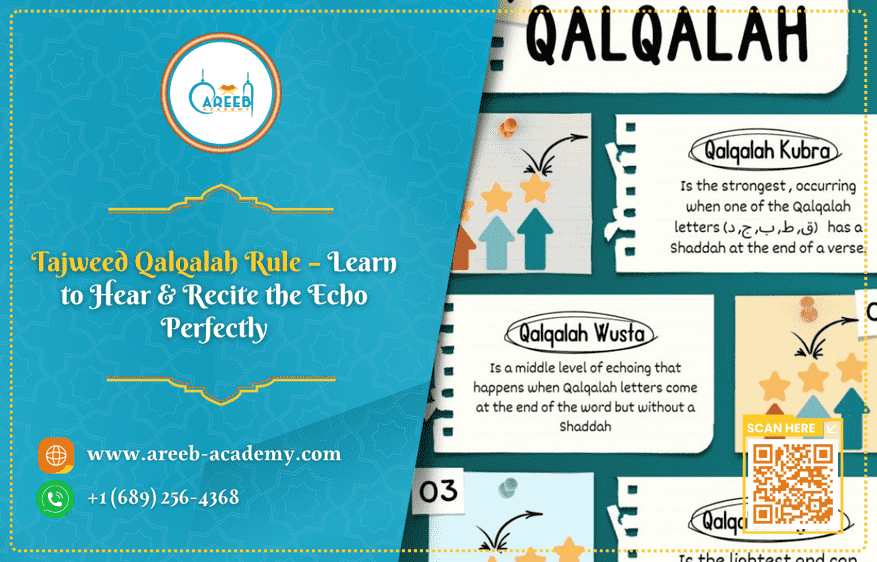
Mastering Tajweed Qalqalah rule is essential for anyone who wants to recite the Quran clearly and beautifully. This unique rule focuses on producing a subtle echo or bounce on five specific letters (ق، ط، ب، ج، د) when they are silent or stopped upon. Proper application of Qalqalah ensures that your recitation is accurate, distinct, and melodious, preserving the true rhythm and meaning of the Quran. Whether you are a beginner or advancing your Tajweed skills, understanding Qalqalah is a crucial step toward perfect pronunciation and fluency.
What Is the Tajweed Qalqalah Rule?
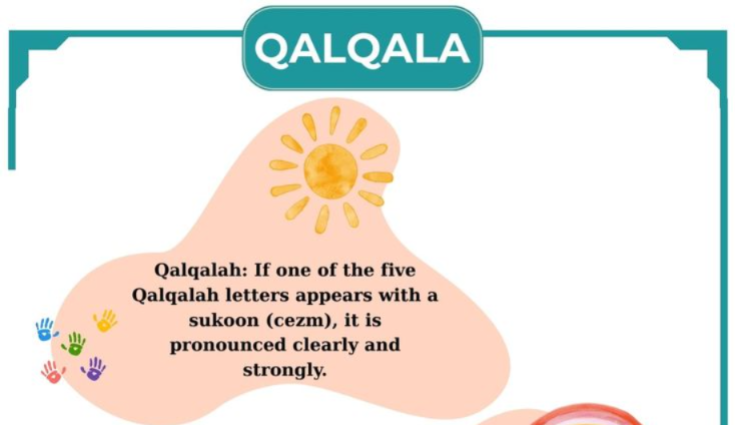
The Tajweed Qalqalah rule is one of the essential rules of Quran recitation. In simple terms, it refers to producing a slight echoing or bouncing sound when pronouncing specific Arabic letters that carry a Sukoon (ْ).
As a result, this rule ensures that these letters are clear, distinct, and not swallowed during recitation. Without it, these naturally strong consonants may sound unclear or incomplete if they are not properly released.
In particular, Qalqalah applies to five letters:
ق، ط، ب، ج، د — commonly remembered as “Qutb Jadd” (قطبجد).
Furthermore, understanding when to apply this rule is just as important as knowing the letters themselves.
Definition of Qalqalah
Qalqalah (قلقلة) in Tajweed is defined as:

A slight vibration, bounce, or echoing sound produced when pronouncing one of the five Qalqalah letters in a state of Sukoon.
Linguistically, the word Qalqalah means disturbance, shaking, or vibration—which perfectly describes how the sound is released during recitation.
In practice, this means that instead of letting the letter sound flat or silent, the reciter gives it a controlled “bounce” to make it audible and clear.
What Does “Echo” Mean in Tajweed?
The term “echo” in Tajweed does not mean adding a new vowel sound. Instead, it refers to a quick, subtle release of sound from the articulation point of the letter.
It happens because:
- The letter is sakin (no vowel)
- Air pressure builds up when pronouncing it
- The sound is then released slightly, creating a bounce
⚠️ Important clarification:
- It is NOT a full vowel (not “a”, “i”, or “u”)
- It is just a brief vibration that makes the letter audible
For example:
- Without Qalqalah → the letter may sound cut off or unclear
- With Qalqalah → the letter sounds sharp, clear, and distinct
In addition, understanding related rules such as Noon Sakinah helps you develop a deeper awareness of how sounds interact in Tajweed.
Why Qalqalah Is Important in Quran Recitation
Qalqalah plays a crucial role in maintaining the clarity, accuracy, and beauty of Quran recitation.
Here’s why it matters:
1. Preserves Correct Pronunciation
However, without Qalqalah, letters like ب or د can become unclear or even completely muted, which may affect the meaning.
2. Prevents Sound “Swallowing”
It ensures that sakin letters are not lost in the flow of recitation.
3. Enhances Clarity and Fluency
The slight echo makes the recitation more balanced and easier to understand.
4. Reflects Proper Tajweed Application
Moreover, applying Qalqalah correctly shows a strong understanding of Tajweed rules and improves overall recitation quality.
5. Adds Beauty to Recitation
That subtle bounce gives Quran recitation its distinct rhythmic and melodic flow.
Similarly, mastering other Tajweed rules like Meem Sakinah also plays a key role in improving clarity and fluency in recitation.
Letters of Qalqalah (قطب جد)
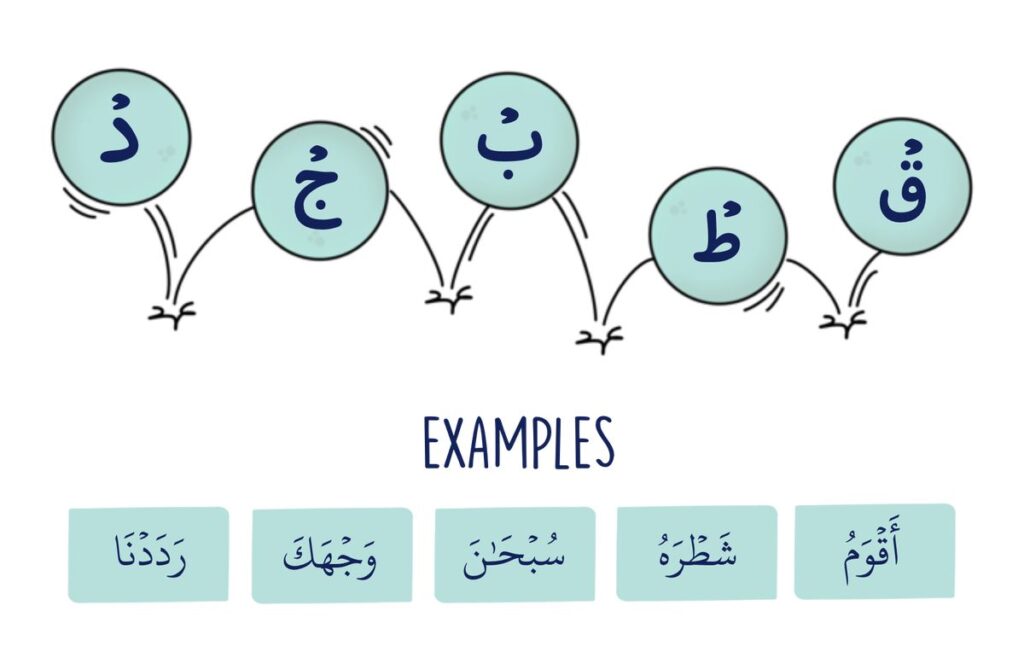
The Five Qalqalah Letters
The five letters of Qalqalah are the core of this Tajweed rule. Firstly, let’s look at each letter and how it is pronounced:
- ق (Qaaf) – Produced from the back of the tongue.
For example: الْحَقُّ (al-ḥaqq) – strong bounce when stopping. - ط (Taa’) – Comes from the front part of the tongue with emphasis.
Similarly, it requires a firm but controlled release.
Example: وَالطَّارِقِ (waṭ-ṭāriq) – clean, noticeable bounce. - ب (Baa’) – A labial letter pronounced by bringing the lips together.
Example: تَبَّتْ (tabbat) – soft, subtle pop. - ج (Jeem) – Middle of the tongue touches the roof of the mouth.
Example: يَجْعَلُونَ (yaj‘alūna) – clear echo in the middle of the word. - د (Daal) – Produced from the tip of the tongue near the teeth.
Therefore, it gives a sharp and crisp sound when paused on.
Example: أَحَدْ (aḥad) – strong, clear bounce.
Overall, these letters share one key trait: they “bounce” when in a Sukoon state or when stopping at the end of a word. Because of this, they play a major role in giving the Quran its distinct rhythm and clarity.
Easy Way to Remember (Qutb Jad)
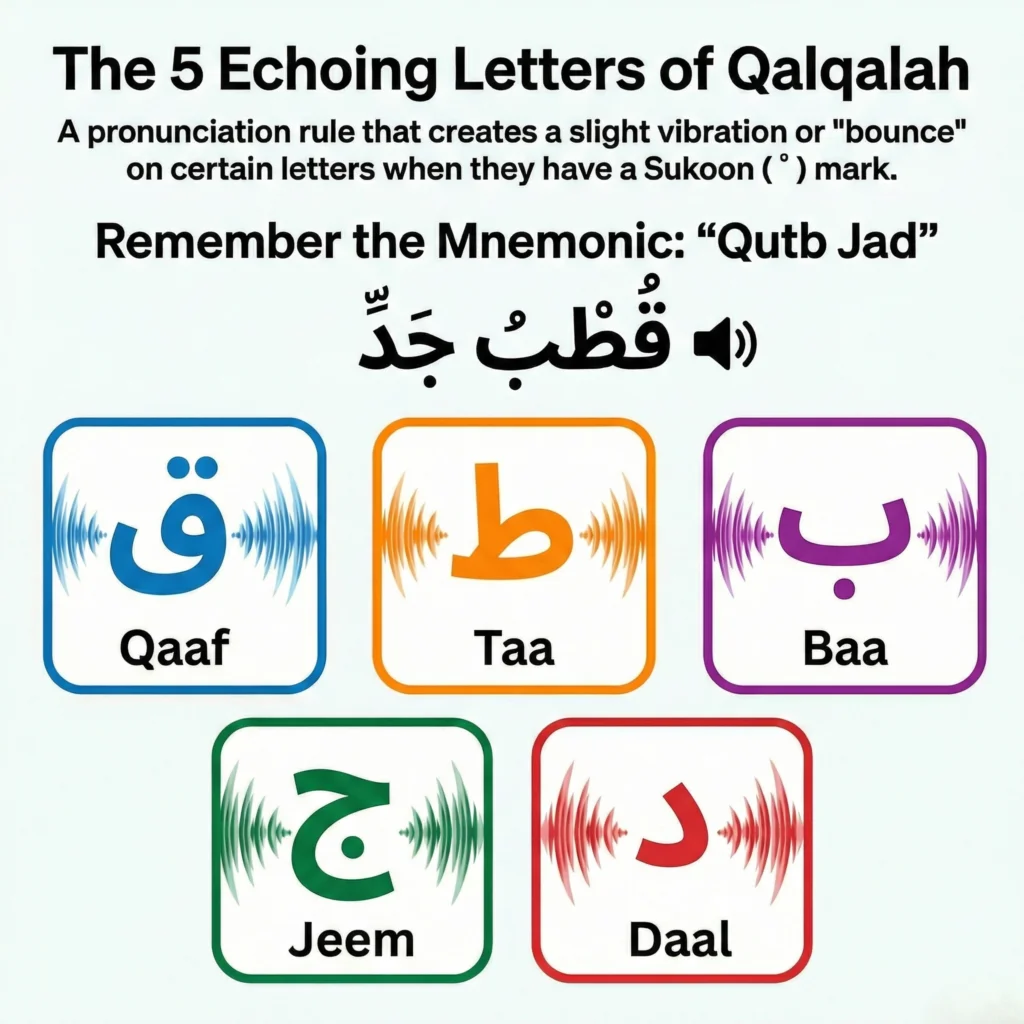
To help memorization, scholars combined these five letters into the mnemonic:
قُطْبُ جَدّ – Qutb Jadd
- ق (Qaaf)
- ط (Taa)
- ب (Baa)
- ج (Jeem)
- د (Daal)
Repeating this phrase while practicing makes recognizing Qalqalah letters easier and faster during recitation.
How These Letters Produce the Echo Sound
The “echo” in Qalqalah is a quick, bouncing release of sound without adding a vowel or moving the mouth/jaw excessively.
It occurs in two main scenarios:
- Middle of a word (Qalqalah Sughra – Minor Echo)
- When the letter has a natural Sukoon inside a word.
- Example: يَقْتُلُونَ (yaqtulūn) – gentle, subtle bounce.
- End of a word (Qalqalah Wusta & Kubra – Medium & Strong Echo)
- Medium (Wusta): Letter ends a word; stopping produces a temporary Sukoon.
Example: الْفَلَقْ (al-falaq) – medium-strength echo. - Strongest (Kubra): Letter ends a word with a Shaddah (ّ); stopping amplifies the bounce.
Example: الْحَقّ (al-ḥaqq) – strong, clear echo.
- Medium (Wusta): Letter ends a word; stopping produces a temporary Sukoon.
Key Tips for Pronunciation:
- Keep the echo short and crisp – don’t turn it into a vowel.
- Feel the bounce from the tongue or lips according to the letter’s articulation point.
- Listening to skilled Qaris helps internalize the subtle vibration.
Types of Qalqalah in Tajweed
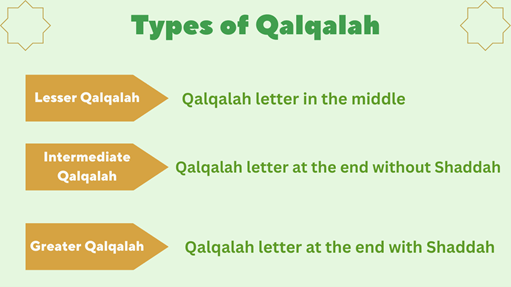
Qalqalah Sughra (Minor Echo)
- Occurrence: In the middle of a word or sentence, not at the end.
- Sound: Gentle, subtle, quick bounce.
- Examples:
- يَجْعَلُونَ (Yaj’aloona)
- أَبْصَرَ (Absara)
- يَقْطَعُ (Yaqta’u)
- Intensity: Weak / Light
- Practice Tip: Recite slowly, make the bounce audible but soft. Avoid overemphasis.
Al-Qalqalah Al-Mutawassita (Medium Echo)
- Occurrence: Near the end of a word, close to a pause but not fully at the end.
- Sound: Distinctive, moderate bounce — stronger than Sughra but softer than Kubra.
- Examples:
- ق in يَأْقَم
- د in تَعْدِل
- Practice Tip: Tap the sound noticeably, but don’t exaggerate; this is the “just right” bounce.
Qalqalah Kubra (Major Echo)
- Occurrence: At the end of a word or verse with a full stop (waqf).
- Sound: Strong, firm, clear, resonant bounce. Intensified if the letter has a shaddah (ّ).
- Examples:
- الْفَلَقِ (Al-Falaq)
- أَحَدٌ (Ahad)
- مُحِيطٌ (Muheet)
- Intensity: Strongest
- Practice Tip: Imagine a firm drumbeat — clear, natural bounce without forcing it.
How to Pronounce Qalqalah Correctly Based on The Tajweed Rule

First, identify if the letter is one of the five Qalqalah letters: ق، ط، ب، ج، د. Then, check if it carries a Sukoon (ْ) or if you stop at the end of a word.
Next, position your articulation point correctly and produce a small bouncing release without adding a vowel.
The bounce should be light inside a word, medium at word-end, and strong when stopping with shaddah. Finally, practice with short surahs, focusing on each Qalqalah letter, to make your recitation clear and precise.
Step-by-Step Pronunciation Guide
- Understand the Letters – The Qalqalah letters are:
ق (Qaf), ط (Ta), ب (Ba), ج (Jeem), د (Dal)- Mnemonic: قُطْبُ جَد helps remember them.
- Identify the Sukoon – Qalqalah applies when these letters have a sukoon (ْ) or when pausing on them at the end of a word.
- Position Your Articulation Points –
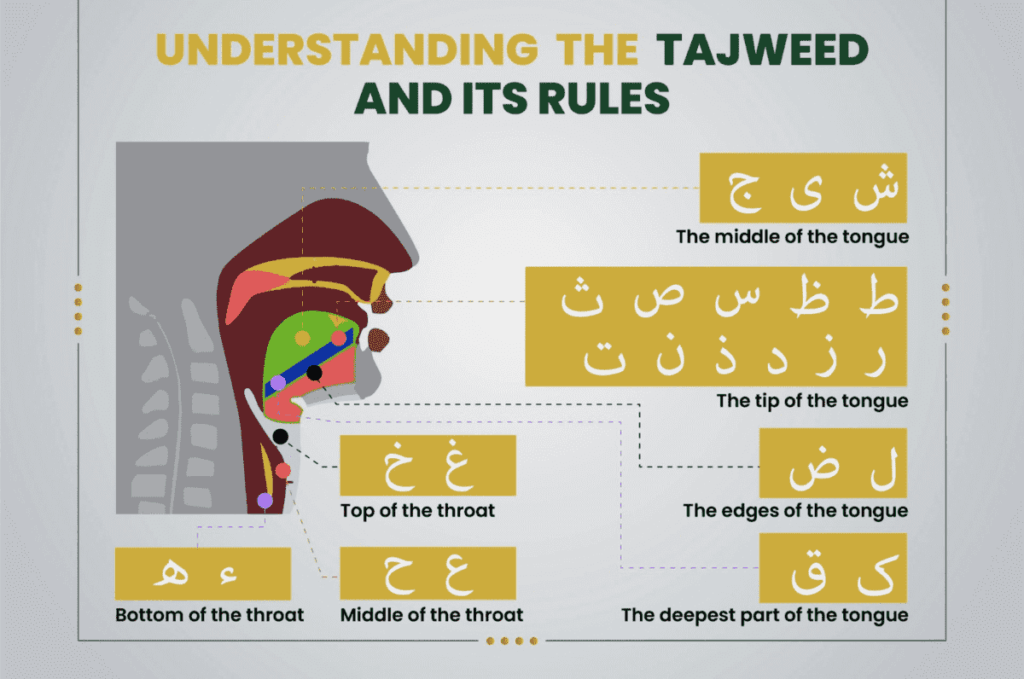
- ق – back of tongue touches the soft palate
- ط – tip of tongue touches upper gums
- ب – lips pressed firmly
- ج – middle of tongue touches the roof of the mouth
- د – tip of tongue touches upper gums
- Produce the Bounce – Release the articulation point briefly to create a short, sharp echo without adding any vowel sound.
- Practice with Words and Verses – Start with single words (e.g., يَقْضِي, أَقْدَام), then progress to phrases and full verses for natural application.
The “Bounce” Without Adding a Vowel
- Key Rule: Avoid turning the Qalqalah letter into a vowel sound.
- ❌ Incorrect: Adding an “a” sound after ب → saying “baba” instead of “bab”.
- ✅ Correct: Produce a short, abrupt echo — no elongation.
- Think of it like a light tap or bounce: sharp, clear, but not forced.
Common Pronunciation Mistakes
- Adding a vowel – Turns the Qalqalah into a “fa” or “ba” sound.
- Over-bouncing – Making the echo too strong sounds artificial.
- Weak or muted Qalqalah – Letter must be audible; don’t just stop on it without a bounce.
- Ignoring medium positions (Mutawassita) – Only applying Kubra leads to flat recitation.
- Rushing recitation – Skipping the bounce reduces clarity.
- Incorrect tongue or throat placement – Distorts the echo.
- Practicing letters in isolation only – Without words and verses, application is incomplete.
Examples of Qalqalah Tajweed Rule from the Quran
Examples of Qalqalah Sughra (Minor Echo – Middle of Word)
Occurs when the Qalqalah letter has a sukoon in the middle of a word. The echo is light and subtle.
Examples:
- نَخْلُقْكُمْ (Nakhluqkum) – Surah Al-Mursalat (77:20)
- يَجْعَلُونَ (Yaj‘alūna) – Mid-verse
- قَدْ أَفْلَحَ (Qad aflaḥa) – Surah Al-Mu’minun (23:1)
- نُطْعِم (Nut‘im)
- بِعِجْلٍ (Bi‘ijl)
- أَقْسِمُ (Aqsimu)
Tip: Lightly “bounce” the letter without adding any vowel or elongation.
Examples of Qalqalah Kubra (Major Echo – End of Verse/Pause)
Occurs when stopping on a Qalqalah letter at the end of a word or ayah. The echo is strong and clear, especially if the letter has a shaddah.
Examples:
- وَتَبَّ (Wa tabb) – Surah Al-Masad (111:1)
- أَحَدٌ (Aḥad) – Surah Al-Ikhlas (112:1)
- غَاسِقٍ إِذَا وَقَبْ (Waqab) – Surah Al-Falaq (113:3)
- الْحَقُّ (Al-Ḥaqq) – End of verse
- تَبَّتْ يَدَا أَبِي لَهَبٍ وَتَبَّ – Surah Al-Masad (111:1–2)
Tip: At the end of a pause, produce a firm bounce without adding a vowel or connecting it to the next word.
Practice Tajweed Qalqalah Rule for Beginners
To internalize Qalqalah, try practicing these words with proper echo:
| Letter | Example Word | Type |
|---|---|---|
| ق | خَلَقَ (Khalaqa) | Sughra / Kubra depending on position |
| ط | مُحِيطٌ (Muḥīṭ) | Sughra / Kubra |
| ب | كَسَبَ (Kasaba) | Sughra / Kubra |
| ج | مَجْرَاهَا (Majrāhā) | Sughra / Kubra |
| د | يَدَا (Yadā) | Kubra at end of verse |
Practice Tips:
- Identify the Qalqalah letters in a verse.
- Check if the letter has sukoon or occurs at the end of a word/ayah.
- Apply the correct bounce intensity:
- Sughra: Light, subtle
- Kubra: Strong, firm
- Avoid adding vowel sounds (“fa” or “a”) after the letter.
- Repeat daily and record your recitation to check clarity.
Tajweed Qalqalah Rule Chart (Quick Summary)
Quick Table for Easy Revision
| Type | When it Occurs | Strength | Example | Qalqalah Letter |
|---|---|---|---|---|
| صغرى (Minor / Sughra) | Middle of word, sukun | Light / Quick | يَقْطَعُونَ | ق |
| وسطى (Medium / Wusta) | End of word, without shaddah, continuation | Moderate | الْفَلَقِ | ق |
| كبرى (Major / Kubra) | End of word, stop (waqf) | Strong / Deep | الْحَقْ | ق |
| كبرى جداً (Strongest) | End of word with shaddah + stop | Very Strong | وَتَبَّ | ب |
Key Points:
- Five Qalqalah Letters: ق ط ب ج د (memorize as قُطْبُ جَدٍ)
- Always check sukun (ْ) or waqf at the end of the word.
- The echo is a short percussive bounce; do not add a vowel.
- Strength depends on position + stopping + shaddah.
How to Memorize Qalqalah Fast

Step 1 – Learn the Letters
Memorize the phrase: قُطْبُ جَدٍ → Qāf, Ṭā’, Bā’, Jīm, Dāl
Step 2 – Identify sukun
Check if the letter has a ْ (silent) or if you are stopping on it. Only then Qalqalah applies.
Step 3 – Practice Bounce
- Minor (middle of word): light, subtle
- Medium (end without stop): moderate bounce
- Major (end + stop): strong, clear
- Strongest (end + shaddah + stop): very strong
Approach 4 – Drill & Repeat

- Start with single letters: بْ → short pop
- Single words: يَدْ → stop and bounce
- Inside words: اِقْتِرَاب → light internal bounce
- Record yourself → check: no added vowel, clear bounce
Step 5 – Apply in Quranic Reading
- Stop at the end of ayah → Major Qalqalah
- Continue mid-verse → Minor Qalqalah
- Use shaddah correctly → Strongest Qalqalah
Common Mistakes in Tajweed Qalqalah Rule

Even though Qalqalah is simple to learn, many beginners make mistakes. For instance, some add extra vowels, which changes the sound. Additionally, others produce a weak or missing echo, making the letters unclear. On the other hand, over-exaggerating the bounce can make recitation choppy and unnatural.
Adding Extra Vowels (Wrong!)
What Happens:
- Reciter accidentally adds a vowel sound (a, u, i) to the qalqalah letter.
- Example: تَبَّتْ → pronounced tabba instead of tabbْ.
- This changes the sound and breaks the rule.
How to Fix:
- Focus on silent stop (sukūn) → don’t vocalize the letter.
- Practice holding the letter briefly at its articulation point, then release with a short bounce.
- Record yourself → ensure no extra vowel is added.
Example:
✅ Correct: wa-tabbْ (clear pop of ب)
❌ Incorrect: wa-tabba (added vowel “a”)
Weak or Missing Echo Sound
What Happens:
- The qalqalah letter becomes almost silent, especially in minor qalqalah inside words.
- Example: اِقْتِرَاب → the قْ has no bounce → sounds flat.
How to Fix:
- Emphasize the release of pressure at the articulation point (makhraj).
- Practice with single letters first → بْ, دْ, قْ → short bounce.
- Gradually move to words and phrases, maintaining the audible echo.
Example:
✅ Correct: iqtirāb → small bounce on قْ
❌ Incorrect: iqtirab → no audible echo
Over-Exaggerating the Bounce
What Happens:
- Reciter makes the bounce too long or strong, giving a choppy or unnatural sound.
- Example: الْحَقْ → prolonged “q” instead of a quick pop.
How to Fix:
- Aim for a brief percussive bounce, not a full stress.
- Adjust strength according to position:
- Minor (middle of word) → subtle
- Major (end + stop) → strong
- Strongest (shaddah + stop) → firm but short
- Practice with recording to find the right duration.
Example:
✅ Correct: al-ḥaqqْ → firm, short echo
❌ Incorrect: al-ḥaqqq → too prolonged
Tips to Master the Tajweed Qalqalah Rule

Practice with Short Surahs (Like Al-Ikhlas):
First, start with small surahs to identify the Qalqalah letters clearly. For example, in اللَّهُ الصَّمَدْ, stop at دْ and practice the minor or major bounce. Then, repeat slowly, focusing on each Qalqalah letter both in isolation and within the context of the word. Finally, gradually connect the letters to the next words while maintaining the correct echo, so your recitation becomes smooth and precise.
Listen and Repeat Technique:
- Use Quran recitations from qualified reciters.
- Pause after each qalqalah letter → repeat the bounce aloud.
- Compare your recording with the original to ensure correct strength and duration.
Learn with a Qualified Tajweed Teacher
- A teacher can correct subtle mistakes, like adding vowels or over-bouncing.
- They help with articulation points (makhārij) and advanced nuances like qalqalah with shaddah.
- Personalized guidance accelerates mastery and prevents forming bad habits.
If you want to take your recitation to the next level, you can also explore our Online Tajweed lessons in English designed for beginners and advanced learners.
Start with Single Letters and Words
- Practice individual letters بْ، دْ، قْ، جْ، طْ first → then move to words like يَدْ, تَبَّتْ.
- Helps train your lips, tongue, and airflow to produce the correct echo naturally.
Gradual Progression (Minor → Major → Strongest)
First, begin with minor Qalqalah inside words to get comfortable with the subtle bounce. Next, practice medium Qalqalah at the end of words without stopping. Finally, focus on the strongest Qalqalah by stopping on letters with shaddah, producing a clear, strong echo. By following this step-by-step progression, you gradually build muscle memory and confidence for each scenario.
Use Recording for Self-Evaluation
- Record yourself reading short passages with multiple qalqalah letters.
- Check for:
- Missing or weak bounce
- Extra vowels
- Over-exaggeration
- Self-review ensures consistent improvement before advancing to longer surahs.
Final Thoughts on Tajweed Qalqalah Rule
By practicing Qalqalah consistently, you can gradually improve your Qur’an recitation. Firstly, start with short surahs to get used to the subtle bounce of each letter. Then, listen carefully and repeat after a qualified teacher or recording to internalize the correct echo. Next, work progressively from minor to strong echoes, ensuring that you maintain clarity without adding extra vowels. Additionally, focus on controlling the bounce so that the letters remain distinct and melodic. Finally, with patience and daily practice, even complex rules will become second nature, allowing your recitation to reflect the elegance and depth of the Arabic language.
Join Areeb Academy Today!
At Areeb Academy, our native Arabic-speaking teachers who speak fluent English guide you one-on-one, making learning easy and interactive. Our flexible schedules ensure that both children and adults can join without stress, and every session is personalized to your pace and level.
Start your Tajweed journey with us today and experience the joy of perfect Qur’an recitation.
FAQs About Tajweed Qalqalah Rule
1. What is the Tajweed Qalqalah rule in simple terms?
Simply put, Qalqalah is a slight echo or bounce sound produced when pronouncing specific letters with sukoon. In other words, it helps make these letters clear instead of sounding cut off.
2. When should I apply Qalqalah while reciting the Quran?
Generally, Qalqalah is applied when one of its letters has a sukoon or when you stop at the end of a word containing it. Therefore, always check the letter’s position before applying the bounce.
3. What are the five Qalqalah letters?
Firstly, you need to memorize the five letters: ق، ط، ب، ج، د. Additionally, they are commonly remembered using the phrase “Qutb Jadd” (قطب جد) to make learning easier.
4. What is the most common mistake in Qalqalah?
One of the most common mistakes is adding a vowel sound after the letter. For example, turning “بْ” into “ba.” Instead, the sound should remain short and sharp without any extra vowel.
5. How can I improve my Qalqalah pronunciation?
To improve, practice regularly using short surahs and listen to skilled reciters. Moreover, recording yourself can help you notice mistakes and refine your pronunciation over time.