
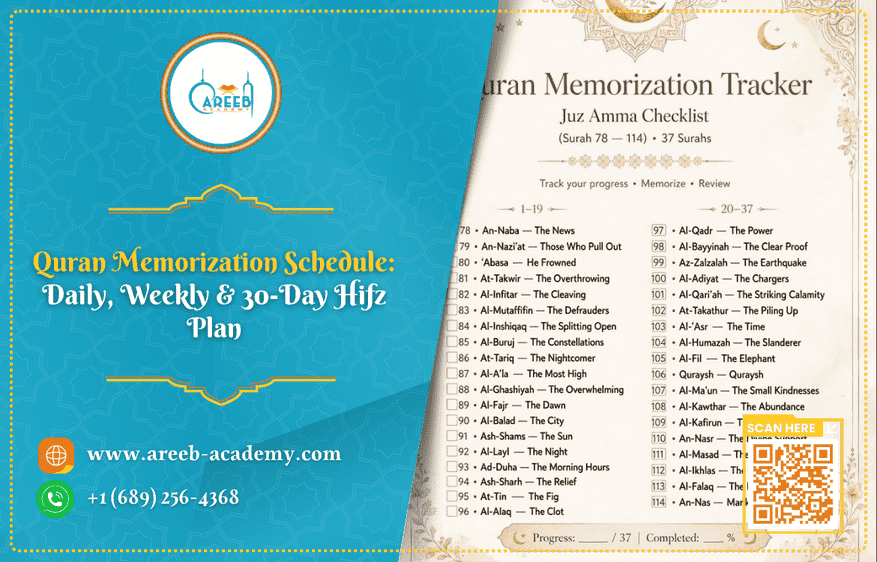
Building a Quran memorization schedule you can actually follow is the best way to stay consistent with Hifz, even when work, school, and family compete for your time. Many learners memorize new verses with energy, then struggle to remember them a few weeks later.
A clear plan tells you what to memorize, what to review, and when, so you can stop guessing and build a lasting habit.
In this guide, you will learn how to create a realistic schedule step by step. You will also find sample daily, weekly, and 30-day routines, plans for kids and adults, and practical ways to balance new memorization with revision, whether you are starting with Juz Amma or working toward completing Hifz.
Why You Need a Quran Memorization Schedule
Without a plan, it is easy to memorize new verses and forget the old ones. A schedule helps you in four ways:
- Consistency: A fixed time and goal turn memorization into a habit. Even 10–15 minutes a day works as a starting point.
- Balance: It gives revision the same importance as new memorization.
- Realistic goals: Small daily targets add up over weeks and months, and they are easier to keep when life gets busy.
- Clear progress: You always know what you have learned and what needs attention.
Successful Hifz is not about memorizing as much as possible in one sitting. It is about a sustainable routine that helps you memorize accurately and retain what you learn.
The Quran itself reminds us that memorizing it is within reach: (وَلَقَدْ يَسَّرْنَا الْقُرْآنَ لِلذِّكْرِ فَهَلْ مِن مُّدَّكِرٍ) (Surah Al-Qamar, 54:17), meaning: “And We have certainly made the Quran easy for remembrance, so is there anyone who will remember?”
And the Prophet ﷺ taught that “the most beloved deeds to Allah are those done consistently, even if they are small” (Sahih al-Bukhari 6464, Sahih Muslim 783). This is exactly why a steady schedule matters more than a burst of motivation.
How to Create a Quran Memorization Schedule in 6 Steps
Step 1: Assess your level. Can you read Arabic fluently? Do you know basic Tajweed? How much time do you have, and how well do you retain verses? If you still struggle with Arabic letters, strengthen your reading first.
Step 2: Set a realistic goal. Define a long-term goal (a Juz or the whole Quran), a monthly goal, and a daily goal. Separate your ideal target from your minimum commitment, so you can keep going on tired or busy days.
Allah says: (فَاقْرَءُوا مَا تَيَسَّرَ مِنْهُ) (Surah Al-Muzzammil, 73:20), meaning: “So recite what is easy for you of it.” This verse is a gentle reminder that your minimum commitment on a tired or busy day still counts. Keep a small target you can always meet, and let your ideal target be the bonus.
Step 3: Choose a consistent time. Many learners prefer after Fajr, when it is quiet and the mind is fresh. Others do better after Maghrib or Isha. The best time is the one you can protect every day.
Step 4: Decide your daily amount. Use these as flexible starting points:
| Pace | Daily target | Best for |
|---|---|---|
| Gentle | 1–3 verses | Beginners, young children |
| Moderate | 3–5 lines | Building a habit |
| Steady | About half a page | Fluent readers with revision time |
| Intensive | One page or more | Experienced learners with lots of time |
Increase your target only when you can recall yesterday’s portion accurately. On busy days, reduce new memorization and focus on revision instead of skipping altogether.
The Quran was revealed gradually, not all at once: (وَقُرْآنًا فَرَقْنَاهُ لِتَقْرَأَهُ عَلَى النَّاسِ عَلَىٰ مُكْثٍ) (Surah Al-Isra, 17:106), meaning: “And [it is] a Quran which We have separated [into parts] so that you may recite it to the people over a prolonged period.” Following the same pattern, break your Hifz into small portions and take your time with each one.
Step 5: Include daily and weekly revision. Review recent lessons before learning anything new. Rotate through older passages during the week. Set aside one day to consolidate and fix weak spots.
Step 6: Track and adjust. Record the date, new memorization, revision, and difficult verses. A notebook or simple spreadsheet is enough. Review it weekly and adjust your pace.
The Three Parts of a Hifz Session: Sabaq, Sabqi, and Manzil
Every good Quran memorization schedule is built on three parts:
- Sabaq (new memorization): the verses you are learning today.
- Sabqi (recent revision): what you memorized over the past few days.
- Manzil (older revision): previously memorized portions, revisited on a planned rotation.
A common guideline is to spend about two-thirds of your time on revision and one-third on new material once you have a substantial amount memorized. Beginners can spend more time on new verses. If you keep forgetting recent lessons, pause new memorization and focus on revision until your recall is secure. That is not failure, it is protecting your foundation.
The Prophet ﷺ stressed the importance of revision when he said: “Keep refreshing your memory of the Quran, for by Him in whose hand is my soul, it escapes faster than camels from their ropes” (Sahih al-Bukhari 5033, Sahih Muslim 791). This is why revision deserves the same priority as new memorization in every session.
Daily Quran Memorization Schedule for Beginners
🕐15-minute routine
- Minutes 1–3: Listen to a reliable reciter while following the Mushaf.
- Minutes 4–9: Read the verse aloud, then try reciting it without looking.
- Minutes 10–13: Repeat from memory and correct mistakes.
- Minutes 14–15: Recite once more and connect it to previous verses.
🕐 30-minute routine
- 15 minutes: new memorization
- 10 minutes: recent revision
- 5 minutes: older revision
🕐 60-minute routine
- 25 minutes: new memorization (Sabaq)
- 15 minutes: recent revision (Sabqi)
- 15 minutes: older revision (Manzil)
- 5 minutes: final recitation and progress notes
You do not need to memorize a full page just because you have an hour. If you make frequent mistakes, reduce the new portion and use the extra time for revision.
Sample Daily Timetable
- After Fajr (15–20 minutes): Learn new verses. Listen first, read aloud, memorize in small sections, then test yourself without the Mushaf.
- During the day (5–15 minutes): Recite the morning lesson from memory. Check the Mushaf afterward.
- After Maghrib (10–15 minutes): Practice the day’s verses, mark difficult ones, and revise older passages.
- Before bed (5–10 minutes): Recite once more and note what to review tomorrow. If you are too tired, listening is a fine alternative.
Listening to audio helps, but it should support active recitation, not replace it.
Weekly Quran Memorization Schedule
| Day | Focus |
|---|---|
| Monday–Thursday | New memorization plus daily revision |
| Friday | Review previously memorized surahs and weak passages |
| Saturday | Recitation assessment, ideally with a teacher |
| Sunday | Light revision and planning next week’s goals |
Swap days to suit your routine. Use Saturday’s assessment to decide your next step: continue at the same pace if your recitation is accurate, or add more revision if you keep forgetting certain verses.
30-Day Plan for Beginners (Starting from Juz Amma)
Juz Amma is a popular starting point because it has many short surahs, some of which you may already know from Salah. Many learners begin with An-Nas and work backward toward An-Naba. Treat this plan as a guide, not a deadline.
- Week 1: Build the habit. Pick a fixed time, start with a short surah, listen and repeat, and review daily.
- Week 2: Add more short surahs. Split each session into new memorization, recent revision, and earlier revision.
- Week 3: Strengthen Tajweed. Practice difficult verses separately, connect verses smoothly, and get feedback from a teacher. For practical tips and a simple daily routine, see How to Improve Quran Recitation: 9 Tips + 25-minute Daily Routine.
- Week 4: Review and test. Spend days 22–26 reviewing and fixing weak passages. Recite everything in sequence on day 27, get assessed on day 28, and plan next month on day 30.
Some learners finish Juz Amma in two or three months, others need longer. Move to longer surahs when you can recite recent lessons accurately, connect verses without losing your place, and keep up regular revision. For long surahs, divide them into small sections over several days.
Quran Memorization Schedule for Kids

Children need short, encouraging sessions. These are flexible guidelines, not strict rules:
- Ages 4–6: a few minutes of listening and repetition with short surahs.
- Ages 6–10: one to three short verses per session.
- Ages 11–14: a few more verses, if they read fluently and revise well.
10–15 minute routine for young children:
- 2–3 minutes: revise a familiar surah
- 5 minutes: listen and repeat the new verses together
- 3–4 minutes: the child recites from memory, with gentle correction
- 1–2 minutes: recite together and celebrate the effort
School-age children (20–25 minutes): 5 minutes of revision, 10 minutes of new verses, 5 minutes of recitation from memory, then a quick review. Use four days for new verses, one for review, one for reciting to a parent or teacher, and one for rest or light listening.
Tips for parents: Set realistic goals, begin each session with revision, track progress simply, correct mistakes gently, and praise effort rather than quantity. If your child forgets a passage, return to it patiently and reduce new material for a while.
Discover simple steps, easy routines, and practical tips to make Quran memorization easier and more enjoyable for your child!
🌙 Read our blog post:
How to Help Kids Memorize Quran: Easy Steps Parents Must Know
Quran Memorization Schedule for Adults
Adults rarely have uninterrupted hours, so short, consistent sessions work best.
For a busy schedule:
- Start with 10–15 minutes and one or two verses.
- Recite yesterday’s portion before adding new verses.
- Split practice into two short sessions, for example 10 minutes of new verses in the morning and 5–10 minutes of review later.
- Never double your workload to make up for a missed day.
Routine for working professionals (30–45 minutes):
- After Fajr or before work: learn new verses (15–20 minutes)
- During a break: revise recent verses or listen (5–10 minutes)
- After Maghrib or before bed: review older material and the day’s lesson (10–15 minutes)
For university students: Aim for 15–30 minutes daily. During exams, cut new memorization and focus on maintaining what you know. A weekly pattern of four new-memorization days, one review day, one older-passage day, and one light day works well.
Quran Memorization Schedule for Completing Hifz
A standard Madinah Mushaf has about 604 pages. These timelines are estimates, not guarantees:
| Plan | Approximate pace | Best for |
|---|---|---|
| 1 year | About 2 pages/day | Fluent readers with several hours daily |
| 2 years | About 1 page/day | Learners with regular time and other commitments |
| 3 years | About half a page/day | A moderate, sustainable pace |
| 5 years | About 2–3 pages/week | Busy learners needing flexibility |
Whatever you choose, plan for revision from day one. As your memorized portion grows, older material needs more time, which may mean lowering your new daily target. Allow room for exams, illness, and busy periods, and schedule weekly revision days. After a break, review your last passages before resuming your normal workload.
Effective Techniques to Include in Your Schedule
- Repetition and active recall: Read the verse slowly, repeat it, then close the Mushaf and recite from memory. Check, correct, and add the next verse. Some learners use seven repetitions while reading and three from memory, but repeat as much as you need.
- Listening: Use a reliable reciter and one consistent recitation while learning a passage. Listening complements active recitation, it does not replace it.
- One Mushaf: Using the same copy helps you remember where verses sit on the page, but make sure you remember the actual words.
- Understanding meaning: Read a translation or brief Tafsir first. Knowing the theme helps you recall the sequence and tell similar verses apart.
- Reciting to a teacher: A qualified teacher catches Tajweed and pronunciation errors you may miss alone.
Common Schedule Mistakes to Avoid
- Unrealistic goals: Choose a target that fits your level, and adjust it if it keeps taking too long.
- Skipping revision: Include new, recent, and older revision in every session.
- Catching up too fast after missed days: Return to your normal routine instead of doubling your target.
- Moving on before fixing mistakes: Correct pronunciation and recall before adding more. If you are not sure which errors to watch for, read our guide on 12 Common Mistakes in Quran Recitation & How to Avoid Them.
- Comparing yourself with others: Everyone has different time, experience, and revision needs. Measure your own steady progress.
How to Track Your Progress

You only need a notebook or a simple spreadsheet:
- Daily checklist: the new passage, yesterday’s review, an older passage, and notes on mistakes.
- Weekly tracker: what you memorized and revised, how confidently you recalled it, recurring mistakes, and challenges. Use it to plan the next week.
- Mistake log: record the surah and verse, the difficulty, and your teacher’s correction, then review it before your next session.
- Monthly milestone: recite selected passages from memory and, if possible, have a teacher assess you.
Ask yourself regularly: Can I recite recent lessons without looking? Am I forgetting older passages? Is my target realistic? If not, reduce new memorization and increase revision.
Final Thoughts
The best Quran memorization schedule is not the fastest one. It is the one you can follow consistently. Start small, give revision the same importance as new verses, and track your progress so you can adjust when life changes. A few verses learned accurately and reviewed regularly will always take you further than a large portion you cannot retain.
Be patient with yourself, return to your routine after any missed day without guilt, and remember that every step in your Hifz journey is valuable. With consistency and the right guidance, you can build a strong, lasting connection with the Quran, one verse at a time.
🌟Ready to Start Your Hifz Journey?
You do not have to build your plan alone. At Areeb Academy, our one-to-one online Quran lessons help children and adults with memorization, Tajweed, and revision, guided by qualified Arabic-speaking teachers who are fluent in English. Your teacher will assess your level, correct your recitation, and set a pace that fits your schedule.
Book your FREE trial with Areeb Academy today and start following a Quran memorization schedule that works for you.
FAQs
What is the best time to memorize the Quran?
Many learners prefer after Fajr because it is quiet and the mind is fresh. Others find after Maghrib or Isha works better. The best time is the one you can keep consistently, so choose a slot that fits your routine and protect it daily.
How do I stop forgetting what I have memorized?
Revise every day, not only when you have free time. Recite from memory first, then check the Mushaf. Keep a list of verses you often forget, rotate through older surahs weekly, and recite to a teacher for feedback. If recent lessons keep slipping, pause new memorization and focus on revision.
Should I start with Juz Amma?
Many beginners do, because it has many short surahs and some may already be familiar from Salah. A common approach is to start with An-Nas and work backward toward An-Naba. It is a good way to build confidence and a daily habit before moving to longer passages.
How much time should I spend on revision?
Once you have a substantial amount memorized, a useful guideline is about two-thirds of your time on revision and one-third on new verses. Beginners with only a few surahs can spend more time on new material. Let your actual recall guide the balance.
Can I memorize the Quran with a busy schedule?
Yes. Start with 10 to 15 minutes a day, split your practice into two short sessions, and review before adding new verses. Progress may be slower during demanding weeks, and that is completely fine as long as you stay consistent.