
Surah Luqman is one of the most beloved chapters of the Quran, cherished for the timeless wisdom a father passes down to his son. In just a few short verses, it brings together the foundations of faith, the rights of parents, and the everyday manners that shape a person’s character — making it a surah that families return to again and again. This guide walks through what Surah Luqman is, who Luqman was, and the lessons his advice still holds for believers today.
What Is Surah Luqman?
Surah Luqman is the 31st chapter of the Holy Quran. It is located in Juz 21, after Surah Ar-Rum and before Surah As-Sajdah. It contains 34 verses (ayat) and is classified as a Makki surah. This means it was revealed before the Prophet Muhammad ﷺ migrated from Makkah to Madinah.
The surah reflects the concerns of the Makki period. Its main themes include Tawhid, belief in the Hereafter, and gratitude to Allah. It also highlights Allah’s signs in creation, including the heavens, earth, mountains, rain, and plants.
The surah is named after Luqman mentioned in verses 12–19. Allah granted him wisdom, and the surah centers on the advice he gave his son — practical guidance on worship, family relationships, patience, and humility.
The 34 verses cover four main subjects:
- Verses 1–11: The Quran as guidance and mercy, the qualities of righteous believers, and signs of Allah’s power.
- Verses 12–19: Luqman’s wisdom and his advice to his son.
- Verses 20–32: Allah’s power, His signs in creation, and the response of believers and disbelievers.
- Verses 33–34: A reminder of the Day of Judgment and the limits of human knowledge.
Who Was Luqman in the Quran?

Luqman, often known as Luqman al-Hakim (Luqman the Wise), was a righteous and wise man to whom Allah granted wisdom (hikmah) and gratitude. Allah says:
“And We had certainly given Luqman wisdom, [saying], ‘Be grateful to Allah.'” (ٍSurah Luqman: 31:12)
The Quran does not provide many details about Luqman’s background — no lineage, occupation, or historical account. Its focus is entirely on the wisdom Allah gave him and the advice he passed on to his son. This teaches that true wisdom is not simply having knowledge; it means putting faith into practice through worship, gratitude, patience, humility, and good conduct.
Was Luqman a Prophet?
The Quran does not explicitly describe Luqman as a prophet. The majority of Muslim scholars understood him to be a righteous servant of Allah rather than a prophet, so it is safer to describe him as a wise and righteous man.
What Is Surah Luqman About?
Surah Luqman is about faith, wisdom, gratitude, and righteous living. It calls people to worship Allah alone and recognize His power through the signs found in creation. Surah Luqman also presents Luqman’s advice to his son as a practical example of how faith should shape character and daily actions.
The surah contrasts the attitude of believers with those who reject the truth. It also warns against blindly following the beliefs of ancestors. Instead, it encourages people to reflect on Allah’s signs.
The main message is that true wisdom begins with recognizing Allah. It also means living according to that belief. Knowledge alone is not enough. A wise person shows gratitude and worships Allah sincerely. They also treat others well and remain humble.
Three themes run through the surah and through Luqman’s advice in particular:
- Tawheed: Luqman warns his son against shirk and teaches that Allah alone deserves worship, pointing to the order and beauty of creation as evidence of His power.
- Wisdom: reflected in how Luqman’s guidance moves from the foundations of faith to practical actions — how to respond to hardship, treat parents, and behave with humility.
- Good character: prayer, encouraging right and discouraging wrong, patience, and humility connect a person’s relationship with Allah to how they live and interact with others.
✨Surah Luqman also encourages believers to reflect on Allah’s signs in creation and strengthen their faith through this reflection. If you would like to explore similar themes in another surah, read our guide to Surah Al Hajj: 6 Key Themes That Shape a Believer’s Faith and discover how its key themes can strengthen a believer’s faith and connection with Allah.
Luqman’s Advice to His Son (Verses 12–19)

Luqman’s advice to his son — found in verses 12–19 — is the heart of the surah. He addresses him with the affectionate expression “Ya bunayya” (“O my dear son”) throughout, showing that even serious lessons about faith and responsibility should be delivered with love and care. This gentle approach is itself a lesson in parenting: how advice is delivered matters as much as the advice itself.
Verse 12 — The Gift of Wisdom and Gratitude
وَلَقَدْ ءَاتَيْنَا لُقْمَـٰنَ ٱلْحِكْمَةَ أَنِ ٱشْكُرْ لِلَّهِ ۚ وَمَن يَشْكُرْ فَإِنَّمَا يَشْكُرُ لِنَفْسِهِۦ ۖ وَمَن كَفَرَ فَإِنَّ ٱللَّهَ غَنِىٌّ حَمِيدٌۭ ١٢
Indeed, We blessed Luqmân with wisdom, ˹saying˺, “Be grateful to Allah, for whoever is grateful, it is only for their own good. And whoever is ungrateful, then surely Allah is Self-Sufficient, Praiseworthy.”1
Surah Luqman shows that Allah gave Luqman wisdom and instructed him to be grateful. Gratitude here benefits the believer, not Allah — it helps a person recognize Allah’s blessings and use them well. True wisdom begins with this recognition.
Verse 13 — Do Not Associate Partners with Allah
وَإِذْ قَالَ لُقْمَـٰنُ لِٱبْنِهِۦ وَهُوَ يَعِظُهُۥ يَـٰبُنَىَّ لَا تُشْرِكْ بِٱللَّهِ ۖ إِنَّ ٱلشِّرْكَ لَظُلْمٌ عَظِيمٌۭ ١٣
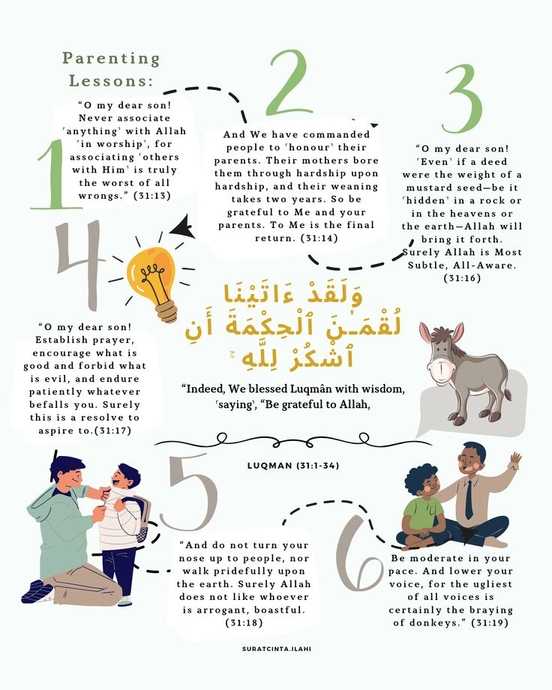
And ˹remember˺ when Luqmân said to his son, while advising him, “O my dear son! Never associate ˹anything˺ with Allah ˹in worship˺, for associating ˹others with Him˺ is truly the worst of all wrongs.”
Luqman begins his advice with the most important foundation of faith: Tawheed. It means believing that Allah alone deserves to be worshiped. He warns his son against shirk, or associating partners with Allah. Shirk is a great injustice because it gives Allah’s right of worship to others.
Verses 14–15 — Kindness to Parents, with Limits
وَوَصَّيْنَا ٱلْإِنسَـٰنَ بِوَٰلِدَيْهِ حَمَلَتْهُ أُمُّهُۥ وَهْنًا عَلَىٰ وَهْنٍۢ وَفِصَـٰلُهُۥ فِى عَامَيْنِ أَنِ ٱشْكُرْ لِى وَلِوَٰلِدَيْكَ إِلَىَّ ٱلْمَصِيرُ ١٤
وَإِن جَـٰهَدَاكَ عَلَىٰٓ أَن تُشْرِكَ بِى مَا لَيْسَ لَكَ بِهِۦ عِلْمٌۭ فَلَا تُطِعْهُمَا ۖ وَصَاحِبْهُمَا فِى ٱلدُّنْيَا مَعْرُوفًۭا ۖ وَٱتَّبِعْ سَبِيلَ مَنْ أَنَابَ إِلَىَّ ۚ ثُمَّ إِلَىَّ مَرْجِعُكُمْ فَأُنَبِّئُكُم بِمَا كُنتُمْ تَعْمَلُونَ ١٥
And We have commanded people to ˹honour˺ their parents. Their mothers bore them through hardship upon hardship, and their weaning takes two years. So be grateful to Me and your parents. To Me is the final return. But if they pressure you to associate with Me what you have no knowledge of,1 do not obey them. Still keep their company in this world courteously, and follow the way of those who turn to Me ˹in devotion˺. Then to Me you will ˹all˺ return, and then I will inform you of what you used to do.
Allah commands gratitude to Him and to one’s parents, highlighting the mother’s hardship during pregnancy and nursing. In Surah Luqman, kindness to parents is emphasized as an important duty. However, if parents pressure a child to commit shirk, the child must not obey them in that matter while still treating them with kindness and respect in worldly affairs.
Verse 16 — Allah Knows Even the Smallest Deed
يَـٰبُنَىَّ إِنَّهَآ إِن تَكُ مِثْقَالَ حَبَّةٍۢ مِّنْ خَرْدَلٍۢ فَتَكُن فِى صَخْرَةٍ أَوْ فِى ٱلسَّمَـٰوَٰتِ أَوْ فِى ٱلْأَرْضِ يَأْتِ بِهَا ٱللَّهُ ۚ إِنَّ ٱللَّهَ لَطِيفٌ خَبِيرٌۭ ١٦
˹Luqmân added,˺ “O my dear son! ˹Even˺ if a deed were the weight of a mustard seed—be it ˹hidden˺ in a rock or in the heavens or the earth—Allah will bring it forth. Surely Allah is Most Subtle, All-Aware.
Nothing is hidden from Allah — a good deed no one notices, or a wrong deed someone hides, is still known to Him. This awareness encourages sincerity in both actions and intentions.
📖This reminder of Allah’s complete knowledge also connects to the importance of trusting Him and remaining firm in faith. For more reflections on faith and reliance on Allah, read Surah Tauba Last Two Verses: 3 Lessons on Faith & Tawakkul.
Verse 17 — Prayer, Enjoining Good, and Patience
يَـٰبُنَىَّ أَقِمِ ٱلصَّلَوٰةَ وَأْمُرْ بِٱلْمَعْرُوفِ وَٱنْهَ عَنِ ٱلْمُنكَرِ وَٱصْبِرْ عَلَىٰ مَآ أَصَابَكَ ۖ إِنَّ ذَٰلِكَ مِنْ عَزْمِ ٱلْأُمُورِ ١٧
“O my dear son! Establish prayer, encourage what is good and forbid what is evil, and endure patiently whatever befalls you. Surely this is a resolve to aspire to.
Luqman tells his son to establish prayer, encourage what is right, and discourage what is wrong. He also teaches him to remain patient through any difficulties that may arise. Prayer comes first as one of the most important acts of worship. Encouraging good and discouraging wrong reflects a believer’s responsibility toward others. Patience is essential because this responsibility may bring hardship or criticism.
🛐 Prayer is one of the most important lessons Luqman teaches his son. If you are looking for practical ways to help children build a strong prayer habit, explore our guide, Salah for Kids: When, How, and Why to Teach Children to Pray, for helpful guidance for parents.
Verses 18–19 — Humility and Good Manners
وَلَا تُصَعِّرْ خَدَّكَ لِلنَّاسِ وَلَا تَمْشِ فِى ٱلْأَرْضِ مَرَحًا ۖ إِنَّ ٱللَّهَ لَا يُحِبُّ كُلَّ مُخْتَالٍۢ فَخُورٍۢ ١٨ وَٱقْصِدْ فِى مَشْيِكَ وَٱغْضُضْ مِن صَوْتِكَ ۚ إِنَّ أَنكَرَ ٱلْأَصْوَٰتِ لَصَوْتُ ٱلْحَمِيرِ ١٩
“And do not turn your nose up to people, nor walk pridefully upon the earth. Surely Allah does not like whoever is arrogant, boastful. Be moderate in your pace. And lower your voice, for the ugliest of all voices is certainly the braying of donkeys.”
Luqman’s final advice concerns everyday behavior: avoid arrogance and looking down on others, walk with moderation, and lower your voice. Islam teaches good character not only through major acts of worship, but through how a person walks, speaks, and treats others.
The 9 Key Lessons from Luqman’s Advice
- Be grateful to Allah for His blessings.
- Worship Allah alone and avoid shirk.
- Honor and treat your parents kindly.
- Remember that Allah knows every deed, even the smallest one.
- Establish and protect your prayers.
- Encourage good and discourage wrong with wisdom.
- Be patient when facing difficulties.
- Avoid arrogance and treat others with humility.
- Walk with moderation and speak at a respectful volume.
Parenting Lessons from Surah Luqman
Beyond what children owe their parents, Luqman’s conversation with his son offers lessons for parents raising children:
- Teach Tawheed before everything else: Luqman began with the oneness of Allah before anything else, showing that faith should be the foundation of a child’s upbringing.
- Give advice with love: his repeated use of “Ya bunayya” shows that children listen better when they feel loved and respected, not just commanded.
- Explain the reason behind teachings: Luqman connected actions to their consequences (e.g., Allah knowing even the smallest deed) rather than issuing bare rules, helping children build an internal sense of responsibility.
- Combine worship with character: prayer, encouraging good, discouraging wrong, and patience show that Islamic education should shape a child’s behavior toward others, not just their acts of worship.
- Prepare children for real challenges: by teaching patience through hardship rather than shielding children from every difficulty, Luqman modeled how to build resilience grounded in faith.
Together, these lessons show that Islamic parenting is not only about instruction — it is about building a relationship in which children feel safe enough to listen, question, and learn.
📿These teachings show that Islamic faith should be reflected in a child’s everyday behavior. For more practical guidance, explore Islamic Etiquettes for Kids: +30 Manners Every Child Should Learn, which covers important manners children can practice at home, with family, and in their daily interactions.
Final Thoughts on Surah Luqman
Surah Luqman packs an entire life’s worth of guidance into a short, tender conversation between a father and his son — faith before everything else, gratitude to Allah and to parents, sincerity in every deed, and humility in how we walk, speak, and treat others. Reading the surah is one thing; sitting with a qualified teacher to understand its verses, tajweed, and tafsir in depth is what turns that reading into lasting understanding.
Learn Surah Luqman and Tafsir with Areeb Academy
- Understand the Quran Beyond Memorization
- Online Quran and Tafsir Classes for Kids and Adults
- One-on-One Islamic Studies Lessons
- Learn Quran with Experienced Teachers
Ready to learn more? Book a FREE trial class with Areeb Academy today and start your Quran learning journey!
Frequently Asked Questions About Surah Luqman
What is Surah Luqman about?
Surah Luqman is about faith, wisdom, gratitude, and righteous living. It calls people to worship Allah alone and presents Luqman’s advice to his son as a practical model of how faith should shape a person’s character and daily life.
Is Surah Luqman Makki or Madani?
Surah Luqman is a Makki surah, revealed before the Prophet Muhammad ﷺ migrated from Makkah to Madinah.
Was Luqman a prophet?
The Quran does not describe Luqman as a prophet. Most scholars consider him a righteous, wise man rather than a prophet.
What are the main lessons in Luqman’s advice to his son?
His advice covers avoiding shirk, gratitude to Allah, kindness to parents, awareness that Allah knows every deed, establishing prayer, enjoining good and forbidding wrong, patience, humility, and good manners in how one walks and speaks.
What does Surah Luqman say about parents?
It commands gratitude and kindness toward parents, especially recognizing a mother’s hardship in pregnancy and nursing — while making clear that obedience to Allah always comes before obedience to parents.