

Many Muslims wonder what to say in Sujud to follow the Sunnah correctly and make the most of this special moment in Salah. Sujud is the position where a believer is closest to Allah, making it a time for glorifying Him, reciting authentic supplications, and making heartfelt dua.
In this guide, you’ll learn the main dhikr to recite in Sujud, authentic Sunnah duas taught by the Prophet Muhammad ﷺ, whether you can make personal dua in your own words, and how to perform Sujud correctly with proper etiquette and humility.
What Is Sujud in Islam?
Sujud (also called Sajdah) is the act of prostration performed during Salah, where a Muslim places the forehead, nose, palms, knees, and toes on the ground in complete submission to Allah. It is one of the main pillars of prayer and represents the highest level of humility, worship, and devotion.
Every Rak’ah includes two Sujud, making it one of the most meaningful acts of worship. During this position, Muslims glorify Allah, seek His mercy and forgiveness, and make sincere supplications.
Why Sujud Is the Closest Position to Allah
Sujud is the moment when a believer is spiritually closest to Allah. The Prophet Muhammad ﷺ said:
“The closest a servant comes to his Lord is when he is prostrating, so increase your supplications.” (Sahih Muslim)
For this reason, Sujud is one of the best times to make dua. After reciting the prescribed dhikr, Muslims are encouraged to ask Allah for forgiveness, guidance, mercy, and any good in this life and the Hereafter.
The Importance of Humility in Prostration
Humility is at the heart of Sujud. By placing the forehead—the part often associated with honor and dignity—on the ground, a Muslim acknowledges that true greatness belongs only to Allah. As a result, Sujud reminds believers to let go of pride, strengthen their faith, and rely completely on their Creator.
Sujud teaches believers to:
- Strengthen their sincerity in worship.
- Let go of pride and arrogance.
- Express gratitude for Allah’s countless blessings.
- Seek forgiveness and mercy with a humble heart.
- Renew their dependence and trust in Allah.
Beyond its physical movement, Sujud is a reminder that success comes through submission to Allah and that every prayer offers an opportunity to draw closer to Him with humility, hope, and devotion.
What to Say in Sujud

Sujud is one of the most powerful moments in Salah. During prostration, Muslims glorify Allah with the words taught by the Prophet Muhammad ﷺ and are encouraged to make sincere dua.
The Main Dhikr to Recite in Sujud
The primary remembrance (dhikr) recited during Sujud is:
Subḥāna Rabbiyal-A‘lā
Meaning:
“Glory is to my Lord, the Most High.”
This is the main Sunnah dhikr for Sujud. The Prophet ﷺ also recited other authentic supplications, including:
Subḥānaka Allāhumma Rabbana wa biḥamdika, Allāhumma-ghfir lī.
Meaning:
“Glory is to You, O Allah, our Lord, and all praise is Yours. O Allah, forgive me.”
The Prophet ﷺ also recited other authentic duas in Sujud, which you’ll find later in this guide.
How Many Times Should You Say It?
It is sufficient to say “Subhana Rabbiyal A’la” once, while the Sunnah is to recite it three times. You may also repeat it more often, especially during voluntary prayers. After the prescribed dhikr, take the opportunity to make sincere dua and ask Allah for forgiveness, guidance, mercy, and every good in this life and the Hereafter.
Want to learn what to recite in another essential position of Salah? Read our What to Say in Ruku: The Correct Dhikr, Meaning & Sunnah Guide to learn the authentic remembrances and Sunnah supplications for bowing in prayer.
Authentic Sunnah Duas in Sujud
Besides reciting “Subhana Rabbiyal A’la,” the Prophet Muhammad ﷺ used to recite different authentic supplications during Sujud. These duas praise Allah, seek His forgiveness and mercy, and express complete submission to Him. It is recommended to alternate between these authentic supplications rather than reciting the same one every time.
Here are two authentic Sunnah duas you can recite during Sujud:
1. Asking Allah for Forgiveness
Meaning:
“O Allah, forgive me all my sins, the small and the great, the first and the last, the public and the private.”
2. Seeking Allah’s Pleasure and Protection
Meaning:
“O Allah, I seek refuge in Your pleasure from Your anger, in Your forgiveness from Your punishment, and I seek refuge in You from You. I cannot praise You enough; You are as You have praised Yourself.”
When to Recite Different Sujud Duas
Begin every Sujud by reciting “Subhana Rabbiyal A’la.” Then, after the prescribed dhikr, you may recite one of the authentic Sunnah duas or make a personal supplication. Additionally, alternating between different authentic duas is a beautiful Sunnah that helps revive the Prophet’s ﷺ practice and keeps your worship meaningful and engaging.
Can You Make Personal Dua in Sujud⁉️
Yes. After reciting the prescribed dhikr, such as “Subhana Rabbiyal A’la,” you are encouraged to make sincere dua during Sujud. This is one of the best moments in Salah to ask Allah for forgiveness, guidance, mercy, and any good in this life and the Hereafter.
What You Can Ask Allah For
There is no limit to the beneficial things you may ask Allah for during Sujud. You can make dua for both your religious and worldly needs, including:
- Forgiveness for your sins.
- Guidance and steadfastness in faith.
- Mercy, patience, and a purified heart.
- Good health and protection from harm.
- Ease during difficulties and relief from hardship.
- Success in your studies, work, or family life.
- Righteous children and a blessed marriage.
- Jannah and protection from the Hellfire.
The Prophet ﷺ encouraged making abundant dua in Sujud, so this is an excellent time to ask Allah for everything that is good in this life and the Hereafter.
How to Perform Sujud Correctly
Sujud is one of the essential pillars of Salah and should be performed with humility, tranquility, and proper posture. When you move into Sujud, say “Allahu Akbar” and lower yourself calmly into prostration. Then, complete each movement without rushing, allowing yourself to pray with focus and devotion.
The Seven Body Parts That Touch the Ground
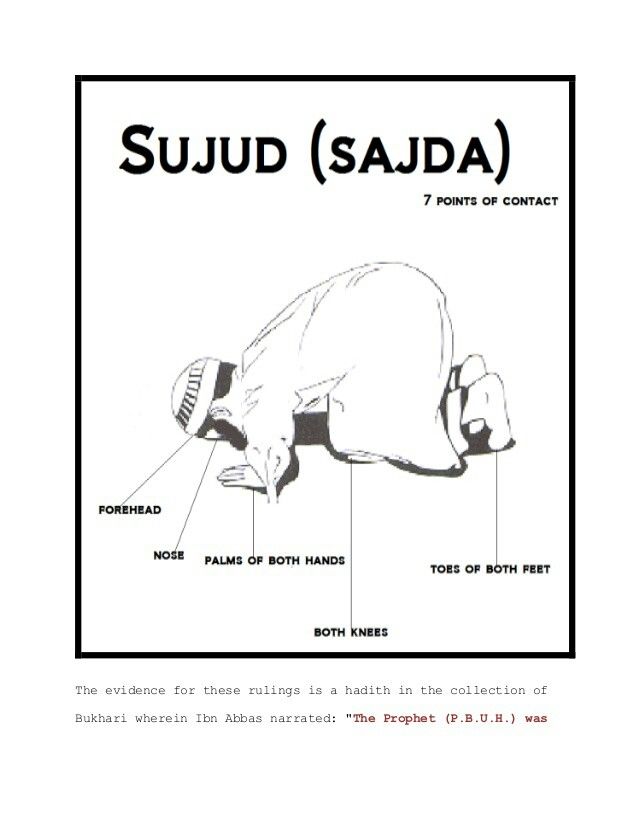
The Prophet ﷺ instructed Muslims to prostrate on seven body parts:
- The forehead and nose together.
- Both palms.
- Both knees.
- The toes of both feet.
All seven points should touch the ground whenever possible, with the toes bent and pointing toward the Qiblah. This posture reflects complete submission to Allah.
Proper Posture in Sujud
To perform Sujud according to the Sunnah:
- Say “Allahu Akbar” as you go into prostration.
- Place your forehead, nose, palms, knees, and toes firmly on the ground.
- Keep your hands in line with your shoulders or ears, with the fingers pointing toward the Qiblah.
- Raise your elbows off the floor and keep your stomach away from your thighs.
- Recite “Subhana Rabbiyal A’la” before making personal dua.
- Remain calm and still, reflecting on your dhikr and supplications without rushing through the prayer.
If you are unable to perform Sujud fully because of illness or physical limitations, pray according to your ability, as Islam does not burden a person beyond their capacity.
Improve Your Salah with Areeb Academy 🌟
- Learn Salah Step by Step – Master every step of Salah, from the prayer movements to the authentic adhkar and duas.
- Quran, Tajweed, and Islamic Studies Classes – Learn Quran recitation, Tajweed, Hifz, Tafsir, Hadith, Aqeedah, and more with qualified teachers.
- Personalized One-on-One Online Lessons – Enjoy live, private classes tailored to your level, goals, and schedule.
Book your FREE trial lesson today and start improving your Salah with confidence!
Frequently Asked Questions About Sujud
1. What should you say in Sujud?
Recite “Subhana Rabbiyal A’la” at least three times, then make authentic Sunnah or personal duas.
2. Can you make dua in your own language during Sujud?
Many scholars allow it for those who do not know Arabic, especially while learning, though the authentic Arabic duas remain the preferred choice.
3. How many times should you say “Subhana Rabbiyal A’la”?
Once is sufficient, while three times is the Sunnah. You may repeat it more often in voluntary prayers.
4. Why is Sujud considered the closest position to Allah?
The Prophet ﷺ taught that a servant is closest to Allah during Sujud, making it one of the best times for dua.
5. Can you make personal dua after the prescribed dhikr in Sujud?
Yes. After the prescribed dhikr, you may ask Allah for forgiveness, guidance, mercy, or any beneficial need.