
Arabic sentence structure for beginners can feel unfamiliar at first, especially if English is your first language. For example, verbs often come first, there is no word for “is” in many sentences, and adjectives follow the nouns they describe. However, Arabic follows clear, logical patterns. Once you recognize them, building sentences becomes far easier.
In this guide to Arabic sentence structure for beginners, you will first learn the two main types of Arabic sentences and how word order works. Then, you will explore the agreement rules every beginner needs, along with how to form negative sentences and questions. Finally, you will discover common mistakes, try practical exercises, and find useful tips to learn faster.
Table of Contents
- Arabic Sentence Structure for Beginners: The Two Main Types
- Arabic Sentence Structure for Beginners: Word Order vs. English
- Building Simple Arabic Sentences Step by Step
- Essential Arabic Sentence Structure Rules for Beginners
- How to Make Negative Sentences
- How to Ask Questions Using Arabic Sentence Structure
- Common Arabic Sentence Structure Mistakes for Beginners
- Practice Exercises
- Tips for Learning Arabic Sentence Structure Faster
- Final Thoughts
Arabic Sentence Structure for Beginners: The Two Main Types
In Arabic sentence structure, sentences are divided into two types: nominal sentences (الجملة الاسمية – Jumla Ismiyyah) and verbal sentences (الجملة الفعلية – Jumla Fi’liyyah). To tell them apart easily, look at the first word. If it is a noun or pronoun, the sentence is nominal. On the other hand, if it is a verb, the sentence is verbal.
Nominal Sentences
A nominal sentence describes someone or something. To understand how it works, think of it as having two main parts:
- Mubtada’ (المبتدأ): the subject, or what the sentence is about.
- Khabar (الخبر): the predicate, or the information about the subject.
For example:
الْبَيْتُ كَبِيرٌ
Al-baytu kabīrun. – “The house is big.”
In this example, al-baytu is the mubtada’ and kabīrun is the khabar. Unlike English, Arabic does not use a separate word for “is,” “am,” or “are” in simple present-tense sentences. Instead, the two parts work together to express the complete meaning.
| Arabic | Transliteration | English |
|---|---|---|
| الْوَلَدُ ذَكِيٌّ | Al-waladu dhakiyyun | The boy is smart. |
| أَنَا طَالِبٌ | Anā ṭālibun | I am a student. |
| الْكِتَابُ جَدِيدٌ | Al-kitābu jadīdun | The book is new. |
Verbal Sentences
A verbal sentence talks about an action. In its most common basic pattern, it follows Verb + Subject + Object:
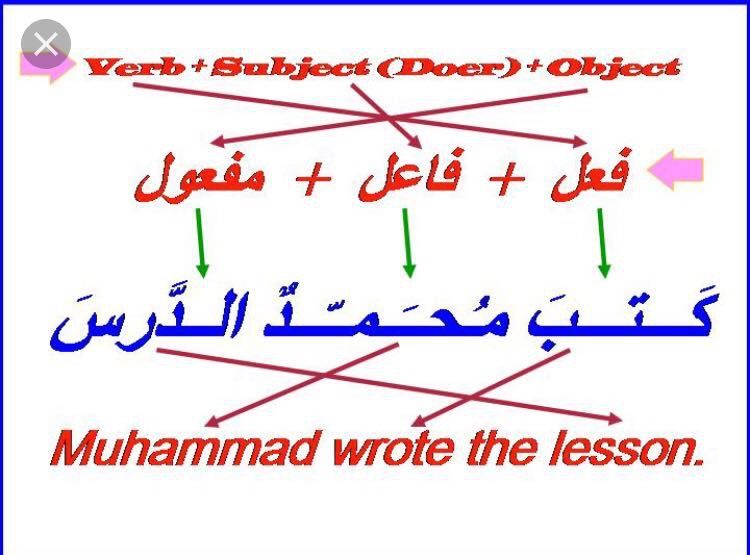
- Fi’l (الفعل): the verb.
- Fa’il (الفاعل): the doer of the action.
- Maf’ul Bihi (المفعول به): the object, when there is one.
For example:
كَتَبَ الْوَلَدُ رِسَالَةً
Kataba al-waladu risālatan. – “The boy wrote a letter.”
However, not every verbal sentence needs an object. For instance, جَاءَ الرَّجُلُ (Jā’a ar-rajulu) – “The man came” is a complete sentence with just a verb and a subject.
So, when should you use each type? Use a nominal sentence to describe a person, thing, or state (الطَّقْسُ جَمِيلٌ – “The weather is nice”). By contrast, use a verbal sentence to describe what someone does or did (ذَهَبَ أحمد إِلَى الْمَدْرَسَةِ – “Ahmad went to school”).
Arabic Sentence Structure for Beginners: Word Order vs. English Explanation
English usually follows the Subject–Verb–Object (SVO) order. In contrast, verbal sentences in Arabic commonly follow the Verb–Subject–Object (VSO) pattern:
يَقْرَأُ الْوَلَدُ كِتَابًا
Yaqra’u al-waladu kitāban. – “The boy reads a book.”
However, Arabic also allows a subject-first order when the speaker wants to emphasize who performs the action:
الْوَلَدُ قَرَأَ الْكِتَابَ
Al-waladu qara’a al-kitāba. – “The boy read the book.”
In this case, the sentence is technically nominal because it begins with a noun, while the verbal clause acts as its predicate. Therefore, both word orders are correct, but they place emphasis differently: verb-first presents the action, whereas subject-first highlights the doer.
Building Simple Arabic Sentences Step by Step
Arabic sentence structure for beginners starts with three basic word categories: nouns (ism – اسم), verbs (fi’l – فعل), and particles (ḥarf – حرف), such as فِي (in), إِلَى (to), and وَ (and). Once you understand these categories, you can start building simple sentences by choosing a subject and adding information about it.
For example:
مُحَمَّدٌ طَالِبٌ ذَكِيٌّ – Muhammad is a smart student.
ذَهَبَ مُحَمَّدٌ إِلَى الْمَسْجِدِ – Muhammad went to the mosque.
As you can see, you can use these word categories to describe someone or express an action.
Using Pronouns
| Arabic | Pronunciation | English |
|---|---|---|
| أَنَا | Anā | I |
| أَنْتَ / أَنْتِ | Anta / Anti | You (m. / f.) |
| هُوَ / هِيَ | Huwa / Hiya | He / She |
| نَحْنُ | Naḥnu | We |
| هُمْ | Hum | They (m. or mixed) |
Pronouns work in both sentence types: هِيَ مُعَلِّمَةٌ (She is a teacher) and نَحْنُ نَتَعَلَّمُ الْعَرَبِيَّةَ (We learn Arabic).
Want to learn more? Check out our guide, [Arabic Pronouns Explained Simply: Master Them in 10 Minutes!], to understand Arabic pronouns and learn how to use them confidently in everyday sentences.
Essential Arabic Sentence Structure Rules for Beginners
However, good Arabic sentence structure involves more than just word order. Words must also agree with one another in gender, number, and other grammatical features.
Gender
Arabic nouns are masculine or feminine, and adjectives and verbs must match. A final ة (ta marbuta) is a common sign of a feminine noun, though not all feminine nouns have it.
| Masculine | Feminine | English |
|---|---|---|
| وَلَدٌ صَغِيرٌ | بِنْتٌ صَغِيرَةٌ | A small boy / girl |
| طَالِبٌ مُجْتَهِدٌ | طَالِبَةٌ مُجْتَهِدَةٌ | A hardworking student |
Verbs agree too: ذَهَبَ الْوَلَدُ (the boy went) and ذَهَبَتِ الْبِنْتُ (the girl went).
Want to understand Arabic gender rules in more detail? Read our guide, [Masculine and Feminine in Arabic: Step-by-Step Guide for Learners], to learn how to identify masculine and feminine words and use them correctly.
Singular, Dual, and Plural
In addition to singular and plural forms, Arabic has a special dual form for exactly two: طَالِبٌ (one student), طَالِبَانِ (two students), and طُلَّابٌ (students).
Moreover, the verb changes depending on the word order. When the verb comes before the subject, it stays singular: حَضَرَ الطُّلَّابُ (the students attended). However, when the subject comes first, the verb agrees with it: الطُّلَّابُ حَضَرُوا.
If you’re also learning to count in Arabic, explore our guide to Arabic Numbers 1 to 100: Read, Write & Pronounce to learn how to read, write, and pronounce numbers correctly.
Definite and Indefinite
Another important feature of Arabic nouns is definiteness. The prefix الـ (al-) makes a noun definite. To see the difference, compare الْبَيْتُ كَبِيرٌ (“The house is big”), which is a complete sentence, with الْبَيْتُ الْكَبِيرُ (“the big house”), which is only a phrase because both words are definite.
Adjectives
Similarly, adjectives in Arabic come after the nouns they describe and agree with them in gender, number, definiteness, and case. For example, كِتَابٌ جَدِيدٌ (a new book) and الْمَدْرَسَةُ الْكَبِيرَةُ (the big school).
How to Make Negative Sentences ➖
The negative word depends on the sentence type and tense:
- لا (Lā) negates present-tense verbs: لا أَفْهَمُ – “I do not understand.”
- لم (Lam) negates the past, followed by a jussive verb: لَمْ يَحْضُرْ – “He did not attend.”
- لن (Lan) negates the future, followed by a subjunctive verb: لَنْ أُسَافِرَ – “I will not travel.”
- ليس (Laysa) negates nominal sentences: هُوَ لَيْسَ طَبِيبًا – “He is not a doctor.”
Note that laysa changes with the subject: أَنَا لَسْتُ طَالِبًا (“I am not a student”) and هِيَ لَيْسَتْ مُعَلِّمَةً (“She is not a teacher”). Also, the predicate after laysa takes the accusative ending.
| Positive | Negative | English |
|---|---|---|
| أَنَا أَفْهَمُ | أَنَا لَا أَفْهَمُ | I do not understand. |
| حَضَرَ الطَّالِبُ | لَمْ يَحْضُرِ الطَّالِبُ | The student did not attend. |
| أُسَافِرُ غَدًا | لَنْ أُسَافِرَ غَدًا | I will not travel tomorrow. |
Tip for Egyptian Arabic: in everyday speech, you will often hear مِش (mish) instead of laysa, as in أَنَا مِش تَعْبَان (“I am not tired”).
How to Ask Questions Using Arabic Sentence Structure ⁉️
Yes-or-No Questions
In Modern Standard Arabic, you can form a yes-or-no question by starting the sentence with هَلْ (hal).
For example:
هَلْ أَنْتَ طَالِبٌ؟ – Hal anta ṭālibun? – “Are you a student?”
To answer, use نَعَمْ (na’am, yes) or لَا (lā, no).
Question Words
| Arabic | Pronunciation | Meaning |
|---|---|---|
| مَنْ | Man | Who? |
| مَاذَا | Mādhā | What? |
| مَتَى | Matā | When? |
| أَيْنَ | Ayna | Where? |
| كَيْفَ | Kayfa | How? |
| لِمَاذَا | Limādhā | Why? |
| كَمْ | Kam | How many / much? |
For example, you can use these common questions in everyday conversations: أَيْنَ تَسْكُنُ؟ (Where do you live?), لِمَاذَا تَتَعَلَّمُ الْعَرَبِيَّةَ؟ (Why are you learning Arabic?), and كَيْفَ حَالُكَ؟ (How are you?).
Keep in mind that كَيْفَ حَالُكِ؟ (Kayfa ḥāluki?) is the feminine form used when speaking to a woman.
Common Arabic Sentence Structure Mistakes for Beginners

1. Translating word for word. English uses “am” and “is” in sentences where Arabic does not need them. For example, say أَنَا مُعَلِّمٌ (“I am a teacher”) instead of adding an extra word through a literal translation.
2. Confusing the two sentence types. To avoid this mistake, decide first whether you are describing someone or something (nominal) or reporting an action (verbal).
3. Forgetting agreement. For instance, compare the incorrect البِنْتُ جَمِيلٌ with the correct البِنْتُ جَمِيلَةٌ (“The girl is beautiful”). Similarly, use الوَلَدَانِ مُجْتَهِدَانِ when describing two boys. Before choosing an adjective or verb, ask yourself: Is the noun masculine or feminine? Does it refer to one, two, or many?
Practice Exercises
Build sentences. First, combine these words to practice basic Arabic sentence structure. Then, read each completed sentence aloud: هُوَ + طَبِيبٌ, البِنْتُ + صَغِيرَةٌ, أَنَا + أَكْتُبُ.
Rearrange the words. Another useful exercise is to put mixed-up words in the correct order. Try these examples:
- المَدْرَسَةِ – إِلَى – يَذْهَبُ – الوَلَدُ
- القَهْوَةَ – أُحِبُّ – أَنَا
Answers:
- يَذْهَبُ الوَلَدُ إِلَى المَدْرَسَةِ (The boy goes to school).
- أَنَا أُحِبُّ القَهْوَةَ (I like coffee).
Describe your day. Finally, practice using Arabic to talk about your daily routine. Choose three activities and write one sentence about each. For example, you can say أَنَا أَسْكُنُ فِي مِصْرَ (I live in Egypt) or أُحِبُّ القِرَاءَةَ (I like reading).
Tips for Learning Arabic Sentence Structure Faster
- Start short. Master one complete idea before adding details, since Arabic sentence structure for beginners works best in small steps.
- Learn words in context. Learn يَقْرَأُ الكِتَابَ (reads the book), not just يَقْرَأُ.
- Practice both sentence types regularly.
- Learn gender with every noun.
- Read and listen daily. Simple dialogues and short stories reveal natural patterns.
To take your practice further, explore [Conversational Fusha Arabic: How to Speak MSA Fluently] and discover how to use Modern Standard Arabic in everyday conversations. - Write three to five sentences a day and review your mistakes.
- Get feedback from a qualified teacher who can explain the rules and correct your Arabic.
Final Thoughts
Arabic sentence structure for beginners becomes much easier once you understand the basics: nominal sentences describe, verbal sentences express actions, and words must agree in gender, number, and definiteness. However, you do not need to memorize every rule at once. Instead, start with short sentences and practice daily. Over time, these patterns will become more natural through reading, listening, and speaking. Remember that mistakes are part of the learning process, and every sentence you build brings you one step closer to confidence. So, be patient, stay consistent, and enjoy your Arabic learning journey!
Ready to Speak Arabic with Confidence?
At Areeb Academy, our qualified instructors help you master Arabic sentence structure for beginners, pronunciation, and real-life conversation through clear lessons and personalized feedback. Explore our online Arabic classes for adults to find a learning plan that matches your goals and level.
Book your free trial lesson with Areeb Academy today and take your first confident step in Arabic!
Frequently Asked Questions About Arabic Sentence Structure
1. What are the two main types of Arabic sentences?
Arabic has two main sentence types: nominal sentences (Jumla Ismiyyah), which begin with a noun or pronoun, and verbal sentences (Jumla Fi’liyyah), which begin with a verb. Nominal sentences usually describe someone or something, while verbal sentences express actions.
2. Is Arabic sentence structure different from English?
Yes. English usually follows Subject–Verb–Object (SVO) order, while Arabic commonly uses Verb–Subject–Object (VSO) in verbal sentences. Arabic also places adjectives after nouns and often does not use a separate word for “is” in simple present-tense sentences.
3. Does Arabic have the word “is”?
Arabic does not usually use a separate word for “is,” “am,” or “are” in simple present-tense nominal sentences. For example, أَنَا طَالِبٌ (Anā ṭālibun) means “I am a student.”
4. Do adjectives come before or after nouns in Arabic?
Adjectives usually come after the nouns they describe. They also agree with the nouns in gender, number, definiteness, and case. For example, كِتَابٌ جَدِيدٌ (kitābun jadīdun) means “a new book.”
5. How do you make a sentence negative in Arabic?
The negative word depends on the tense and sentence type. For example, لا (lā) negates present-tense verbs, لم (lam) negates past actions, لن (lan) negates future actions, and ليس (laysa) is commonly used to negate nominal sentences.
6. How do you ask a question in Arabic?
You can form yes-or-no questions by starting with هَلْ (hal). For other questions, use words such as مَنْ (man, who), مَاذَا (mādhā, what), أَيْنَ (ayna, where), and مَتَى (matā, when).