
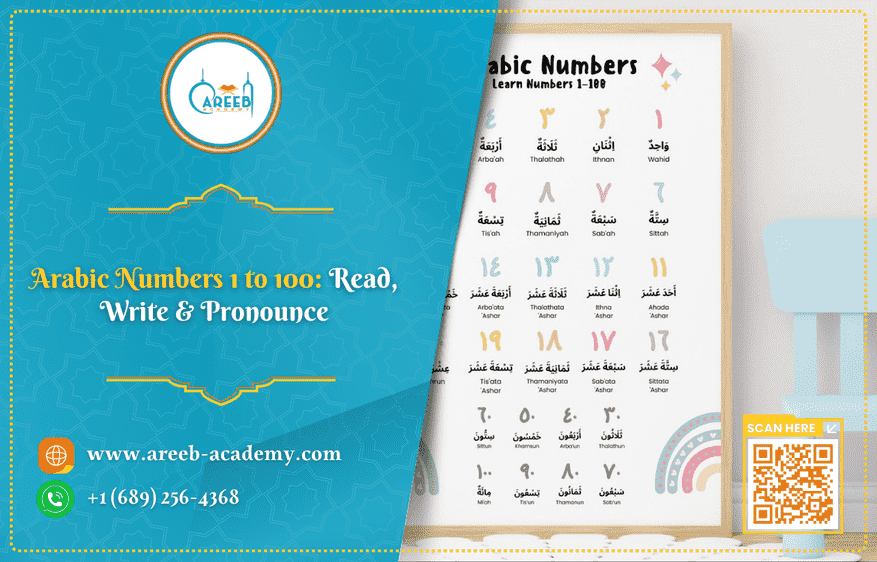
Counting is usually the first thing people want to do when learning a new language. That’s why learning Arabic numbers 1 to 100 is a great place to start. To begin with, once you know the numbers from 1 to 10 and the tens, you can combine them to build every number up to 100 on your own.
In this guide, you’ll learn the digits, written words, and pronunciation. You’ll also discover the pattern behind numbers 21 to 99, explore the sounds that can challenge beginners, and see how to use Arabic numbers in everyday situations with confidence.
Table of Contents
- Two Sets of Digits
- Arabic Numbers 0 to 10
- Arabic Numbers 11 to 20
- The Tens: 20 to 100
- How to Build Numbers from 21 to 99
- Arabic Numbers 1 to 100: Understanding Gender Agreement
- Arabic Numbers 1 to 100: Sounds That Trip Beginners Up
- How to Use Arabic Numbers 1 to 100 in Real Life
- Practice Arabic Numbers 1 to 100: Exercises for Beginners
- Frequently Asked Questions
- Keep Practicing Arabic Numbers 1 to 100
Two Sets of Digits
Arabic uses two digit systems. First, Western digits (0, 1, 2, 3) are the ones you may already know. On the other hand, Eastern Arabic-Indic digits (٠، ١، ٢، ٣) are widely used in Egypt, the Gulf, and the Levant, including on price tags, street signs, and book pages. Meanwhile, Western digits are more commonly used in North Africa. The good news is that both systems carry exactly the same values, so you only need to learn to recognize both.
One important detail to remember is that Arabic text runs from right to left, but digits still run from left to right. For example, ١٥ means fifteen, not fifty-one.
Arabic Numbers 0 to 10
Start here. Everything else builds on these eleven words.
| Western | Eastern | Arabic | Pronunciation |
|---|---|---|---|
| 0 | ٠ | صِفْر | sifr |
| 1 | ١ | وَاحِد | waa-hid |
| 2 | ٢ | اِثْنَان | ith-naan |
| 3 | ٣ | ثَلَاثَة | tha-laa-tha |
| 4 | ٤ | أَرْبَعَة | ar-ba-ʿa |
| 5 | ٥ | خَمْسَة | kham-sa |
| 6 | ٦ | سِتَّة | sit-ta |
| 7 | ٧ | سَبْعَة | sab-ʿa |
| 8 | ٨ | ثَمَانِيَة | tha-maa-ni-ya |
| 9 | ٩ | تِسْعَة | tis-ʿa |
| 10 | ١٠ | عَشَرَة | ʿash-ra |
Say the numbers aloud in two short batches: 1 to 5, then 6 to 10. After that, repeat them a few times before moving on. Short practice rounds can make memorization easier than one long recital.
Arabic Numbers 11 to 20
Numbers 13 to 19 follow a simple pattern: say the unit first, then add عَشَرَ (ʿashara), meaning “ten.” For example, ثَلَاثَةَ عَشَرَ (thalāthata ʿashara) means thirteen. Notice how the unit takes a “-ta” ending in these forms. However, eleven and twelve are irregular, so it is best to learn them as complete words.
| Number | Eastern | Arabic | Pronunciation |
|---|---|---|---|
| 11 | ١١ | أَحَدَ عَشَرَ | a-ha-da ʿa-shar |
| 12 | ١٢ | اِثْنَا عَشَرَ | ith-naa ʿa-shar |
| 13 | ١٣ | ثَلَاثَةَ عَشَرَ | tha-laa-tha-ta ʿa-shar |
| 14 | ١٤ | أَرْبَعَةَ عَشَرَ | ar-ba-ʿa-ta ʿa-shar |
| 15 | ١٥ | خَمْسَةَ عَشَرَ | kham-sa-ta ʿa-shar |
| 16 | ١٦ | سِتَّةَ عَشَرَ | sit-ta-ta ʿa-shar |
| 17 | ١٧ | سَبْعَةَ عَشَرَ | sab-ʿa-ta ʿa-shar |
| 18 | ١٨ | ثَمَانِيَةَ عَشَرَ | tha-maa-ni-ya-ta ʿa-shar |
| 19 | ١٩ | تِسْعَةَ عَشَرَ | tis-ʿa-ta ʿa-shar |
| 20 | ٢٠ | عِشْرُونَ | ʿish-roon |
These are the masculine forms. With feminine nouns, the unit and the word for ten can change. You can learn more about these changes in our guide to [Arabic Numbers 1 to 100: Understanding Gender Agreement].
The Tens: 20 to 100
Most Arabic tens from 30 to 90 end in “-ūn,” which makes them easier to recognize and memorize. Furthermore, several of them share familiar roots with the numbers you have already learned. As a result, you may find them easier to remember once you recognize these similarities. Therefore, take a little time to review the pattern before moving on to the next group of numbers.
| Number | Eastern | Arabic | Pronunciation |
|---|---|---|---|
| 20 | ٢٠ | عِشْرُونَ | ʿish-roon |
| 30 | ٣٠ | ثَلَاثُونَ | tha-laa-thoon |
| 40 | ٤٠ | أَرْبَعُونَ | ar-ba-ʿoon |
| 50 | ٥٠ | خَمْسُونَ | kham-soon |
| 60 | ٦٠ | سِتُّونَ | sit-toon |
| 70 | ٧٠ | سَبْعُونَ | sab-ʿoon |
| 80 | ٨٠ | ثَمَانُونَ | tha-maa-noon |
| 90 | ٩٠ | تِسْعُونَ | tis-ʿoon |
| 100 | ١٠٠ | مِئَة | mi-ʾa |
However, the endings of these tens can also change depending on their grammatical position. For example, عِشْرُونَ (ʿishrūna) becomes عِشْرِينَ (ʿishrīna) in certain sentence positions. For now, beginners can focus on the “-ūn” forms, as these are commonly taught as the basic forms of these numbers. Later on, as you progress in Arabic, you can gradually learn the other endings. In this way, you can build your understanding without getting overwhelmed by grammar rules at the beginning.
How to Build Numbers from 21 to 99
This is where Arabic may surprise English speakers. Unlike English, Arabic places the smaller number before the tens. In other words, instead of saying “twenty-five,” Arabic says “five and twenty.” The good news, however, is that this pattern stays the same across all the decades. Once you understand this simple rule, you can use it to form numbers from 21 to 99.
unit + وَ (wa, “and”) + tens
Because the same formula works for every number from 21 to 99, you don’t need to memorize 79 separate words. Instead, learn the pattern once and apply it to each decade:
| Range | Pattern | Example | Pronunciation |
|---|---|---|---|
| 21–29 | unit + وَ + عِشْرُون | 25 = خَمْسَة وَعِشْرُون | kham-sa wa-ʿish-roon |
| 31–39 | unit + وَ + ثَلَاثُون | 34 = أَرْبَعَة وَثَلَاثُون | ar-ba-ʿa wa-tha-laa-thoon |
| 41–49 | unit + وَ + أَرْبَعُون | 42 = اِثْنَان وَأَرْبَعُون | ith-naan wa-ar-ba-ʿoon |
| 51–59 | unit + وَ + خَمْسُون | 56 = سِتَّة وَخَمْسُون | sit-ta wa-kham-soon |
| 61–69 | unit + وَ + سِتُّون | 67 = سَبْعَة وَسِتُّون | sab-ʿa wa-sit-toon |
| 71–79 | unit + وَ + سَبْعُون | 73 = ثَلَاثَة وَسَبْعُون | tha-laa-tha wa-sab-ʿoon |
| 81–89 | unit + وَ + ثَمَانُون | 88 = ثَمَانِيَة وَثَمَانُون | tha-maa-ni-ya wa-tha-maa-noon |
| 91–99 | unit + وَ + تِسْعُون | 99 = تِسْعَة وَتِسْعُون | tis-ʿa wa-tis-ʿoon |
As a quick practice trick, say 21 as “one and twenty” in your head first, then translate each part. With a little repetition, the word order will start to feel natural, sometimes after just a day or two.
Arabic Numbers 1 to 100: Understanding Gender Agreement
It’s also important to understand that Arabic numbers can change form depending on whether the counted noun is masculine or feminine. Fortunately, the basic rules are short and easy to follow:
- First, numbers 1 and 2 match the noun’s gender.
- Next, numbers 3 to 10 take the opposite gender. For example, a masculine noun gets the form ending in ة, while a feminine noun gets the form without it.
- Finally, the tens (20 to 90) do not change according to gender.
| Counted noun | Arabic | Pronunciation |
|---|---|---|
| three books (masculine) | ثَلَاثَة كُتُب | tha-laa-thatu ku-tub |
| three cars (feminine) | ثَلَاث سَيَّارَات | tha-laath say-yaa-raat |
| five pens (masculine) | خَمْسَة أَقْلَام | kham-satu aq-laam |
| five bags (feminine) | خَمْس حَقَائِب | khamsu ha-qaa-ʾib |
When counting on its own, such as reciting numbers or reading a phone number digit by digit, you can use the basic forms from the tables above. In this case, there is no need to worry about gender agreement because you are not counting a masculine or feminine noun.
If you want to understand how masculine and feminine forms work beyond numbers, check out our step-by-step guide to masculine and feminine in Arabic. It will help you build a stronger foundation in Arabic grammar.
Arabic Numbers 1 to 100: Sounds That Trip Beginners Up
As for pronunciation, the numbers themselves are fairly easy to learn, but a few Arabic sounds need extra attention because they have no exact English equivalent. For example, the symbol ʿ in this guide represents the throaty ع sound.
| Letter | Sound | How to make it | Found in |
|---|---|---|---|
| ع (ʿayn) | deep throat sound | Gently tighten your throat as if starting a gag, then release. | أَرْبَعَة، سَبْعَة، تِسْعَة |
| ث (thaa) | soft “th” as in think | Place the tip of your tongue lightly between your teeth. | ثَلَاثَة، ثَمَانِيَة |
| خ (khaa) | like “ch” in Scottish loch | Let the air pass through the back of your throat, creating a gentle scraping sound. | خَمْسَة، خَمْسُون |
| ح (ḥaa) | breathy, from deeper than English “h” | Whisper an “h” sound as if you are fogging up a mirror. | وَاحِد |
Two habits cause most pronunciation mistakes:
- First, learners may pronounce ث as “s” or “t”, which can change the sound of a word.
- Second, they may shorten long vowels, so wāḥid loses its stretched “aa” sound.
Therefore, pay special attention to these two points as you practice.
To improve your pronunciation, start by listening and then repeating what you hear. For example, play a recording of a native speaker counting from 1 to 10, repeat each word, and record yourself to compare your pronunciation. In addition, try to practice for ten minutes every day. This regular practice is more effective than studying for an hour only once a week.
How to Use Arabic Numbers 1 to 100 in Real Life
🔢Age
Asking and Answering About Age
To ask someone’s age, use كَمْ عُمْرُكَ؟ (kam ʿumruka?) when speaking to a man, or كَمْ عُمْرُكِ؟ (kam ʿumruki?) when speaking to a woman. For example, a typical answer is عُمْرِي خَمْسَةٌ وَعِشْرُونَ عَامًا (ʿumrī khamsatun wa-ʿishrūna ʿāman), meaning “I am 25 years old.” You can also replace the number with any age using the numbers from the tables above.
📱Phone Numbers
Saying Phone Numbers
Unlike regular numbers, phone numbers are read digit by digit rather than as one large number. For example, Egyptian mobile numbers often start with 010, 011, 012, or 015. So, if a number starts with 010, you would say صِفْر وَاحِد صِفْر (sifr, wāḥid, sifr). To practice, try reading your own phone number aloud, one digit at a time.
🛒Shopping and Prices
Prices are where numbers get real, and the expressions are short:
| English | Arabic | Pronunciation |
|---|---|---|
| How much is this? | كَمْ سِعْرُ هَذَا؟ | kam siʿru hādhā? |
| How much is this? (Egyptian) | بِكَام دَه؟ | bi-kaam da? |
| Thirty pounds | ثَلَاثُونَ جُنَيْهًا | tha-laa-thoona gu-nay-han |
| Two kilos of apples | كِيلُوَانِ مِنَ التُّفَّاح | kee-law-aani mina t-tuf-faaḥ |
🕐 Using Arabic Numbers from 1 to 100 for Time and Dates
Telling time uses ordinal numbers (third, fifth) rather than the counting forms. Dates mix both.
| English | Arabic | Pronunciation |
|---|---|---|
| It is 3 o’clock. | السَّاعَةُ الثَّالِثَةُ | as-saa-ʿatu ath-thaa-li-tha |
| It is 5 o’clock. | السَّاعَةُ الْخَامِسَةُ | as-saa-ʿatu al-khaa-mi-sa |
| The 12th of June | الثَّانِي عَشَرَ مِنْ يُونْيُو | ath-thaa-ni ʿa-shara min yoon-yoo |
Finally, try a simple daily habit: every time you check your phone for the time, say the time in Arabic. This way, you can practice regularly and use Arabic numbers in your everyday life.
Practice Arabic Numbers 1 to 100: Exercises for Beginners
Cover the answers and try these first.
Exercise 1. Write the Eastern digit.
| Word | Your answer |
|---|---|
| اِثْنَان | |
| خَمْسَة | |
| سَبْعَة | |
| تِسْعَة |
Exercise 2. Fill in the missing numbers.
- ١ ← ___ ← ٣ ← ___ ← ٥
- ٢٠ ← ___ ← ٤٠ ← ___ ← ٦٠
Exercise 3. Write these in Arabic words.
| Number | Your answer |
|---|---|
| ٨ | |
| ١٢ | |
| ٢٥ | |
| ٩٠ |
Answers
Check your answers below:
- Exercise 1: ٢، ٥، ٧، ٩.
- Exercise 2: ٢، ٤، ٣٠، ٥٠.
- Exercise 3: ثمانية، اثنا عشر، خمسة وعشرون، تسعون.
Final Thoughts

Learning Arabic numbers 1 to 100 becomes much easier once you understand the patterns behind them. To begin with, focus on the numbers from 1 to 10. Then, memorize the tens and practice combining them to form larger numbers. Once you feel comfortable with these patterns, start using what you’ve learned in everyday conversations. For example, you can practice by talking about your age, reading phone numbers, or discussing prices. Most importantly, make regular practice part of your routine. Over time, you’ll remember the numbers more easily, build confidence, and improve your Arabic pronunciation.
Learn Arabic with Areeb Academy
Learning Arabic is easier when you have the right guidance. At Areeb Academy, our native Arabic-speaking teachers, who are fluent in English, will help you understand Arabic step by step, improve your pronunciation, and practice using the language in real-life situations.
Whether you want to learn Modern Standard Arabic (Fusha) or Egyptian Arabic, our personalized one-to-one online lessons are tailored to your level, goals, and schedule. In addition, we offer flexible learning options for different ages and budgets. If you’re a teenager, you can explore our online Arabic lessons for teenagers. Likewise, if you’re looking for affordable ways to learn, read our guide to affordable Arabic lessons online to discover flexible options that fit your budget.
🌟 Ready to take the next step? Book your FREE trial lesson today and start speaking Arabic with confidence!
Frequently Asked Questions
1. Are Arabic numbers read left to right or right to left?
Arabic words are written from right to left. However, digits are read from left to right. For example, ١٥ is read as fifteen, not fifty-one. Therefore, even when reading Arabic text, remember that numbers follow a different direction.
2. How do you count from 1 to 100 in Arabic?
First, learn the numbers from 1 to 10. Next, memorize the tens from 20 to 90. After that, combine the units and tens to form numbers from 21 to 99. Finally, learn the word for 100: مِئَة (mi’a). This way, you can build numbers without memorizing every single one separately.
3. Why does Arabic say “five and twenty” instead of “twenty-five”?
Unlike English, Arabic uses a different word order for numbers from 21 to 99. In other words, the unit comes first, followed by وَ (“and”), and then the tens. For instance, 25 is خَمْسَةٌ وَعِشْرُونَ (khamsatun wa-ʿishrūn). As a result, once you understand this pattern, forming larger numbers becomes much easier.
4. Do Arabic numbers change depending on gender?
Yes, they do. In fact, some Arabic numbers change depending on whether the noun being counted is masculine or feminine. For example, numbers from 3 to 10 generally take a form that is opposite in gender to the noun. However, you don’t need to master every grammatical detail when you’re just starting.