
Finding the right Quran teacher for kids online can make learning easier and more enjoyable. Whether your child is learning Arabic letters, improving recitation, or memorizing short surahs, the right teacher makes a real difference.
This guide explains how to choose a Quran teacher for kids online and what to check before starting lessons.
Why Hire a Quran Teacher for Kids Online?

Every parent wants their child to build strong Quran reading skills and a meaningful connection with the Quran. But school, homework, and family commitments make regular lessons hard, especially for families outside Arabic-speaking countries. An online Quran teacher for kids brings one-on-one lessons to your home. Here is how that helps.
Learning from Home
Children learn in a familiar, quiet space with no travel time, and parents can schedule lessons around school. Online lessons help families:
- Save time: no commuting.
- Access suitable teachers: wherever you live.
- Stay involved: check in and support practice at home.
All you need is a reliable internet connection, a suitable device, and a quiet space.
One-on-One Attention
Children progress at different rates. One may know the letters but struggle to connect them, while another reads confidently but needs help with Tajweed. In one-on-one lessons, the teacher focuses on your child’s needs instead of a group’s pace. If your child confuses two letters, the teacher can demonstrate each sound and give them time to practice before moving on.
Want to understand how one-on-one lessons compare with group classes? Read our guide, [One-to-One Learning vs. Group Learning: Best for Quran Online], to explore the differences and decide which approach best suits your child’s learning needs.
Flexible Scheduling
Online lessons let you choose days and times without accounting for travel. At Areeb Academy, one-on-one lessons are available in 30, 45, and 60 minutes. Younger children often start well with 30 minutes, while older learners may handle longer sessions. Aim for a routine your family can keep without sacrificing rest.
Building a Connection with the Quran
Learning the Quran is more than reading or memorizing. A supportive environment helps children celebrate small wins, ask questions, and approach hard passages with patience. Parents can help by listening to recitation, praising effort, and avoiding comparisons with other children.
What Makes a Good Quran Teacher for Kids Online?
A good teacher does more than recite accurately. They explain clearly, adapt to your child’s level, and correct mistakes constructively. Look for these qualities.
Strong Recitation and Tajweed Knowledge
Correct pronunciation matters most for beginners, who are building their foundation. A good teacher can:
- Demonstrate the correct pronunciation of Arabic letters
- Explain differences between similar sounds
- Identify and correct mistakes
- Introduce Tajweed rules gradually
You can also ask about Islamic education, recitation training, or an Ijazah. Qualifications vary, so verify each teacher’s credentials.
Experience with Children
A young beginner needs a different approach from an older child working on fluency. A good teacher adjusts explanations, activities, and pace to your child’s age and ability. During a lesson, notice whether they give your child time to respond and explain things in simple language.
Patience, Kindness, and Clear Communication
Forgetting verses or needing several attempts is normal. A good teacher corrects mistakes without embarrassing the child and lets them try again. If your child is more comfortable in English, a teacher who explains in English helps them understand rather than just repeat sounds.
Interactive Teaching and Regular Feedback
Children should participate, not listen passively. Teachers may use screen sharing, digital whiteboards, or guided reading, as long as each activity supports a clear learning goal.
Useful feedback is also specific. For example: “Your child now connects these letters alone but needs practice with two similar sounds.” This guides home revision and helps you and the teacher respond to your child’s actual pace instead of a fixed timeline.
Male or Female Quran Teacher for Kids Online?

This is a personal choice based on your child’s comfort and your family’s preferences. Both can teach well with the right knowledge and experience, so focus on qualifications, communication, and fit.
Choosing a Male Teacher
Some families prefer a male teacher, or their child simply responds well to one. Look at his Quranic knowledge, experience with children, clarity, and how he corrects mistakes.
Choosing a Female Teacher
Some families prefer a female Quran teacher for kids online. Consider her recitation and Tajweed knowledge, experience with your child’s age group, clear communication, and approach to feedback. At Areeb Academy, families can request a female teacher for one-on-one lessons.
Looking for more guidance? Read our guide, [Female Quran Teacher Online: 5 Steps to Find Your Perfect Match], to learn how to choose the right teacher for your child.
What Will Your Kids Learn with an Online Quran Teacher?
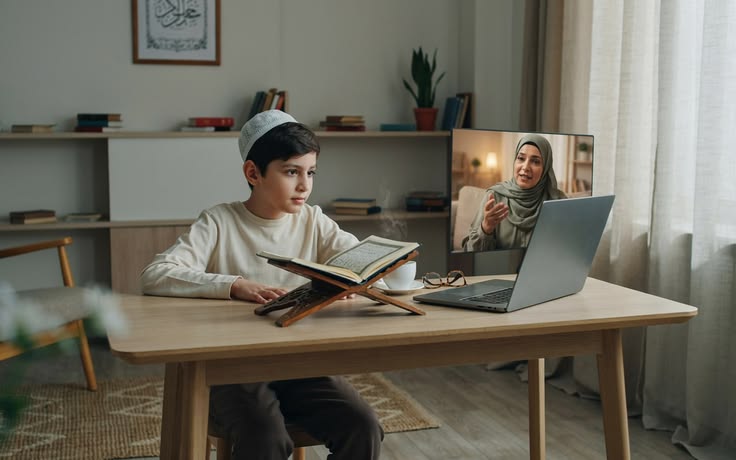
Every child starts at a different level. A good plan builds on existing skills and adds new ones gradually. Depending on the course, lessons may cover the following.
Arabic Alphabet and Pronunciation
Children first learn to recognize letters and pronounce them. They practice letter shapes, sounds, similar letters such as س (Seen) and ص (Saad), and the short vowels Fathah, Kasrah, and Dammah.
Noorani Qaida and Reading Foundations
Many beginners use Noorani Qaida or Noor Al-Bayan to learn how letters form words. Lessons cover connecting letters, short and long vowels, Sukoon, Shaddah, and blending sounds. Guided practice helps children who know individual letters but struggle to read whole words.
Learning Tajweed with an Online Quran Teacher
As children progress, they apply their reading skills to Quranic text and learn Tajweed step by step, such as:
- Makharij al-Huruf: articulation points of letters
- Madd: lengthening certain sounds
- Ghunna: nasalization
- Basic stopping rules: where and how to pause
The teacher introduces one concept at a time instead of all the rules at once.
Memorizing Short Surahs
Children can begin with short surahs from Juz’ Amma. A simple routine is to listen to a correct recitation, repeat each verse, connect the verses, and review earlier memorization. Judge progress by how well your child retains the material, not how fast they learn new verses.
If you want your child to learn Quranic meanings, Tafsir, or Islamic Studies, confirm they are included in the course, as they are often offered separately.
Quran Lessons by Age Group
Age is a guide, not a rule. Previous experience, attention span, and goals matter just as much.
- Preschoolers (Ages 3–5): Lessons introduce the Quran gently with simple instructions: recognizing letters, listening to sounds, and repeating examples. A 30-minute lesson may suit them, depending on attention span.
- Ages 6–8: Children are ready for more structured reading. Beginners can use Noorani Qaida or Noor Al-Bayan, while experienced readers continue developing fluency and may start short surahs. Thirty to Forty Five minutes is often a practical length.
- Ages 9–12 and Teenagers: Older children and teenagers can work toward specific goals such as accuracy, fluency, advanced Tajweed, memorization, or understanding meanings. Clear, achievable goals help them see their progress. A teenager who is new to Arabic may still need beginner lessons, so start from actual ability, not age.
What Progress Looks Like: A Realistic Timeline
Parents often ask how long it takes for a child to read the Quran. The honest answer is that it depends on your child’s age, starting level, attention span, and how regularly they practice. The timeline below is a general guide for a beginner starting from zero, not a promise.
| Time | What many beginners work on |
|---|---|
| First month | Recognizing Arabic letters, learning their sounds, and getting comfortable with the teacher and the lesson routine |
| Months 2–3 | Short vowels, connecting letters, and reading simple words with guided practice |
| Months 4–6 | Reading longer words and short lines more smoothly, starting basic Tajweed rules, and possibly beginning a short surah |
| After 6 months | Gradually moving toward Quran reading with Tajweed and memorization, depending on goals |
A few things can speed up or slow down progress:
- Regular lessons and revision: Three or Four lessons a week with short practice in between usually helps more than occasional long sessions.
- Age and attention span: Younger children may need more repetition and shorter lessons.
- Previous experience: A child who already knows some letters will move faster.
- Consistency: Long gaps between lessons can mean repeating earlier material.
Don’t judge your child by a fixed schedule. Ask the teacher for specific feedback after each stage, such as what your child can now do independently and what needs more practice. That tells you more about progress than any calendar.
How Does a Quran Teacher for Kids Online Conduct Lessons?
A well-organized lesson gives children time to review, practice, and receive guidance suited to their level.
Initial Assessment and Learning Plan
The teacher first finds out what your child already knows by checking letter recognition, listening to their reading, and noting areas that need practice. Then they build a plan around your child’s goals. Beginners focus on foundations, while readers work on fluency, Tajweed, or memorization. The plan should be flexible enough to revisit difficult skills.
Live Reading and Recitation Practice
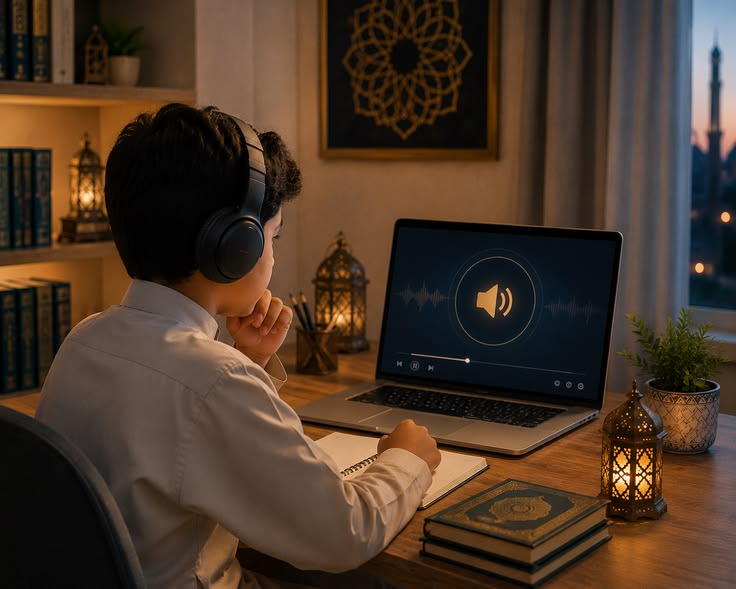
A typical session may include:
- Review: previous letters, verses, or memorized passages
- New material: a skill or passage at a suitable pace
- Guided practice: your child reads aloud while the teacher listens
- Correction: practicing difficult sounds
- Recap: the main point of the lesson
Homework and Parent Communication
Short revision between lessons helps children retain what they learn, such as rereading a passage or reviewing memorized verses. Keep it manageable and pressure-free. Progress shows in accuracy, pronunciation, fluency, and recall.
Talk regularly with the teacher about your child’s level, areas to improve, and recommended revision. At Areeb Academy, parents can contact the administration with any questions, feedback, or concerns about their child’s learning experience, scheduling, or course arrangements
How Often Should Kids Take Online Quran Classes?
Two or three lessons per week is a practical starting point for many families, but the right frequency depends on your child’s level, goals, and routine.
Two, Three, or More Classes
- Two classes: suit beginners who need regular instruction plus manageable revision.
- Three classes: help children who benefit from more reading practice.
- More: may suit specific memorization goals if the routine stays manageable.
More is not automatically better. Check that your child is retaining the material and not feeling overwhelmed.
Are 30-Minute Lessons Enough?
Yes. A focused 30-minute lesson is enough to review, practice a skill, or work on a short passage. It suits younger children, including those under seven, who may struggle to concentrate for longer.
When to Consider 45 or 60 Minutes
A 45-minute lesson gives older or stronger learners more time for fluency, Tajweed correction, or memorization. A 60-minute lesson may suit advanced learners who can stay focused. Consider attention span, level, and daily routine. The longest session is not always the best one.
→ Explore our packages and find the right option for your child.
How to Keep Kids Engaged in Online Quran Classes
Children participate more when lessons let them respond, practice, and work toward achievable goals.
- Games, Stories, and Visuals
A teacher may ask a beginner to find letters on a shared screen, repeat a sound, or connect letters in a short word. Age-appropriate stories can introduce Islamic values. Activities should reinforce the lesson, not distract from it.
- Small, Achievable Goals
Big goals can feel overwhelming. A lesson goal might be to learn a few letters, read a short line alone, practice one Tajweed rule, or revise a memorized passage. Steady improvement matters more than speed.
- Celebrating Progress Without Pressure
Praise improvements in pronunciation, independent reading, or memorization, and acknowledge the effort. Avoid comparing siblings or classmates. Every child develops at their own pace.
How Parents Can Support Kids in Online Quran Lessons at Home
You don’t need to read Arabic to help your child succeed with a Quran teacher for kids online. Your role is to create the right conditions, not to teach. Here is what makes the biggest difference.
- Choose a quiet, consistent space: Pick a spot with minimal distractions and a clear view of the screen. Test the sound before the first lesson so your child can hear the teacher clearly.
- Keep a fixed lesson time: A regular schedule turns lessons into a habit. Try to avoid times when your child is tired or hungry.
- Listen to your child’s practice: Even if you can’t judge pronunciation, you can sit nearby and listen. Children often read more carefully when someone is paying attention.
- Ask the teacher what to revise: Ask which one skill deserves the most attention between lessons. Short, specific revision works better than long, vague practice.
- Praise effort, not speed: Recognize the work your child puts in, and avoid comparing them with siblings or classmates.
- Stay in touch with the teacher: A quick check-in about your child’s progress helps you support what is being taught.
If your child resists practice, shorten the revision time instead of pushing harder. Consistency matters more than length.
How to Choose the Best Quran Teacher for Kids Online
Once you know what your child needs, compare teachers on qualifications, experience, teaching approach, and fit with your family’s schedule.
Choosing a Quran Teacher for Kids Online: Qualifications and Experience
Ask about the teacher’s training in recitation and Tajweed, and about an Ijazah if relevant. Ask whether they have taught children of your child’s age and level, and how they respond when a child loses focus or struggles with a sound. Also ask how they will assess your child’s level and what the learning plan will look like.
Book a Trial Class
A trial class lets you see the teacher’s approach before committing. Check whether the teacher:
- Checks your child’s existing knowledge
- Gives clear, age-appropriate instructions
- Corrects mistakes constructively
- Lets your child participate
- Adjusts the pace to your child’s level
Afterward, ask your child what felt easy or difficult. One trial can’t predict everything, but it helps you decide.
Final Thoughts
The right Quran teacher for kids online helps your child build confidence, improve recitation, and grow closer to the Quran. Choose someone who understands your child’s needs, keeps lessons engaging, and guides them at the right level.
Start Your Kids’ Quran Journey with Areeb Academy
Areeb Academy offers personalized one-on-one online Quran lessons with:
- Native Arabic-speaking male and female teachers, including Ijazah-qualified teachers
- Experienced teachers who work patiently with children
- Interactive lessons that keep children engaged
- Personalized plans based on your child’s age, level, and goals
- Flexible 30, 45, or 60-minute lessons
Book a FREE trial and find the right approach for your child.
Frequently Asked Questions
1. What is the best age to start Quran classes?
When your child is ready to learn Arabic letters and basic reading. Match lessons to their age and attention span.
2. How long should a child’s Quran lesson be?
Lessons are available in 30, 45, and 60 minutes. For children under seven, 30 minutes is often a good start.
3. How many times a week should my child take Quran classes?
Three or four lessons per week is a good starting point, depending on goals and schedule.
4. Can I request a female Quran teacher?
Yes, based on your preferences and availability.
5. Does my child need to know Arabic before starting?
No. Beginners start with Arabic letters, pronunciation, and foundational reading.