
Zakat is one of the most important obligations in Islam, yet many Muslims still have questions about how it works — who has to pay it, how much is due, and who is eligible to receive it. Understanding Zakat isn’t just about fulfilling a religious duty; it’s about connecting with one of the core values of Islam: caring for those in need while purifying your own wealth and heart.
This guide walks through everything you need to know about Zakat — its meaning and spiritual purpose, who must pay it, how to calculate it step by step, the Nisab and Hawl conditions, who can and cannot receive it, and how it differs from Sadaqah and Zakat Al-Fitr. Whether you’re calculating your Zakat for the first time or simply want a clear refresher, this article covers the essentials in one place.
What Is Zakat in Islam?
Zakat is a mandatory act of worship and one of the Five Pillars of Islam. It requires Muslims who meet certain wealth requirements to give a portion of their qualifying wealth to eligible recipients. Unlike voluntary charity (Sadaqah), Zakat is a religious obligation for Muslims who meet its conditions.
Zakat helps purify a Muslim’s wealth and encourages generosity, responsibility, and care for those in need. It supports a stronger, more compassionate Muslim community by directing part of the wealth of those who have enough toward people facing financial hardship. The Quran emphasizes Zakat throughout its verses, often mentioning it alongside prayer (Salah). This reminds Muslims that wealth is a blessing from Allah, bringing both benefits and responsibilities.
As one of the Five Pillars of Islam, Zakat is part of the foundation of Muslim life. To explore the five pillars, their meanings, and their importance, read our guide to the [5 Pillars of Islam in order].
Meaning of the Word Zakat
The word Zakat comes from an Arabic root associated with purification, growth, and blessing. When Muslims give Zakat, they recognize that the wealth Allah has blessed them with is a gift and a trust from Him. Giving from that wealth helps purify the heart from greed, nurture gratitude, and remind believers to use Allah’s blessings in ways that please Him. Zakat is therefore more than simply giving money to others — it is an act of worship that brings spiritual growth and strengthens a Muslim’s relationship with Allah.
The Spiritual Purpose of Zakat in Islam
Beyond helping people in financial need, Zakat frees the heart from excessive attachment to wealth, greed, and selfishness. The Quran describes charity as a means of purification and growth:
خُذْ مِنْ أَمْوَٰلِهِمْ صَدَقَةًۭ تُطَهِّرُهُمْ وَتُزَكِّيهِم بِهَا وَصَلِّ عَلَيْهِمْ ۖ إِنَّ صَلَوٰتَكَ سَكَنٌۭ لَّهُمْ ۗ وَٱللَّهُ سَمِيعٌ عَلِيمٌ ١٠٣
“Take from their wealth charity by which you purify them and cause them to grow.” Surah At-Tawbah 9:103
Zakat also develops gratitude, generosity, compassion, and trust in Allah, benefiting both the giver and the recipient — the giver grows spiritually while the recipient receives support.
Zakat Supports the Community
The Quran identifies specific categories of people who may receive Zakat, including the poor, needy, debtors, and stranded travelers. It can help cover food, housing, medical needs, and qualifying debts — creating a system of support that helps eligible recipients live with greater dignity, while reducing extreme differences in wealth and strengthening compassion and solidarity within the Muslim community.
Who Has to Pay Zakat?

Zakat is not required from every Muslim. A person becomes liable when their eligible wealth meets certain conditions:
- Being Muslim — Zakat is a religious obligation for Muslims.
- Owning enough wealth — eligible wealth must reach or exceed the Nisab (the minimum threshold).
- Having full ownership — the person must control and be able to use the wealth.
- Meeting the Hawl — for most wealth types, it must stay at or above the Nisab for one complete Islamic lunar year.
- Having wealth beyond basic needs — Zakat applies to surplus wealth, not essential housing, food, clothing, or necessary belongings.
- Considering debts — outstanding debts may affect whether a person is liable.
Rules can vary by the type of wealth and school of Islamic thought, so when in doubt, consult a qualified scholar or trusted Zakat calculator.
What Is the Nisab?
The Nisab is the minimum amount of wealth a Muslim must own before Zakat becomes due, traditionally based on:
- ~87.48 grams of gold (some scholars use 85g)
- ~612.36 grams of silver (some sources use 595g)
Because gold and silver prices fluctuate, the Nisab’s monetary value changes too — multiply the current price per gram by the applicable weight to find today’s value in your currency.
Gold vs. silver Nisab: Since the silver Nisab has a lower monetary value, using it means more people with savings become liable for Zakat — some contemporary scholars recommend this standard, especially for cash. Scholarly opinion differs, particularly for mixed assets, so consult a trusted authority if unsure.
What Is the Hawl?
The Hawl is the one complete Islamic lunar year that most Zakatable wealth must remain above the Nisab before Zakat is due. Since the lunar year is shorter than the Gregorian year, use the Islamic calendar when tracking it. The Hawl doesn’t apply the same way to every asset — agricultural produce, for example, is Zakatable at harvest rather than after a full year.
How Much Is Zakat in Islam?
For most types of wealth, the standard rate is 2.5% — one-fortieth of eligible wealth, paid once each lunar year.
Formula: Net Zakatable Wealth × 2.5% = Zakat Due
Example: If your net Zakatable wealth is $10,000, your Zakat is $10,000 × 2.5% = $250.
The 2.5% rate applies once your wealth reaches the Nisab, the Hawl has passed, and the wealth is a type subject to this rate. Note that Zakat is calculated on Zakatable wealth and savings — not simply on annual income; your salary isn’t automatically subject to 2.5% as soon as you receive it.
Rates by Type of Wealth
| Type of Wealth | General Zakat Rate |
|---|---|
| Cash and savings | 2.5% |
| Gold and silver | 2.5% |
| Business inventory | 2.5% |
| Certain investments | Generally 2.5% on the Zakatable portion |
| Agricultural produce | 5% or 10%, depending on irrigation method |
| Livestock | Varies by type and number of animals |
Investments, livestock, and crops have more complex rules, so consult a qualified scholar for these.
How to Calculate Zakat

Step 1 — List your Zakatable assets: cash at home, bank balances, gold and silver, business inventory, certain investments, and money owed to you that you expect to receive. Your home, everyday clothing, furniture, and personal vehicle are generally excluded.
Step 2 — Identify deductible liabilities: debts currently due, overdue payments, certain short-term liabilities, and the portion of longer-term debt due within the relevant period. Rules on deductions vary, so follow a reliable method or ask a scholar if your situation is complex.
Step 3 — Check the Nisab: compare your net Zakatable wealth to the current gold or silver Nisab value.
Step 4 — Calculate 2.5%: once you’ve confirmed you meet the Nisab and Hawl, multiply your net wealth by 2.5%.
Example: Zakatable assets $15,000 − deductible liabilities $3,000 = net wealth $12,000. Zakat = $12,000 × 2.5% = $300.
Worked example — Sarah: Sarah has $8,000 in savings, $2,000 in cash, $4,000 in gold, and $2,000 in investments — a total of $16,000. After deducting $1,000 in liabilities, her net wealth is $15,000. If this exceeds the Nisab and the Hawl has passed: $15,000 × 2.5% = $375 owed.
Zakat calculations vary by wealth type, debts, investments, and school of jurisprudence — use a reliable calculator or consult a scholar for your personal situation.
What Types of Wealth Are Subject to Zakat in Islam?
- Cash and savings — cash at home, bank accounts, savings, digital money. Generally 2.5% once the Nisab and conditions are met.
- Gold and silver — coins, bullion, and jewelry (rules on jewelry differ by scholar, so follow a trusted authority).
- Business assets — merchandise, inventory, and goods held for resale, assessed at current market value; standard rate 2.5%.
- Investments — stocks, mutual funds, and certain digital/cryptocurrency assets. Treatment depends on whether the asset is held for trading, investment, or income — consult an advisor for complex portfolios.
- Agricultural produce and livestock — produce is Zakatable at harvest, with the rate depending on irrigation method; livestock (cattle, sheep, goats, camels) is Zakatable once they reach specific minimum numbers. These follow more detailed rulings than the standard 2.5%.
Generally not subject to Zakat: your primary home, personal clothing, household furniture, your personal vehicle, and tools/equipment needed for work — unless purchased or held for trade or investment.
Who Does Islam Allow to Receive Zakat?

The Quran specifies eight eligible categories:
۞ إِنَّمَا ٱلصَّدَقَـٰتُ لِلْفُقَرَآءِ وَٱلْمَسَـٰكِينِ وَٱلْعَـٰمِلِينَ عَلَيْهَا وَٱلْمُؤَلَّفَةِ قُلُوبُهُمْ وَفِى ٱلرِّقَابِ وَٱلْغَـٰرِمِينَ وَفِى سَبِيلِ ٱللَّهِ وَٱبْنِ ٱلسَّبِيلِ ۖ فَرِيضَةًۭ مِّنَ ٱللَّهِ ۗ وَٱللَّهُ عَلِيمٌ حَكِيمٌۭ
“Zakat expenditures are only for the poor, the needy, those employed to collect it, those whose hearts are to be reconciled, those in bondage, those in debt, for the cause of Allah, and the stranded traveler.” Surah At-Tawbah 9:60
- The Poor (Al-Fuqara) — those with little or no wealth.
- The Needy (Al-Masakin) — those with some income who still can’t cover essential expenses.
- Zakat Administrators (Al-Amilina Alayha) — those appointed to collect and distribute Zakat.
- Those Whose Hearts Are to Be Reconciled (Al-Mu’allafati Qulubuhum) — scholars differ on how broadly this applies today.
- Those in Bondage (Fir-Riqab) — historically, helping enslaved people gain freedom.
- Those in Debt (Al-Gharimun) — people with legitimate debts they cannot repay.
- In the Cause of Allah (Fi Sabilillah) — meaning and modern application is debated among scholars.
- The Stranded Traveler (Ibn Al-Sabil) — travelers who’ve lost access to their money.
Not everyone experiencing hardship automatically qualifies — eligibility depends on falling within one of these categories under Islamic law.
Who Cannot Receive Zakat?
- Parents/grandparents you’re already responsible for supporting — their support is already your obligation.
- Children/grandchildren you’re responsible for supporting.
- Other relatives (a poor sibling, aunt, uncle, or cousin) can receive Zakat if eligible, combining support with maintaining family ties.
- Non-Muslims — most scholars don’t consider them eligible for Zakat, though Sadaqah can be given to them freely.
Zakat in the Quran and Sunnah
The Quran repeatedly pairs Zakat with Salah, showing that Islam combines spiritual devotion with social responsibility:
وَأَقِيمُوا۟ ٱلصَّلَوٰةَ وَءَاتُوا۟ ٱلزَّكَوٰةَ وَٱرْكَعُوا۟ مَعَ ٱلرَّٰكِعِينَ ٤٣
“And establish prayer and give Zakat and bow with those who bow.” Surah Al-Baqarah 2:43
When the Prophet ﷺ sent Mu’adh ibn Jabal to Yemen, he explained that after worshiping Allah alone and establishing prayer, Muslims must give Zakat from their wealth to the poor. This shows that Zakat is not an optional donation.
After the Prophet’s death, Abu Bakr رضي الله عنه firmly upheld this obligation and rejected the idea that Muslims could separate Zakat from Salah.
Zakat vs. Sadaqah
| Zakat | Sadaqah | |
|---|---|---|
| Status | Obligatory for eligible Muslims | Voluntary |
| Amount | Fixed by wealth type | No fixed amount |
| Timing | Generally annual, after the Hawl | Anytime |
| Recipients | Must meet specific eligibility rules | Can be given more broadly |
| Form | Based on qualifying wealth/assets | Money, goods, or acts of kindness |
Muslims can give both — Zakat fulfills the obligatory duty, while Sadaqah is additional voluntary giving throughout the year (even a kind word or helping someone counts as Sadaqah).
When Should You Pay Zakat?
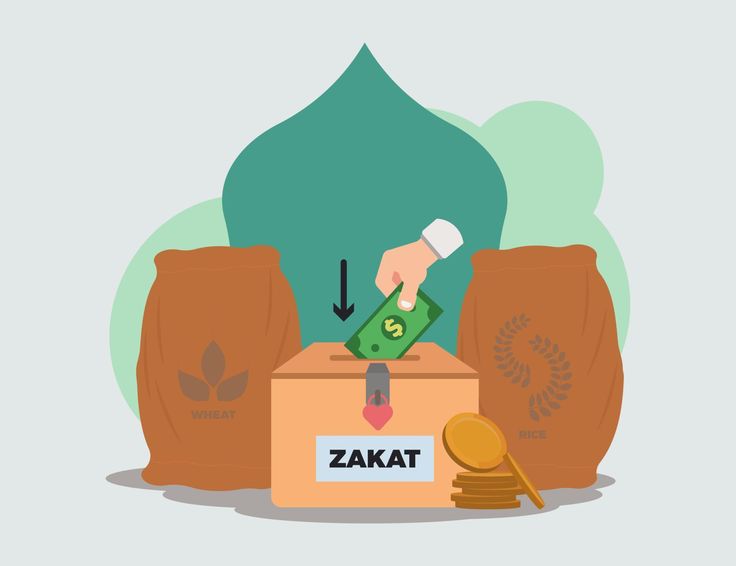
Zakat is due once your eligible wealth has stayed at or above the Nisab for a full lunar year — so your personal Zakat date depends on when you first became eligible, and may differ from Ramadan.
Does it have to be paid in Ramadan? No — though many Muslims choose to pay during Ramadan because charitable acts are especially encouraged then. If your Zakat becomes due at another time, pay it then rather than waiting.
Choosing your date: it’s helpful to pick a fixed date each year (often the date your wealth first reached the Nisab) and keep a record, making it easier to review your savings, gold, investments, and other assets annually.
Paying in advance: this is permitted in certain circumstances — calculate carefully and keep track so your annual obligation is properly fulfilled. Consult a scholar if unsure.
Zakat Al-Mal vs. Zakat Al-Fitr in Islam
| Zakat Al-Mal | Zakat Al-Fitr | |
|---|---|---|
| Basis | Qualifying wealth and assets | Each eligible person |
| Timing | After the Hawl | End of Ramadan, before Eid prayer |
| Amount | Usually 2.5% | A fixed amount per person |
| Purpose | Purifies wealth; supports eligible recipients | Helps the needy prepare for Eid |
| Eligibility | Reaching the Nisab and other conditions | Being financially capable at Ramadan’s end |
Zakat Al-Fitr (also called Sadaqat Al-Fitr) isn’t a percentage of savings — it’s a fixed amount per person, traditionally a specific quantity of staple food or its monetary equivalent.
Common Mistakes When Calculating Zakat in Islam
- Calculating 2.5% on the wrong assets, or basing Zakat only on bank balances while forgetting gold, investments, or business inventory — review all your qualifying wealth each year.
- Confusing Zakat with regular charity — Sadaqah given throughout the year doesn’t replace the Zakat you owe; keep them separate.
- Assuming Zakat is only paid in Ramadan — your due date depends on when your wealth met the Nisab and completed its Hawl, not the Islamic calendar month.
Keeping a record of your annual Zakat date and reviewing your qualifying assets beforehand makes the process easier and helps you fulfill the obligation accurately.
Final Thought
Zakat is far more than a financial calculation — it’s an act of worship that purifies your wealth, strengthens your faith, and directly supports people in your community who need it most. Getting the details right (the Nisab, the Hawl, which assets qualify, who’s eligible to receive) helps ensure your Zakat is both valid and impactful. But just as important as the numbers is the knowledge behind them — understanding why Zakat matters, and how it fits into the wider picture of Quran, Sunnah, and Islamic practice.
If you’d like to deepen that understanding, Areeb Academy offers online classes for all ages, with:
- Flexible schedules that fit around your daily life.
- Learn Quran recitation, Tafsir (Quranic interpretation), Islamic studies, and more
- Classes are guided by qualified teachers, from wherever you are. Whether you’re a beginner or looking to go deeper
Start your learning journey with Areeb Academy today.
BOOK A FREE TRIAL NOW
FAQs
Is Zakat the same for everyone? No. The amount depends on the type and value of your qualifying wealth. Most cash, savings, gold, and business assets are Zakatable at 2.5%, but agricultural produce and livestock follow different rates and rules.
What happens if I forget to pay Zakat one year?
Pay it as soon as you remember. Zakat does not expire, and Islam discourages delaying it beyond your due date without a valid reason. Calculate the amount you owed when it became due, then pay it as soon as possible.
Can I pay Zakat monthly instead of once a year?
Yes. Some Muslims choose to pay Zakat in monthly installments rather than one lump sum. Just make sure you pay the full amount you owe by your Zakat due date.
Do I pay Zakat on my salary as soon as I receive it?
No. Zakat applies to wealth that remains at or above the Nisab for a full lunar year, not to income as soon as you earn it. Count the portion that remains as savings or other qualifying wealth on your Zakat date.
Is Zakat the same as a tax?
No. Zakat is a religious obligation rooted in worship and guided by specific Islamic rulings. It has its own conditions, recipients, and spiritual purpose. Although Zakat has a required rate and structure, it is not a government tax.