
Understanding the meaning of Inshallah (إن شاء الله) is an essential part of nurturing faith, patience, and trust in Allah in daily life. This simple phrase, meaning “if Allah wills,” goes far beyond being a polite word—it teaches children and adults alike that while we can plan and work hard, the ultimate outcome rests in Allah’s hands. By introducing the phrase early, whether at home, school, or in conversations, we instill values of sincerity, responsibility, and spiritual mindfulness.
In this article, we will explore a simple approach to teaching kids the meaning of Inshallah, practical examples for daily life, and creative ways to make it a natural part of speech, helping them grow with faith and confidence.
Inshallah meaning in simple words

Inshallah (pronounced in-shaa-Allah) is an Arabic phrase that means “if God wills” or “God willing.”
People use it when talking about future plans, hopes, or expectations while recognizing that the future is ultimately in God’s hands.
In simple terms, saying it means:
👉 I plan or hope this will happen, but only if God allows it.
The phrase combines planning with faith, showing humility and acceptance that humans cannot fully control what will happen next.
What inshallah means in English

In English, it is usually translated as:
- If God wills
- God willing
- Hopefully (depending on context)
The literal meaning comes from three Arabic words:
- إن (in) — if
- شاء (shaa) — willed
- الله (Allah) — God
So the full meaning becomes: “If God wills it.”
However, its meaning can slightly change depending on how it’s used in conversation. It may express:
- sincere hope about the future
- a promise with humility
- uncertainty about an outcome
- or simply optimism about something yet to happen
Why Muslims say inshallah in daily life
Muslims say inshaallah because Islam teaches that nothing happens without God’s permission. When mentioning future events, believers are encouraged to remember that outcomes are not completely under human control.
In daily life, the phrase helps express:
✅ Faith and trust in God — acknowledging divine will
✅ Humility — avoiding absolute claims about the future
✅ Hope and optimism — wishing for a positive result
For example:
- “I’ll see you tomorrow, inshallah.”
- “We will finish the project next week, inshallah.”
Importantly, the phrase is not only used by Muslims. Arab Christians and many Arabic speakers from different cultures also use it naturally in everyday speech.
In casual conversation, it can sometimes also mean “hopefully” or even politely soften a response when someone is unsure or doesn’t want to give a direct no — showing how cultural context affects its meaning.
How to write inshallah correctly (and why spelling matters)

Because Arabic uses a different alphabet, inshaAllah appears in English in several spellings. While many versions are understandable, correct spelling matters because it preserves the original meaning of the phrase.
Arabic spelling: إن شاء الله
The correct Arabic form is:
إن شاء الله
This structure is important because it literally means:
👉 “If Allah wills.”
Each word has a specific grammatical role, and together they form a complete religious expression connected to intention and faith.
Common English spellings: inshallah, in sha Allah, in shaa Allah
Since Arabic sounds don’t perfectly match English letters, multiple spellings are widely accepted, such as:
- inshallah
- in sha Allah
- in shaa Allah
- inshaAllah
All of these attempt to represent the same pronunciation and meaning. Differences usually come from dialects, transliteration styles, or personal preference.
The meaning changes if it’s written incorrectly (quick explanation)
Writing the phrase incorrectly in Arabic — especially as انشاء الله — can unintentionally change the meaning.
- إن شاء الله → If God wills ✅ (correct)
- انشاء الله → can linguistically imply creating God ❌ (incorrect meaning)
That’s why many Arabic speakers emphasize writing it properly, especially in religious or formal contexts.
How to pronounce inshallah (beginner-friendly)
Learning how to pronounce inshallah is easier than it looks. The word may seem long at first, but breaking it into small sound parts makes it simple for beginners to say naturally.
The phrase is commonly pronounced as:
In – shaa – Allah
Each part flows smoothly into the next, and with a little practice, it becomes easy to say in everyday conversation.
Easy pronunciation tips
Here’s a beginner-friendly way to pronounce inshaAllah step by step:
1. In
Sounds like the word “in” or rhymes with “pin.”
2. Shaa
Pronounced like “sha” in shadow or shake.
This part is slightly longer and usually carries the emphasis in the word.
3. Allah (lah)
Sounds like “lah”
The ending has a soft, gentle sound rather than a strong stress.
✅ Put together, it sounds like:
in-SHAA-lah or in-shall-AH in natural speech.
Helpful beginner tip:
Many learners find it easier to add a tiny pause at first:
👉 in-shaa… Allah
After practice, native speakers usually connect the sounds smoothly into one flowing word.
Common pronunciation mistakes to avoid
When learning to say inshaAllah, beginners often make a few common mistakes:
❌ Saying it too fast without clear sounds
Try to pronounce each part clearly before blending them together.
❌ Shortening “shaa” too much
The middle sound should be slightly longer. Saying “shaa” too quickly can make the pronunciation sound unnatural.
❌ Over-emphasizing the last syllable
The stress is usually on “shaa,” not on the ending.
❌ Dropping the soft final sound
The last “lah” should be gentle and smooth, not sharp or cut off.
With regular listening and repetition, the pronunciation becomes natural — and you’ll start recognizing how it flows effortlessly in everyday Arabic conversations.
When to say inshallah (everyday situations)
The phrase is mainly used when talking about the future. It expresses intention, hope, or commitment while recognizing that the final outcome is in God’s hands.
People use the phrase to show humility and faith — meaning they plan to do something, but understand that unexpected circumstances may change what happens.
In daily life, inshallah can be used in both religious and casual conversations, depending on context and tone.
Plans and future events

The most common time to say inshallah is when discussing future plans or upcoming events.
Whenever you talk about something that has not happened yet, adding inshallah acknowledges that the future is uncertain and ultimately guided by God’s will.
Examples:
- “I will finish this work tomorrow, inshallah.”
- “We’ll travel next summer, inshallah.”
- “See you tomorrow, inshallah.”
In this context, the phrase simply combines planning with hope and humility.
Promises and commitments (what it should NOT mean)
When making promises or agreeing to requests, it shows sincere intention while recognizing that things may happen beyond your control.
For example:
- “I will pick up the kids after school, inshallah.”
- “I’ll send you the report tonight, inshallah.”
However, culturally the phrase is sometimes used to politely avoid giving a definite answer. In some situations, it may imply “maybe” or a soft refusal instead of directly saying no.
⚠️ Important:
InshaAllah should not be used when you already know you have no intention of doing something. Using it to escape responsibility or mislead others goes against the sincerity behind the phrase.
The ideal use reflects honest intention combined with trust in God — not avoidance.
Duas and hopes (beautiful ways to use inshallah)
InshaAllah is also commonly used when expressing hopes, dreams, or wishes for good outcomes.
People say it when hoping for success, health, or positive life events, such as:
- “I hope I pass my exam, inshallah.”
- “Inshallah, everything will get better soon.”
- “Inshallah, your family stays healthy and happy.”
Here, the phrase becomes a gentle expression of optimism and faith, reminding the speaker that effort matters, but the result ultimately belongs to God.
💡 One important distinction:
When making direct supplication (du‘a), Muslims are encouraged to ask God with certainty rather than conditionally. Instead of saying, “O Allah forgive me, inshallah,” the preferred form is a direct request: “O Allah, forgive me.”
Inshallah etiquette (adab): saying it with sincerity
In Islam, saying inshaAllah is more than a cultural habit or everyday expression. It is part of Islamic etiquette (adab) and reflects a sincere acknowledgment that the future is entirely in Allah’s control.
When said with sincerity (ikhlās), the phrase becomes an act of faith — showing humility, trust, and submission to Allah’s will. It reminds believers that while humans make plans, only Allah determines the final outcome.
Using inshaAllah properly involves intention, honesty, and responsibility, not just words spoken out of habit.
Inshallah is not a “maybe” or an excuse
Although in casual conversations some people use inshaAllah to mean “maybe,” this is not its true purpose in Islamic etiquette.
Saying inshaAllah should never be:
- a polite way to avoid commitment
- an indirect way to say “no”
- an excuse for delay or irresponsibility
Instead, it should reflect a genuine intention to fulfill what you are saying while recognizing that circumstances remain in Allah’s hands.
Before saying inshallah, a person should honestly ask themselves whether they truly intend to do what they promise. Without sincere intention, the phrase loses its spiritual meaning.
Matching words with action: planning and effort with inshallah

True sincerity means combining trust in Allah with personal effort.
Islam teaches that saying inshaAllah does not replace planning or hard work. A believer is expected to:
- make realistic plans
- take practical steps
- put in sincere effort
- then rely on Allah for the result (tawakkul)
For example, saying “I will succeed, inshaAllah” should be followed by studying, preparation, and consistent effort — not passivity.
If the outcome turns out differently than expected, sincerity also means accepting Allah’s decree with patience and contentment, trusting that His wisdom is greater than human understanding.
In this way, inshallah transforms from a simple phrase into a reminder to act responsibly while keeping the heart connected to faith.
Inshallah vs mashallah vs alhamdulillah (don’t mix them up)
Arabic contains many common phrases that express a Muslim’s reliance on, praise for, and appreciation of Allah. Three of the most frequently used are InshaAllah, Mashallah, and Alhamdulillah. While they may sound similar, each has a distinct purpose and context.
Inshallah: for the future
- Meaning: “If Allah wills” or “God willing” (إن شاء الله)
- Usage: Refers to future plans, intentions, or hopes, acknowledging that the outcome is ultimately in Allah’s hands.
- Examples:
- “I will finish the report tomorrow, Inshallah.”
- “See you at the meeting tomorrow, Inshallah.”
- Key Note: Indicates commitment or hope but recognizes that only Allah controls the outcome. Used by Muslims and Arabic speakers of other faiths alike.
Mashallah: for admiration and protection from envy
- Meaning: “What Allah has willed” (ما شاء الله)
- Usage: Used to praise beauty, success, or good fortune, often in the present or past. It also serves as a shield against envy or the “evil eye.”
- Examples:
- “She has a beautiful voice, Mashallah.”
- “Mashallah, your garden is amazing.”
- Key Note: While it expresses admiration, it also acknowledges that all good things come from Allah.
👉 If you’d like to explore the deeper meaning, spiritual wisdom, and everyday usage of this phrase, you can read our detailed guide on Mashallah meaning and proper usage
Alhamdulillah: for gratitude after something happens
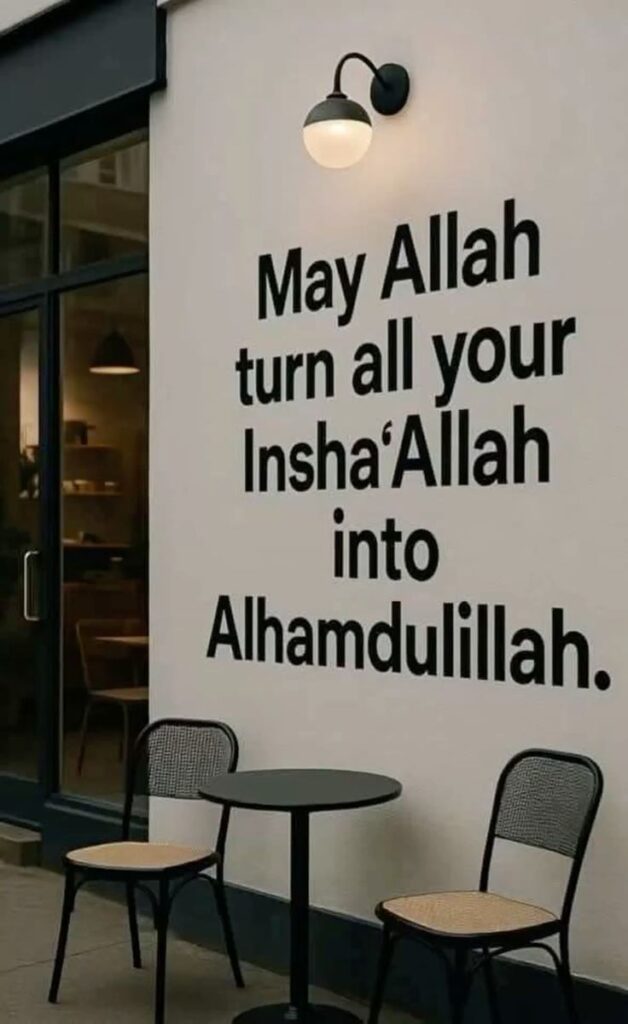
- Meaning: “All praise is due to Allah” (الحمد لله)
- Usage: Expresses gratitude for blessings, relief, survival, or any positive outcome. Can also be used in everyday greetings to answer “How are you?”
- Examples:
- “Alhamdulillah, I passed the exam.”
- “How are you?” — “Alhamdulillah, I am well.”
- Key Note: Recognizes and appreciates what Allah has provided, whether in the present or for past events.
👉 If you want to understand the deeper spiritual meaning and everyday use of this beautiful expression, read our full guide on Alhamdulillah meaning and how to use it correctly
Inshallah examples (Arabic + English)
“Inshallah” isn’t just a word—it’s a way to show hope, faith, and humility in everyday life. Here are some real-life examples you can use right away.
Short sentences you can copy and use today
| Arabic | English |
|---|---|
| سأزور جدتي غدًا إن شاء الله | I will visit my grandmother tomorrow, Inshallah |
| سأحضر الاجتماع بعد الظهر إن شاء الله | I will attend the meeting in the afternoon, Inshallah |
| سأخلص هذا المشروع الأسبوع القادم إن شاء الله | I will finish this project next week, Inshallah |
| سأجرب الطبخة الجديدة اليوم إن شاء الله | I’ll try the new recipe today, Inshallah |
| سأذهب إلى السوق بعد الصلاة إن شاء الله | I’ll go to the market after prayer, Inshallah |
Inshallah in polite replies (work, school, family)
Using “Inshallah” can be a graceful way to respond without over-promising:
| Situation | Arabic | English |
|---|---|---|
| Work task | سأرسل التقرير قبل الخامسة إن شاء الله | I’ll send the report before 5 PM, Inshallah |
| School assignment | سأدرس للفصل القادم إن شاء الله | I’ll study for the next lesson, Inshallah |
| Family request | سأحضر الغداء غدًا إن شاء الله | I’ll join for lunch tomorrow, Inshallah |
| Invitation | شكرًا على الدعوة، سأحاول الحضور إن شاء الله | Thank you for the invitation; I’ll try to come, Inshallah |
| Help with chores | سأساعدك في التنظيف لاحقًا إن شاء الله | I’ll help you clean later, Inshallah |
Cultural Note: Using “Inshallah” in replies shows respect and acknowledgment of Allah’s will while staying polite. It’s perfect for professional, casual, and family settings.
Common mistakes people make with inshallah
“Inshallah” is a powerful phrase, but misusing it can dilute its meaning or create misunderstandings. Here are the most common mistakes and how to avoid them.
Using inshaAllah to delay or avoid
- Polite “No” or Deception: Saying “I’ll be there, Inshallah” when you actually don’t intend to go.
✅ Correction: Be honest if you cannot commit. Inshallah should reflect sincere intent. - Replacing Effort: Believing “Inshallah” is enough without planning or acting.
✅ Combine intention with actual effort, then leave the outcome to Allah.
Overusing inshallah in a confusing way
- Past or Absolute Events: Saying “I went to the store, Inshallah” is incorrect.
✅ Only use Inshallah for future actions over which you don’t have complete control. - Misuse in Du’a (Supplication): “Oh Allah, forgive me, Inshallah” implies doubt in Allah’s will.
✅ Du’a should be confident and direct: “Oh Allah, forgive me.”
Cultural tone differences (how it may sound to non-Muslims)
- Professional Settings: Constantly saying Inshallah without following through may appear unprofessional.
- Non-Muslim perception: Overuse or casual usage can confuse non-Muslims, making it seem like a vague “maybe.”
✅ Balance sincerity with clarity, especially in work or formal communication.
Summary:
- Only say Inshallah if you truly intend to do the action.
- Use it for future events to acknowledge Allah’s will.
- Pair it with genuine effort and responsibility.
- Avoid mispronunciations, misapplications, and casual overuse that could mislead or confuse.
Teaching kids the meaning of inshallah (simple approach)

Teaching children the meaning of Inshallah (إن شاء الله) helps them understand trust, patience, and reliance on Allah while keeping plans and actions meaningful.
A short explanation for ages 4–7
- Simple definition:
Inshallah means “If Allah wills” – we plan to do something, but Allah decides if it actually happens. - Kid-friendly analogy:
Imagine building a sandcastle: you do your best, but a big wave (Allah’s plan) might change the outcome. Saying Inshallah shows you trust Allah. - Key points for children:
- It’s not “maybe” – it’s a sincere hope.
- It goes with effort – you still try your best.
- It teaches humility – we’re not in control of everything.
- Examples to use daily:
- “We’ll go to the playground tomorrow, Inshallah.”
- “You’ll finish your drawing, Inshallah.”
- “I will help you clean your room, Inshallah.”
A practical habit: “plan + inshallah + action”
- Step 1: Plan – Decide what you want to do (e.g., homework, chores, trip).
- Step 2: Say Inshallah – Acknowledge Allah’s will for the outcome.
- Step 3: Act – Put in your best effort to accomplish the plan.
Activities to reinforce the habit:
- Role-playing: Children pretend to make plans and add Inshallah to their sentences.
- Storytelling: Share stories from the Quran (like Surah Al-Kahf 18:23-24) where the Prophet ﷺ used Inshallah.
- Modeling: Adults use Inshallah sincerely in conversations, explaining why it’s said.
By repeating this habit, children learn that Inshallah is not just a word—it’s a way to combine faith, effort, and trust in Allah’s plan.
Final Thought
Understanding and using Inshallah is more than just learning a phrase—it’s about instilling faith, patience, and trust in Allah’s plan. By teaching children (and practicing ourselves) the true meaning of Inshallah, we nurture sincerity, responsibility, and hope for the future. Incorporating it into daily life helps create mindful, spiritually aware individuals who approach life with humility and reliance on Allah.
Want to unlock more Islamic meanings?
At Areeb Academy, we bring these lessons to life:
- Excellent Teachers – Native Arabic speakers, fluent in English, fully certified.
- Flexible, One-to-One Classes – Tailored to your schedule for the best learning experience.
- High-Quality, Engaging Quran / Islamic Studies and Arabic Fusha Lessons – Fun, interactive, and practical for kids of all ages.
- Free Trial Available – Book a FREE class today and experience the quality yourself!
FAQs
1- What does Inshallah mean in Islam?
Inshallah (إن شاء الله) means “if Allah wills.” Muslims use it when talking about future plans to acknowledge that the outcome ultimately depends on Allah’s will.
2- When should you say Inshallah?
You should say Inshallah when speaking about future intentions or plans, such as meetings, travel, studying, or any event that has not happened yet.
3- Is Inshallah the same as saying “maybe”?
No. Inshallah does not mean “maybe.” It expresses sincere intention to do something while recognizing that only Allah controls what happens in the future.
4- Can non-Muslims say Inshallah?
Yes. The phrase is widely used culturally across Arabic-speaking communities by Muslims and Christians alike, especially when discussing future events.
5- What is the difference between Inshallah, Mashallah, and Alhamdulillah?
- Inshallah → used for future plans (“if Allah wills”).
- Mashallah → used to admire something good or beautiful and protect from envy.
- Alhamdulillah → used to express gratitude and thankfulness for blessings.