

Fasting during Ramadan becomes even more spiritually rewarding when paired with the right supplications. Suhoor and Iftar Duas help you start and end your fast with intention, gratitude, and reflection, making every day of Ramadan an opportunity to draw closer to Allah. These short, easy-to-remember duas are perfect for both adults and children, ensuring that your fast is not just physical, but deeply meaningful.
Learn the essentials of Ramadan 2026, including key dates and tips to keep your fast meaningful here.
Why suhoor and iftar duas matter in Ramadan
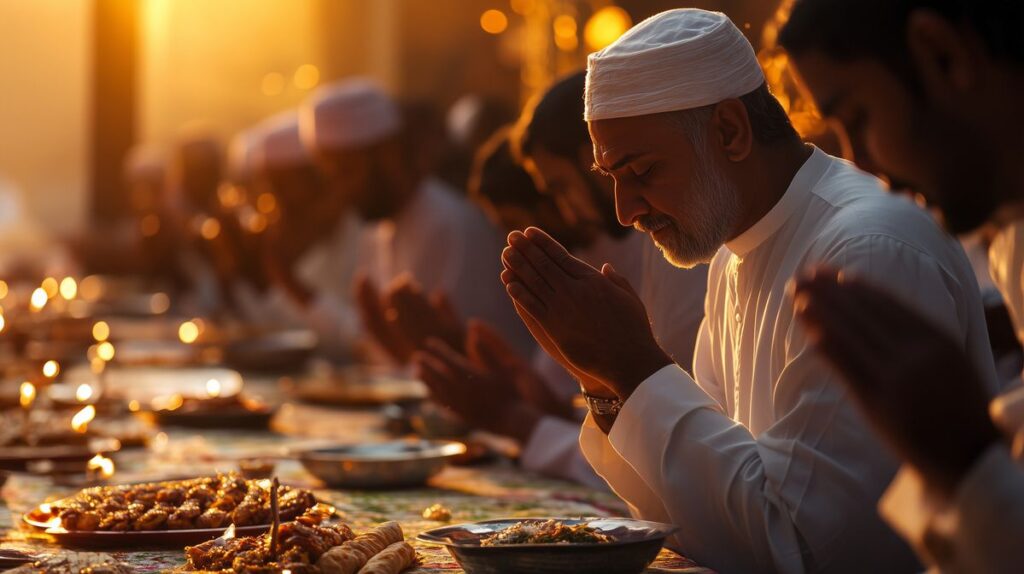
Suhoor and iftar duas are more than rituals—they are moments of deep spiritual connection, gratitude, and devotion. The Prophet Muhammad (PBUH) taught that the supplication of a fasting person, particularly at the time of breaking the fast, is never rejected. These duas allow you to seek forgiveness, reflect spiritually, and make personal requests, turning the physical acts of eating into powerful worship.
The Prophet Muhammad said: “ ثَلاَثَةٌ لاَ تُرَدُّ دَعْوَتُهُمُ الصَّائِمُ حَتَّى يُفْطِرَ وَالإِمَامُ الْعَادِلُ”
“There are three whose supplication is not rejected: The fasting person when he breaks his fast, the just leader, and the supplication of the oppressed person” -Jami` at-Tirmidhi 3598
Key Reasons for Their Significance:
- Highest Chance of Acceptance: Dua at iftar is a time when Allah guarantees acceptance, making it ideal for heartfelt prayers.
- Expression of Gratitude: These duas demonstrate reliance, humility, and thankfulness to Allah for the strength to fast.
- Spiritual Focus: They remind us that Ramadan is not just about abstaining from food and drink, but about self-purification, discipline, and devotion.
Suhoor and iftar are worship duas moments, not just meals

Suhoor (pre-dawn meal):
- Suhoor is more than nourishment—it is a moment of reflection and preparation for the day of fasting.
- Eating Suhoor, encouraged by the Prophet (PBUH), brings spiritual blessings and sustains your body for the day ahead.
- It’s a quiet time for dhikr (remembrance of Allah), sincere supplications, and setting your intention (niyyah).
Iftar (breaking the fast):
- Iftar is a moment of gratitude and togetherness. Following the Sunnah, the fast is broken with water and dates.
- Reciting the dua at iftar:
“Allahumma laka sumtu wa ’ala rizqika aftartu”
(“O Allah! I have fasted for You, and with Your sustenance, I break my fast.”)
connects the act of eating to faith and spiritual fulfillment.
The Role of Dates:
- Dates are highly recommended in both Suhoor and Iftar, offering natural energy, essential nutrients, and a connection to prophetic tradition.
Suhoor is more than nourishment—it is a moment of reflection and preparation for the day of fasting. For an easy daily routine for kids during Ramadan, check out our Ramadan Schedule for Kids.
The power of intention and remembrance before fasting
- Setting a clear intention at Suhoor with a dua such as:
“وَبِصَوْمِ غَدٍ نَوَيْتُ مِنْ شَهْرِ رَمَضَانَ”
“Wa bisawmi ghadinn nawaiytu min shahri Ramadan”
(“I intend to fast tomorrow during Ramadan.”)
focuses your heart and invites divine blessings. - Suhoor and Iftar are ideal times for reflection, gratitude, and asking Allah for guidance, mercy, and provision.
- These moments help elevate the fast from a physical act to a spiritually rewarding practice, reinforcing the purpose of Ramadan—self-discipline, spiritual growth, and compassion for others.
Suhoor dua: what to say before fasting

Suhoor is not just a pre-dawn meal—it’s a sacred opportunity to prepare your heart, mind, and body for the day of fasting. Making duas before and after Suhoor and Iftar elevates your fast from a physical act to a spiritually rewarding one. These moments allow you to set your intention, seek Allah’s guidance, and remember those in need.
Intention (niyyah): what it is and how to do it simply
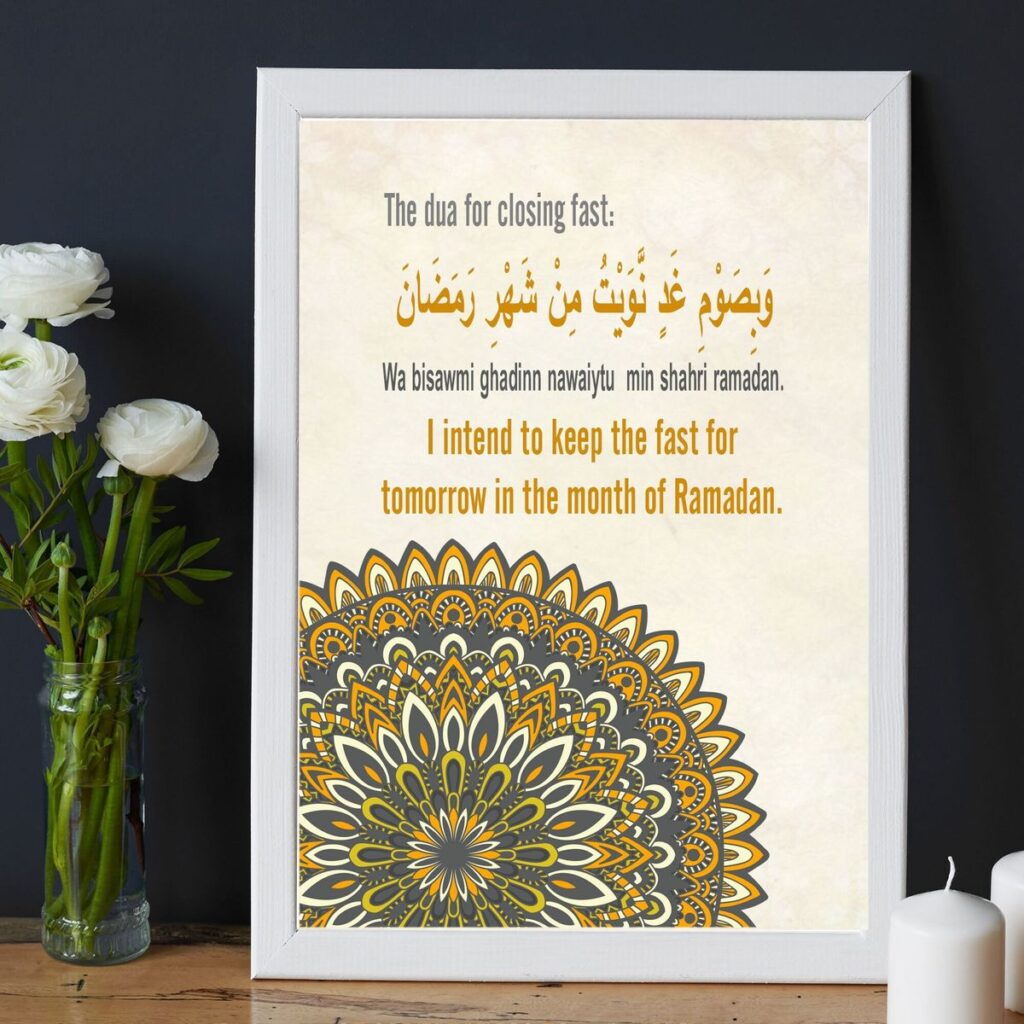
The intention (niyyah) is the heart’s resolve to fast for the sake of Allah. Verbally stating it is not required, but many choose to say it aloud to strengthen focus.
Commonly Recited Suhoor Intention:
- Arabic: وَبِصَوْمِ غَدٍ نَّوَيْتُ مِنْ شَهْرِ رَمَضَانَ
- Transliteration: Wa bi-ṣawmi ghadinn nawaytu min shahri Ramaḍān
- Translation: “I intend to keep the fast for tomorrow in the month of Ramadan.”
Key Points:
- The intention must be made before Fajr (dawn).
- Saying Bismillah before eating is highly recommended.
- Alternative dua: اللَّهُمَّ إِنِّي نَوَيْتُ أَنْ أَصُومَ غَدًا لِلهِ تَعَالَى
Allahumma inni nawaytu an asuma ghadan lillahi ta’ala (“O Allah, I intend to fast tomorrow for Your sake”).
The essence is sincerity in your heart—the verbal form is optional but beneficial for focus.
Can you say intention in your own language?
Yes. While Arabic is traditional, what matters most is the heartfelt resolve to fast for Allah. You may silently or verbally affirm your intention in any language, as long as it reflects sincerity and commitment.
Example:
- “I intend to fast tomorrow for the sake of Allah.”
A short pre-suhoor and pre-fajr dhikr routine
The final minutes before Fajr are ideal for reflection and supplication. A simple routine can include:
- Make your niyyah (intention) for fasting.
- Recite a short dhikr or dua for guidance, strength, and patience throughout the day.
- Reflect on gratitude for your provisions and remember those in need, like orphans or families facing food insecurity.
- Optional Quran recitation: Ayat al-Kursi (Quran 2:255) and the four Quls (last four surahs) for protection and blessings.
These few minutes turn Suhoor into a spiritual preparation, aligning your fast with devotion, mindfulness, and compassion.
These few minutes turn Suhoor into a spiritual preparation, aligning your fast with devotion, mindfulness, and compassion. For a 30-day Quran reading plan to complement your Ramadan routine, see our schedule here.
Dua at suhoor time: best personal duas to make
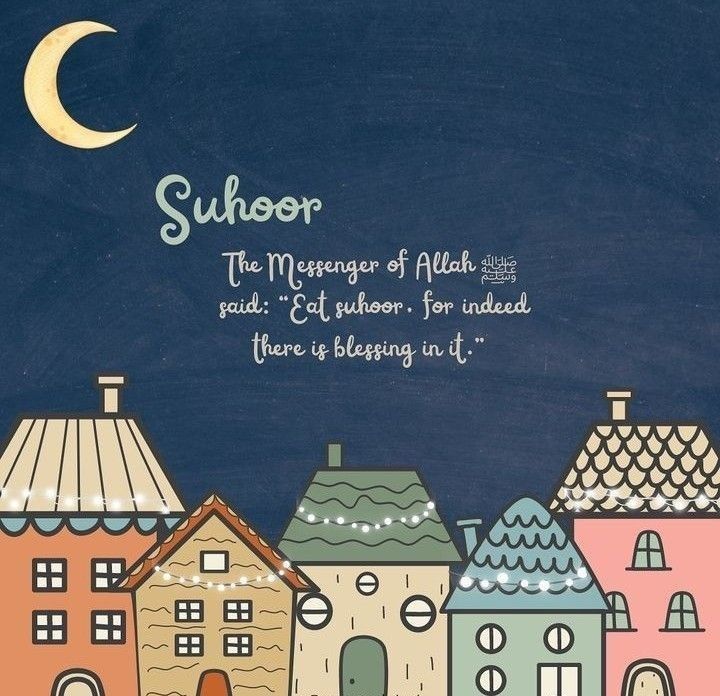
Suhoor—the pre-dawn meal, particularly in the last third of the night—is a blessed moment for spiritual reflection and dua. While there is no specific mandatory dua for suhoor, it is a highly recommended time to make sincere personal supplications, set your intention (niyyah), and seek Allah’s guidance and mercy.
The Prophet Muhammad (PBUH) said:
“ يَنْزِلُ رَبُّنَا تَبَارَكَ وَتَعَالَى كُلَّ لَيْلَةٍ إِلَى سَمَاءِ الدُّنْيَا حِينَ يَبْقَى ثُلُثُ اللَّيْلِ الآخِرُ فَيَقُولُ مَنْ يَدْعُونِي فَأَسْتَجِيبَ لَهُ مَنْ يَسْأَلُنِي فَأُعْطِيَهُ مَنْ يَسْتَغْفِرُنِي فَأَغْفِرَ لَهُ ” .
“Our Lord comes down to the lowest heaven in the last third of the night and says: ‘Who will call upon Me, that I may answer him? Who will ask of Me, that I may give him? Who will ask Me for forgiveness, that I may forgive him?’”
(Sunan Abi Dawud 1315)
This highlights that the last third of the night is a golden hour for acceptance of dua.
Key Points for Suhoor Dua:
- Say Bismillah before eating.
- Make niyyah (intention) in your heart to fast for the sake of Allah.
- Praise Allah and offer blessings on the Prophet (PBUH) before and after the meal.
- Raise your hands and make personal, heartfelt supplications, especially in the last minutes before Fajr.
Forgiveness and guidance
Suhoor is a perfect time to ask Allah for spiritual purification and guidance. Some recommended duas include:
- For Forgiveness (Laylat al-Qadr style):
اللهم انك عفو تحب العفو فاعفو عني
“Allahumma innaka ‘afuwwun tuhibbul-‘afwa fa’fu ‘anni”
(“O Allah, You are Pardoning, and You love to pardon, so pardon me”). - For Guidance:
اللَّهُمَّ اهْدِنَا الصِّرَاطَ الْمُسْتَقِيمَ
“Allahumma ihdina siratal mustaqim”
(“O Allah, guide us to the straight path”). - For Repentance: Speak from your heart in your own words, acknowledging your weaknesses and asking Allah to strengthen your resolve.
These supplications help prepare your heart for a day of mindfulness, patience, and devotion.
Rizq, barakah, and protection

Suhoor is also an opportunity to seek provision, blessings, and protection:
- For Sustenance & Blessings:
اللَّهُمَّ بَارِكْ لَنَا فِيمَا رَزَقْتَنَا وَقِنَا عَذَابَ النَّارِ
“Allahumma barik lana fima razaqtana wa qina ‘azaaban-naar”
(“O Allah, bless for us what You have provided and protect us from the punishment of the Fire”). - For Success in This Life and the Hereafter:
رَبَّنَا آتِنَا فِي الدُّنْيَا حَسَنَةً وَفِي الْآخِرَةِ حَسَنَةً وَقِنَا عَذَابَ النَّارِ
“Rabbana atina fid-dunya hasanatan wa fil-akhirati hasanatan waqina ‘adhaban-nar”
(“Our Lord, give us in this world that which is good and in the Hereafter that which is good, and save us from the punishment of the Fire”). - Protection from Anxiety and Hardship:
اللَّهُمَّ إِنِّي أَعُوذُ بِكَ مِنَ الْهَمِّ وَالْحَزَنِ، وَالْعَجْزِ وَالْكَسَلِ، وَالْبُخْلِ وَالْجُبْنِ، وَضَلَعِ الدَّيْنِ وَغَلَبَةِ الرِّجَالِ
“Allahumma inni a’udhu bika minal-hammi wal-huzni, wal-‘ajzi wal-kasali, wal-bukhli wal-jubni, wa dala’id-dayni wa ghalabatir-rijal”
(“O Allah, I seek refuge in You from anxiety and sorrow, weakness and laziness, miserliness and cowardice, the burden of debts and from being overpowered by men”).
Duas for parents and children
Suhoor is also a blessed time to pray for your loved ones:
- For Parents:
رَبِّ ارْحَمْهُمَا كَمَا رَبَّيَانِي صَغِيرًا
“Rabbirhamhuma kama rabbayani saghira”
(“My Lord, have mercy upon them as they raised me when I was small”). - For Offspring and Family:
رَبَّنَا هَبْ لَنَا مِنْ أَزْوَاجِنَا وَذُرِّيَّاتِنَا قُرَّةَ أَعْيُنٍ وَاجْعَلْنَا لِلْمُتَّقِينَ إِمَامًا
“Rabbana hab lana min azwajina wa dhurriyyatina qurrata a’yunin waj’alna lil-muttaqina imama”
(“Our Lord, grant us from among our spouses and offspring comfort of our eyes and make us an example for the righteous”). - For the Ummah and those in need: Speak from your heart, asking Allah to support the oppressed, heal the sick, and provide for those facing hardship.
Summary:
While there is no prescribed suhoor dua, the time is blessed for personal, heartfelt supplications, setting your intention, and asking Allah for forgiveness, guidance, provision, and protection. Utilize the last third of the night for maximum spiritual benefit, remembering that what matters most is the sincerity of your heart.
Iftar dua: what to say when breaking the fast

Breaking your fast at Iftar is a spiritually significant moment. The Prophet Muhammad (PBUH) emphasized that the dua of a fasting person at this time is not rejected, making it an ideal moment for gratitude, reflection, and asking Allah for forgiveness, health, provision, and mercy.
Key Tips for Iftar:
- Begin by saying Bismillah (“In the name of Allah”).
- Follow the Sunnah by breaking your fast with water or dates.
- Take a moment to praise Allah and send blessings on the Prophet (PBUH) before making personal supplications.
- Remember the blessed opportunity: prayers at Iftar are answered, as fasting humbles the soul and draws you closer to Allah.
The famous dua at iftar (Arabic + transliteration + meaning)
The most authentic and widely recognized dua for breaking the fast is:
- Arabic: ذَهَبَ الظَّمَأُ وَابْتَلَّتِ الْعُرُوقُ وَثَبَتَ الأَجْرُ إِنْ شَاءَ اللَّهُ
- Transliteration: Dhahaba az-zama’u wabtallatil-‘urooq, wa thabata-l-ajru in shaa’ Allah
- Translation: “The thirst is gone, the veins are moistened, and the reward is confirmed, if Allah wills.”
When to say it: Immediately after consuming food or drink, following the practice of the Prophet (PBUH).
Another reported wording (Arabic + meaning)
Another commonly recited dua, though slightly less authentic, is:
- Arabic: اللَّهُمَّ لَكَ صُمْتُ وَعَلَى رِزْقِكَ أَفْطَرْتُ
- Transliteration: Allahumma inni laka sumtu wa ‘ala rizqika aftartu
- Translation: “O Allah! For You I have fasted, and upon Your provision, I have broken my fast.”
Other beneficial supplications at Iftar include:
- For forgiveness and protection:
اللَّهُمَّ إِنِّي أَسْأَلُكَ رِضَاكَ وَالْجَنَّةَ، وَأَعُوذُ بِكَ مِنْ سَخَطِكَ وَالنَّارِ
“Allaahumma innee as-aluka Ridaaka wal Jannah wa a’audhu’bika min sakhatika wan-naar”
(“O Allah, I ask for Your pleasure and Paradise, and I seek refuge from Your displeasure and the Hellfire”). - For general repentance:
الَّذِينَ يَقُولُونَ رَبَّنَا إِنَّنَا آمَنَّا فَاغْفِرْ لَنَا ذُنُوبَنَا وَقِنَا عَذَابَ النَّارِ
“Allazeena yaqooloona Rabbanaaa innanaaa aamannaa faghfir lanaazunoobanaa wa qinaa ‘azaaban Naar”
(“Our Lord! Surely we believe, therefore forgive our faults and save us from the punishment of the Fire”). - When someone angers you while fasting:
إِنِّي صَائِمٌ، إِنِّي صَائِمٌ
“Innee saa’im, innee saa’im”
(“I am fasting, I am fasting”), to maintain patience and restraint.
What if you forget the dua?
If you forget the prescribed dua, there is no harm. The essence is to turn to Allah sincerely from the heart. Any heartfelt supplication at the moment of breaking the fast is valid and rewarded. You may also include personal prayers for health, provision, forgiveness, or the well-being of your family and the Ummah.
The best time for dua before iftar (don’t miss this window)
The final 10–15 minutes before the Maghrib Adhan are considered the most spiritually powerful for making dua before breaking your fast. This is when a fasting person is at their weakest and most humble, making supplications highly likely to be accepted.
Why This Window is Special:
- Guaranteed Acceptance: The Prophet Muhammad (PBUH) said, “Indeed the fasting person has at the time of breaking the fast a supplication, which is not rejected” (Ibn Majah).
- Maximum Humility: Hunger and thirst peak at this time, heightening dependence on Allah.
- The Veil is Removed: There is a closeness between the fasting person and Allah; this is a moment of divine attention.
Dua in the last 10 minutes before maghrib
To utilize this “golden window”:
- Stop Preparations: Pause cooking, setting the table, or checking the clock.
- Raise Your Hands: Sit quietly, raise your hands, and make heartfelt personal supplications.
- Recite Sunnah Duas: Examples include:
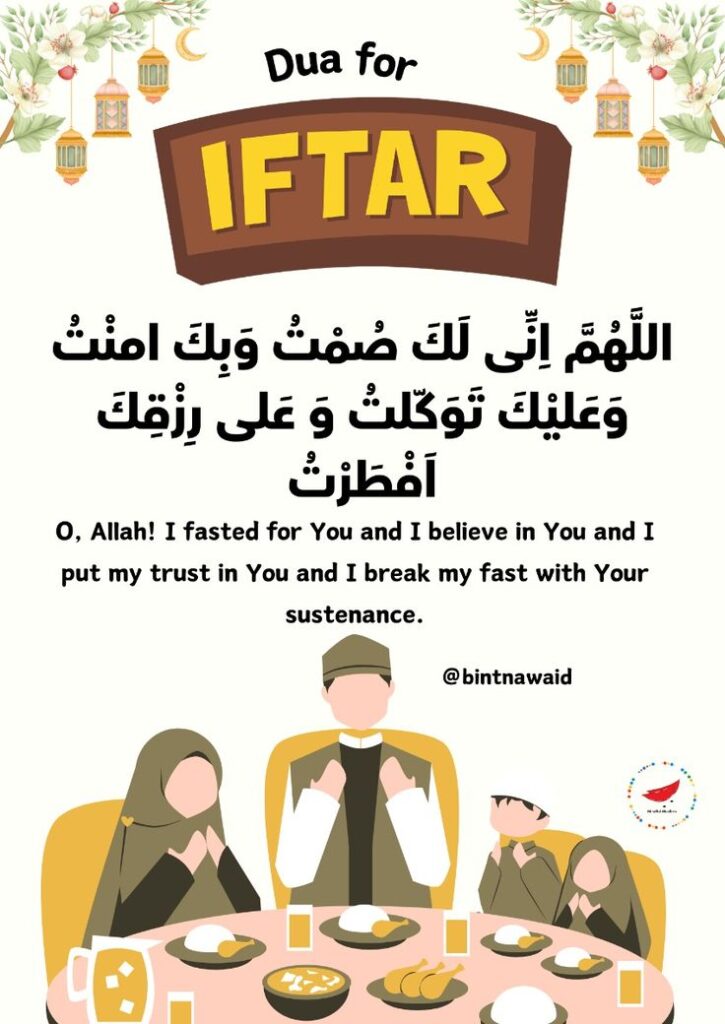
اللَّهُمَّ إِنِّي لَكَ صُمْتُ، وَبِكَ آمَنْتُ، وَعَلَىٰ رِزْقِكَ أَفْطَرْتُ
“Allahumma inni laka sumtu, wa bika aamantu, wa ‘ala rizqika aftartu”
(O Allah! I fasted for You, and I believe in You, and with Your provision, I break my fast.) - Timing: Some scholars recommend before the first bite; others emphasize immediately after breaking the fast. Both are blessed.
- Focus on Forgiveness & Needs: Ask Allah for forgiveness, guidance, health, provision, and blessings for this life and the Hereafter.
Avoid Distractions: Many waste this precious time talking or cooking. Instead, focus entirely on your connection with Allah.
Make a “dua list” so you don’t go blank
To make your dua meaningful:
- Prepare in Advance: Write down or mentally list your personal supplications for yourself, your family, and the Ummah.
- Include Key Areas: Gratitude, forgiveness, health, sustenance, protection, guidance, and the wellbeing of the less fortunate.
- Recite Sunnah Duas First: Then move to personal requests.
- Reflect on Your Day: Use this moment to consider your fast, intentions, and the spiritual benefits of Ramadan.
Tip: Sharing this moment as a family can make it more powerful, reinforcing faith and mindfulness across generations.
Suhoor and iftar duas for kids (easy, short, repeatable)

Kids don’t need long lists of duas to feel connected to Ramadan. What works best are short, repeatable phrases tied to real moments — eating, breaking the fast, bedtime, or saying thank you to Allah.
The goal isn’t perfection.
The goal is helping children feel that du’a is simply talking to Allah.
Start small: choose one of the duas at suhoor, one at iftar, and one simple daily remembrance. Over time, these become natural habits they carry for life.
1-line duas for suhoor and iftart kids can memorize
Here are simple duas children can easily learn and repeat every day:
Before eating (Suhoor or any meal)
بِسْمِ اللَّهِ
Bismillah
In the name of Allah.
After eating
الْحَمْدُ لِلَّهِ
Alhamdulillah
All praise is for Allah.
Simple intention before fasting (meaning-based)
Kids can simply say in their own words:
“O Allah, I want to fast for You.”
(Teaching intention in the heart is enough — it does not have to be spoken formally.)
Iftar dua (short Sunnah dua)
ذَهَبَ الظَّمَأُ وَابْتَلَّتِ الْعُرُوقُ وَثَبَتَ الأَجْرُ إِنْ شَاءَ اللَّهُ
Dhahaba al-zama’u wabtallatil-‘urooq wa thabatal-ajru in shaa’ Allah
The thirst is gone, the veins are refreshed, and the reward is confirmed, if Allah wills.
Simple gratitude at iftar
اللَّهُمَّ لَكَ صُمْتُ وَعَلَى رِزْقِكَ أَفْطَرْتُ
Allahumma laka sumtu wa ‘ala rizqika aftartu
O Allah, I fasted for You and break my fast with Your provision.
Quick forgiveness
أَسْتَغْفِرُ اللَّهَ
Astaghfirullah
O Allah, forgive me.
For parents
رَبِّ ارْحَمْهُمَا كَمَا رَبَّيَانِي صَغِيرًا
Rabbi irhamhuma kama rabbayani saghira
My Lord, have mercy on my parents as they raised me when I was small.
Tip: Teach meaning first — pronunciation improves naturally with repetition.
Family call-and-repeat suhoor and iftar duas routine
Children learn best through routine, not lectures. Try this simple 2-minute family system:
At Suhoor
- Parent says “Bismillah.”
- Everyone repeats together.
- One child makes a short personal du’a in their own words.
Iftar
- Take the first sip or date.
- Say the iftar dua together.
- Everyone says “Ameen.”
At Bedtime
- One short forgiveness du’a (Astaghfirullah or Rabbighfir li).
- Each child asks Allah for one personal thing (school, friends, family).
💡 Micro-tip: Don’t force repetition when kids are tired or hungry. Say it calmly yourself — they will absorb it naturally.
Reward ideas without pressure
Ramadan du’a should feel joyful, not like a test. Encourage without turning worship into performance.
Healthy motivation ideas:
- ⭐ Sticker chart for consistency (not perfection)
- 🌙 “Du’a chooser” — a child picks the du’a of the day
- 🤍 Praise effort, not pronunciation
- 📖 Let kids whisper privately instead of performing in front of guests
Avoid:
- Correcting mistakes mid-du’a
- Comparing siblings
- Teaching too many duas at once
A simple rule: one new du’a every week is enough.
When children understand what they are asking Allah for, du’a stops being memorization — and becomes a real conversation with their Creator.
Common mistakes and misconceptions about suhoor and iftar duas

Ramadan is full of beautiful traditions — but sometimes cultural habits slowly replace what is actually taught in the Sunnah. When it comes to suhoor and iftar duas, many misunderstandings are not about intention, but about timing, simplicity, and what is truly required in Islam.
Understanding these common mistakes helps families — especially children — experience Ramadan with ease, confidence, and sincerity instead of pressure.
Thinking you must know long duas for suhoor and iftar to be accepted
One of the most widespread misconceptions is believing that du’a must be long, perfectly memorized Arabic in order to be accepted.
In reality, du’a is about sincerity, not length.
Many people feel hesitant making du’a because they worry they don’t know enough phrases. This unintentionally turns worship into memorization rather than connection. The Prophet ﷺ taught short, meaningful supplications, and even simple words like:
- “Bismillah” before eating
- “Alhamdulillah” after eating
- “Rabbighfir li” (My Lord, forgive me)
are powerful acts of remembrance.
For children especially, short du’as are closer to the Sunnah approach because they are easy to repeat consistently. A small du’a said daily with understanding is better than a long one said rarely or without meaning.
Key reminder: Allah listens to every sincere call — in Arabic or any language.
Confusing cultural phrases with sunnah duas
Another common issue is assuming certain phrases are required parts of fasting when they are actually cultural additions.
Some examples include:
- Believing a specific spoken duas must be said at suhoor or Iftar to fast.
→ The intention (niyyah) exists in the heart; it does not need to be verbalized. - Stopping food 15–30 minutes before Fajr due to “imsak” warnings.
→ The Quran allows eating and drinking until true dawn begins. - Thinking complicated or lengthy iftar supplications are necessary.
→ The authentic Sunnah emphasizes simplicity.
The established practice is clear and easy:
At Suhoor
- Eat close to Fajr time.
- Begin with Bismillah.
- Make intention in the heart.
At Iftar
- Break the fast immediately after sunset.
- Start with dates or water.
- Say Bismillah, then make du’a.
A well-known authentic supplication after breaking the fast is:
Dhahaba adh-dhama’u wabtallatil-‘urooq wa thabatal-ajru in shaa’ Allah
“The thirst has gone, the veins are refreshed, and the reward is confirmed, if Allah wills.”
Islam intentionally keeps worship accessible — especially for families and children learning step by step.
Rushing iftar and suhoor without duas remembering Allah
Ironically, one of the greatest missed opportunities happens during the busiest moment of the day.
As iftar approaches, many people become fully occupied with food preparation, table arrangements, or serving guests — and forget that the moments just before sunset are among the most accepted times for du’a.
Common habits that reduce the spiritual benefit include:
- Focusing only on food preparation.
- Waiting for long announcements instead of breaking fast promptly.
- Beginning large meals immediately without pausing for remembrance.
The Sunnah encourages a calmer sequence:
- Make personal du’a in the final minutes before Maghrib.
- Break the fast immediately at sunset with dates or water.
- Say Bismillah.
- Make the iftar du’a.
- Pray Maghrib before continuing the full meal.
This simple rhythm keeps the focus on gratitude rather than consumption.
A gentle takeaway for families
Suhoor and iftar du’as were never meant to feel complicated. The prophetic way is built on ease:
- Short words.
- Correct timing.
- Consistent remembrance.
- Sincere intention.
For children and adults alike, Ramadan worship becomes meaningful when duas for Suhoor and Iftar feels natural — not performative. A single heartfelt sentence said daily can shape a lifelong connection with Allah far more than memorizing many phrases under pressure.
Simple is not less rewarding — it is often closer to the Sunnah.
Final Thought
Ramadan is not about perfect words or long routines — it’s about small, sincere moments repeated every day. A short du’a said with presence, a few verses recited with care, or a quiet moment of gratitude, like Suhoor and Iftar Duas, can transform the entire month. Keep your worship simple, consistent, and heartfelt, and let Ramadan gently bring you closer to the Qur’an and to Allah
Keep your worship simple, consistent, and heartfelt, and let Ramadan gently bring you closer to the Qur’an and to Allah. For more tips on fasting, Quran reading, kids’ routines, and memorization plans, explore our previous blog posts.
Learn more and continue your Ramadan journey with us:
- Learn more Ramadan duas and Quran recitation
- Quran reading with tajweed during Ramadan
- Family-friendly Islamic studies for kids
- Free trial class with Areeb Academy ✨
FAQs about suhoor and iftar duas
1. What is the best time to say Suhoor and Iftar duas?
- The Suhoor dua is recited just before Fajr, ideally right before taking the first bite of your pre-dawn meal.
- The Iftar dua is said at the exact moment of breaking the fast, usually with water or dates, as this is a time when duas are highly accepted.
2. Do I have to memorize long duas to be accepted?
- No, sincerity matters more than length. Short, heartfelt duas like “Bismillah” at the start of a meal or “Dhahaba al-ẓama’u…” at iftar are sufficient.
3. Can kids participate in Suhoor and Iftar duas?
- Absolutely! Simple, repeatable phrases with clear meanings, like “Bismillah” and “Alhamdulillah,” help children feel involved and understand gratitude and intention.
4. Can I make personal requests during Iftar dua?
- Yes! The moment of breaking the fast is a golden opportunity to ask Allah for personal needs, forgiveness, and blessings for yourself, family, and the Ummah.
5. Is it necessary to say the intention (niyyah) out loud?
- No, the intention can be in your heart. For Ramadan, a single intention at the start of the month can suffice, though some schools recommend renewing it each day silently.