
Masculine and Feminine in Arabic play a fundamental role in mastering Arabic grammar. Every noun, adjective, and verb in Arabic carries a gender, and understanding these patterns is essential for forming correct sentences and communicating naturally. From learning the taa marbuta (ة) for feminine nouns to ensuring verbs and adjectives agree with the noun’s gender, mastering masculine and feminine forms helps learners avoid common mistakes and boosts confidence in speaking, reading, and writing Arabic.
In this comprehensive guide, we cover key rules, examples, common mistakes, and practical tips for learning Arabic gender. Whether you are a beginner or brushing up on grammar, this article will help you navigate the complexities of Arabic masculine and feminine forms, making your language journey smoother and more effective.
What Are Masculine and Feminine in Arabic?
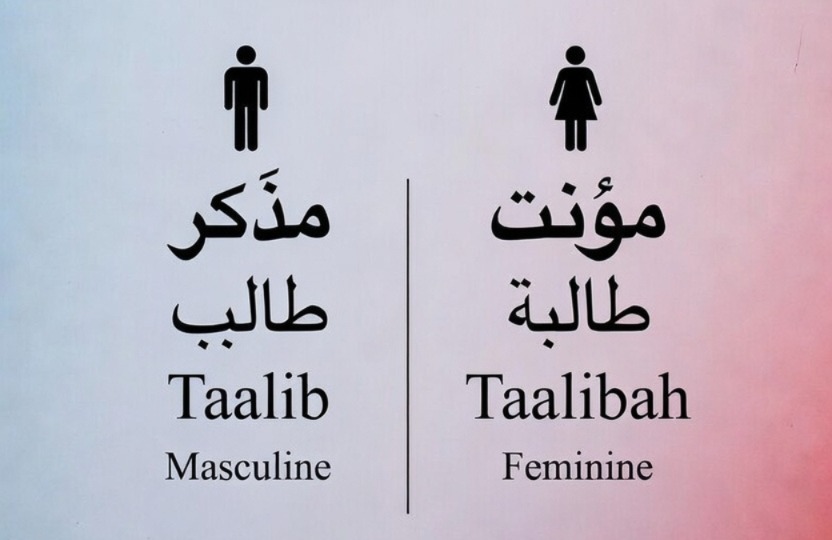
In Arabic grammar, every noun is classified as either masculine (مذكر) or feminine (مؤنث). Unlike some languages, Arabic does not have a neutral gender, which means every noun belongs to one of these two categories.
Generally, masculine is considered the default form. Most masculine nouns do not have a special ending that marks them as masculine. For example:
- كِتَاب (kitaab) – book
- طَالِب (ṭaalib) – male student
Feminine nouns, on the other hand, often include a specific marker that indicates femininity. The most common marker is the taa marbuta (ة) at the end of the word.
Examples:
- طَالِبَة (ṭaalibah) – female student
- جَمِيلَة (jameelah) – beautiful (feminine form)
However, not all feminine nouns have this ending. Some words are simply known to be feminine through usage in the language.
Understanding Gender in the Arabic Language
Arabic gender is mainly associated with nouns, while other parts of speech adjust according to the noun’s gender.
For example:
- Verbs
- Adjectives
- Pronouns
must all agree with the gender of the noun they refer to.
Example:
- الطَّالِبُ مُجْتَهِدٌ
The male student is hardworking. - الطَّالِبَةُ مُجْتَهِدَةٌ
The female student is hardworking.
Arabic also has several signs that indicate femininity, including:
- Taa Marbuta (ة) – the most common sign
- Alif Maqsura (ى) at the end of some words
- Alif Mamduda (اء) in certain nouns
Examples:
- كُبْرَى – greatest
- صَحْرَاء – desert
In addition, some nouns are feminine without a visible marker, such as:
- شَمْس – sun
- دار – house
- عَيْن – eye
These are called irregular or naturally feminine nouns, and learners usually memorize them through exposure.
Verbs, adjectives, and pronouns must all agree with the gender of the noun they refer to. If you want to learn more about how pronouns change depending on gender and number, you can read our guide on Arabic pronouns.
Why Masculine and Feminine in Arabic Are Important
Understanding gender is essential when learning Arabic because it directly affects how sentences are formed.
Since many words in a sentence must match the noun’s gender, identifying whether a noun is masculine or feminine helps learners:
- Build grammatically correct sentences
- Use adjectives correctly
- Conjugate verbs properly
- Speak and write more naturally
For example, if the noun is feminine, the verb and adjective must also appear in their feminine form.
Because of this, many teachers recommend learning the gender of a noun when you first learn the word. This habit helps learners avoid mistakes later when constructing sentences.
If you’re teaching Arabic to children, you may also find our guide on Arabic grammar for kids helpful for introducing grammar concepts in fun and simple ways.
How Gender Affects Words and Sentences
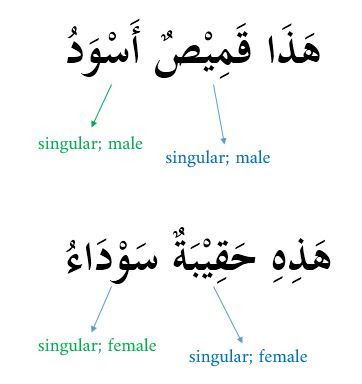
Gender agreement plays a major role in Arabic grammar. When a noun appears in a sentence, several other elements change to match its gender.
These include:
1. Adjectives
Adjectives must match the noun in gender.
Example:
- بَيْتٌ كَبِيرٌ – a big house (masculine)
- سَيَّارَةٌ كَبِيرَةٌ – a big car (feminine)
2. Verbs
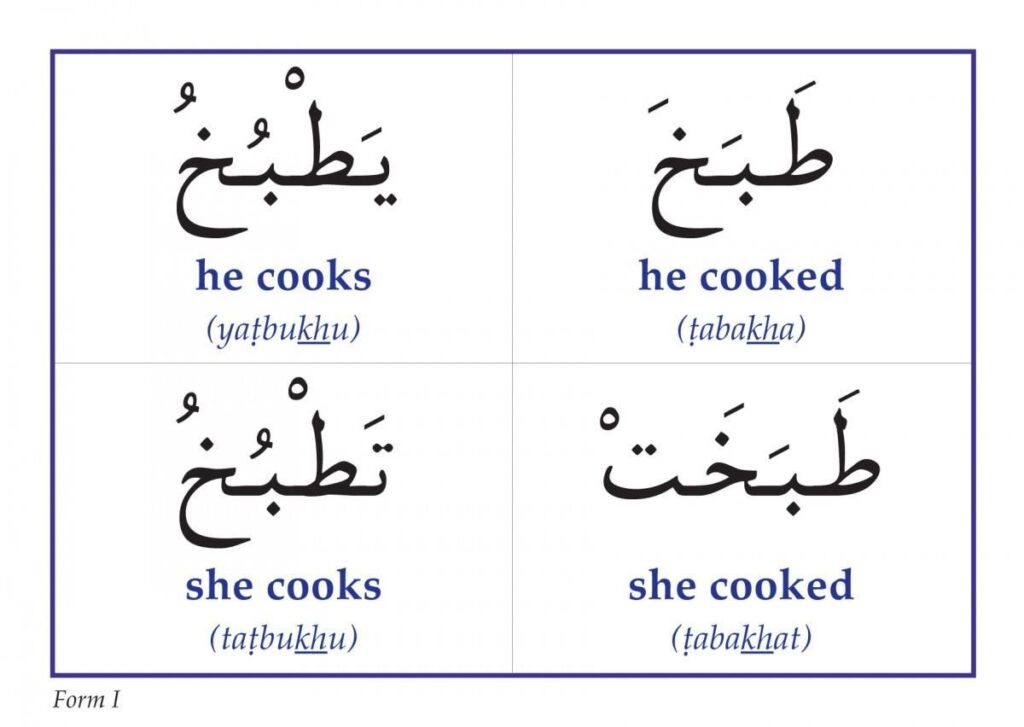
Verbs change depending on whether the subject is masculine or feminine.
Example:
- كَتَبَ الطَّالِبُ – the male student wrote
- كَتَبَتِ الطَّالِبَةُ – the female student wrote
3. Non-Human Plurals
One unique rule in Arabic grammar is that plural nouns referring to non-human things are usually treated as singular feminine.
Example:
- الْكُتُبُ جَدِيدَةٌ
The books are new.
Even though books is plural, the adjective appears in the singular feminine form.
The Basic Rule of Masculine and Feminine in Arabic

In Arabic, every noun belongs to one of two grammatical genders: masculine (مذكر) or feminine (مؤنث). Unlike English, Arabic does not have a neutral gender, so each noun must be categorized as either masculine or feminine.
The basic rule is simple: masculine is the default form, and many masculine nouns appear without any special ending. Feminine nouns, however, often include specific markers that help identify them.
One of the most common ways to form a feminine word is by adding taa marbuta (ة) to the end of a masculine noun or adjective. This small grammatical change allows learners to easily recognize many feminine forms.
For example:
- مُعَلِّم (muʿallim) → teacher (masculine)
- مُعَلِّمَة (muʿallimah) → teacher (feminine)
Understanding this basic rule helps learners quickly identify the gender of many Arabic words.
Most Arabic Words Are Masculine by Default
In Arabic grammar, nouns are usually considered masculine unless there is a sign showing they are feminine. This means many words referring to objects, places, or concepts are treated as masculine.
Examples of masculine nouns:
- كتاب (kitaab) – book
- باب (baab) – door
- جبل (jabal) – mountain
Words that refer to male people or animals are also naturally masculine, such as:
- رجل (rajul) – man
- أسد (asad) – lion
Because masculinity is the default gender, learners often assume a noun is masculine unless it shows a specific feminine marker.
Recognizing Feminine Words With the Ta Marbuta (ة)
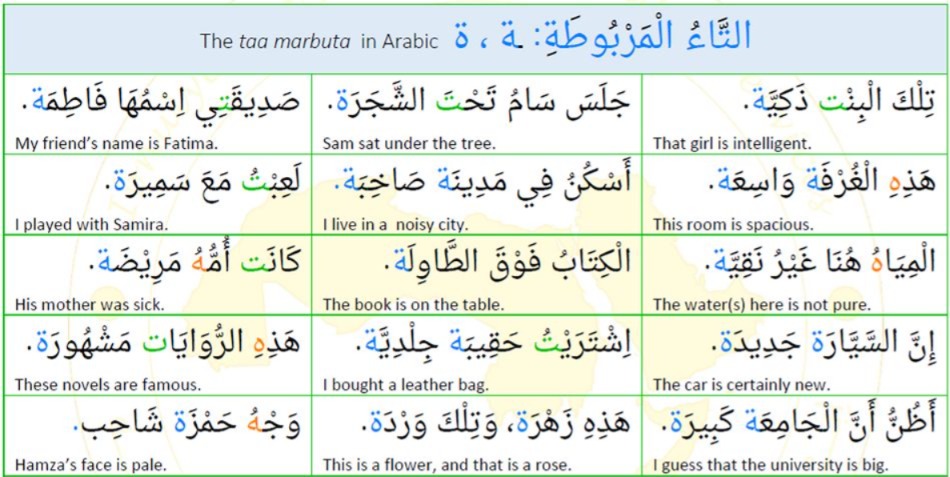
The taa marbuta (ة) is the most common indicator of a feminine noun in Arabic. It appears at the end of a word and often produces an “-a” sound when pronounced.
Examples include:
- سيارة (sayyara) – car
- شجرة (shajara) – tree
- مدرسة (madrasa) – school
This marker is also commonly used to create feminine forms of professions, adjectives, or roles.
Examples:
- جميل (jameel) → جميلة (jameelah) – beautiful
- صغير (sagheer) → صغيرة (sagheerah) – small
Although this rule works for many words, learners should remember that not all feminine nouns end with taa marbuta, and a few masculine words may contain it as well.
Common Feminine Word Patterns
Besides the taa marbuta, Arabic has other patterns that can indicate feminine nouns. These patterns help learners recognize gender even when the common ending is not present.
Some common markers include:
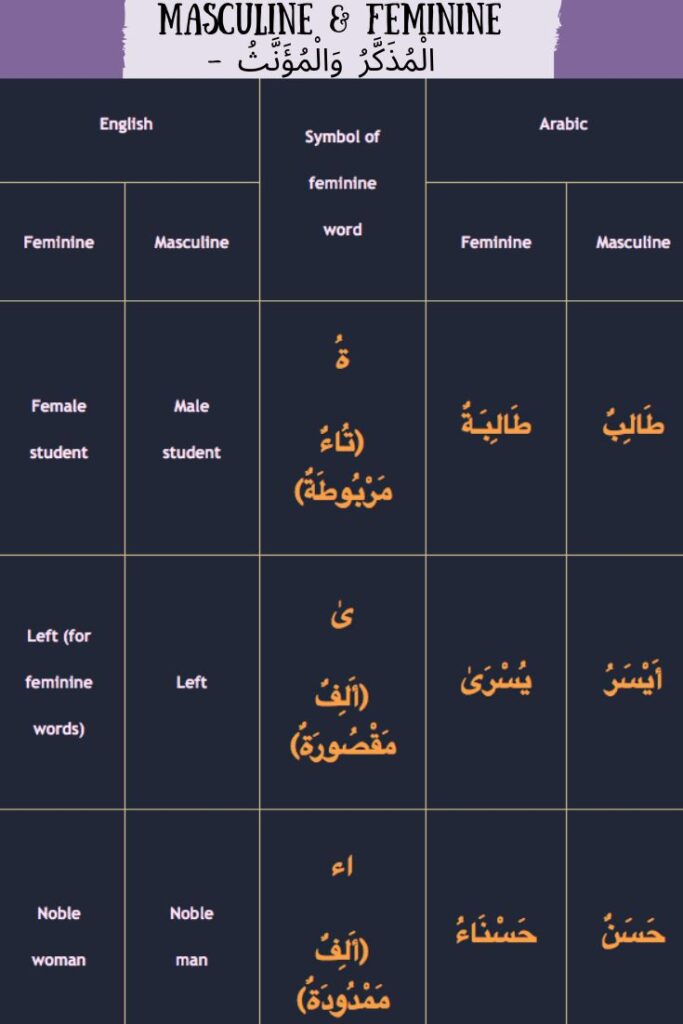
1. Alif Mamduda (اء)
Words ending with اء may be feminine.
Example:
- سماء (samaa) – sky
2. Alif Maqsura (ى)
Some feminine words end with ى.
Example:
- ليلى (Layla) – a female name
3. Naturally Feminine Words
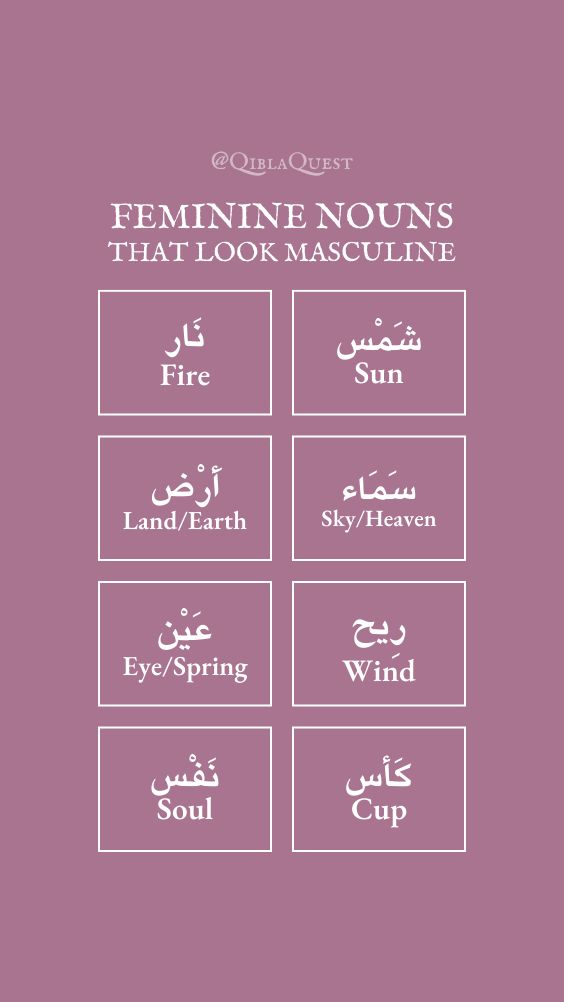
Some nouns are feminine by meaning rather than by form. These words do not contain a visible feminine marker but are traditionally treated as feminine in Arabic.
Examples:
- شمس (shams) – sun
- دار (daar) – house
- عين (ʿayn) – eye
Because of these exceptions, Arabic learners are often encouraged to learn the gender of each noun when building vocabulary. Over time, recognizing these patterns becomes much easier with practice and exposure to the language.
Examples of Masculine and Feminine in Arabic
Understanding masculine and feminine in Arabic becomes much easier when you see real vocabulary examples. In Arabic, nouns, adjectives, and even verbs often change depending on whether the word is masculine or feminine.
Many masculine nouns appear in their basic form, while feminine nouns often include the taa marbuta (ة) or represent female beings. Learning common pairs of masculine and feminine words helps learners quickly recognize gender patterns and use them correctly in sentences.
Below are some common examples that illustrate how gender works in Arabic.
Masculine Nouns in Arabic
Masculine nouns in Arabic may refer to male people, animals, objects, or abstract concepts. Since masculinity is the default gender, most nouns without a clear feminine marker are considered masculine.
Examples of masculine nouns include:

People and roles
- رجل (rajul) – man
- أب (ab) – father
- أخ (akh) – brother
- طالب (taalib) – male student
Animals
- أسد (asad) – lion
- جمل (jamal) – camel
Objects and concepts
- كتاب (kitaab) – book
- قلم (qalam) – pen
- بيت (bayt) – house
- سلام (salaam) – peace
Example sentence:
- البيت جميل
al-bayt jameel
The house is beautiful.
Here بيت (house) is masculine, so the adjective جميل appears in its masculine form.
Feminine Nouns in Arabic
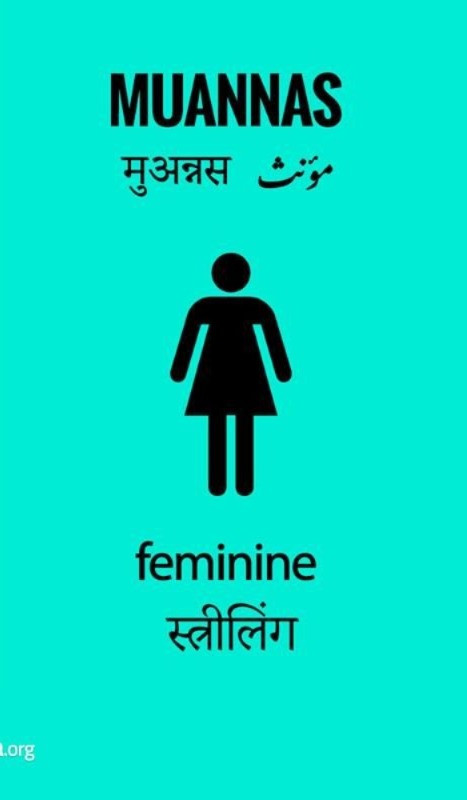
Feminine nouns usually refer to female beings or nouns that include a grammatical feminine marker. The most common sign of a feminine noun is the taa marbuta (ة) at the end of the word.
Examples of feminine nouns include:
Female people
- امرأة (imra’a) – woman
- بنت (bint) – girl
- أم (umm) – mother
Common nouns with taa marbuta
- سيارة (sayyaara) – car
- شجرة (shajara) – tree
- مدرسة (madrasa) – school
Naturally feminine words
Some nouns are feminine even without a feminine ending.
Examples:
- شمس (shams) – sun
- أرض (ard) – earth
- دار (daar) – house/abode
Example sentence:
- السيارة جديدة
as-sayyaara jadeeda
The car is new.
Because سيارة is feminine, the adjective جديدة also appears in the feminine form.
Words That Change Between Masculine and Feminine
Many Arabic words can change between masculine and feminine forms by adding taa marbuta (ة) to the end of the masculine form. This pattern is especially common with professions, adjectives, and roles.
Examples include:
| Masculine | Feminine | Meaning |
|---|---|---|
| طالب (taalib) | طالبة (taaliba) | student |
| صديق (sadeeq) | صديقة (sadeeqa) | friend |
| كاتب (kaatib) | كاتبة (kaatiba) | writer |
| جميل (jameel) | جميلة (jameela) | beautiful |
| صغير (sagheer) | صغيرة (sagheera) | small |
This simple pattern helps learners easily convert many masculine adjectives or nouns into their feminine forms.
However, it’s important to remember that Arabic also includes exceptions, and some words must simply be learned with their correct gender through practice and exposure.
Masculine and Feminine in Arabic Adjectives
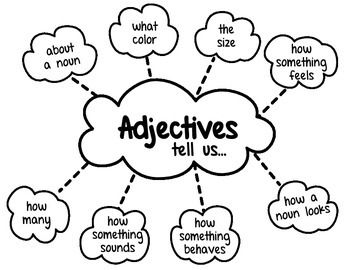
In Arabic grammar, adjectives—called صِفَة (sifah)—must match the noun they describe. This agreement applies to gender, number, and definiteness, making adjective agreement an essential part of forming correct Arabic sentences.
The masculine form of an adjective is usually the base form, while the feminine form is commonly created by adding taa marbuta (ة) at the end of the word. Because of this pattern, recognizing masculine and feminine adjectives becomes easier once learners understand how gender agreement works.
For example:
- بَيْت كَبِير
bayt kabīr – a big house (masculine) - سَيَّارَة كَبِيرَة
sayyārah kabīrah – a big car (feminine)
In these examples, the adjective changes form to match the gender of the noun.
How Adjectives Agree With Gender
Arabic adjectives always follow the noun they describe and must agree with it in several grammatical aspects, including gender.
The basic rule is simple:
- If the noun is masculine, the adjective remains in its masculine form.
- If the noun is feminine, the adjective usually adds taa marbuta (ة).
Example:
- الولد طويل – The boy is tall.
- البنت طويلة – The girl is tall.
Arabic adjectives also match the noun in:
- Number (singular, dual, or plural)
- Definiteness (whether the noun uses “ال” or not)
Another important rule is that plural nouns referring to non-human things are treated as feminine singular.
Example:
- أقلام جميلة
aqlam jamila – nice pens
Even though أقلام is plural, the adjective جميلة appears in the singular feminine form.
Examples of Masculine and Feminine Adjectives
Many Arabic adjectives follow the simple rule of adding taa marbuta (ة) to form the feminine version.
Here are some common examples:
| Masculine | Feminine | Meaning |
|---|---|---|
| جَمِيل | جَمِيلَة | beautiful |
| جَدِيد | جَدِيدَة | new |
| قَرِيب | قَرِيبَة | near |
| طَوِيل | طَوِيلَة | tall |
| بَارِد | بَارِدَة | cold |
These examples show how adjectives change slightly to match the noun’s gender.
Common Adjective Patterns in Arabic
While most adjectives follow the taa marbuta rule, some patterns behave differently.
1. Nisba Adjectives (ending in ي)
Adjectives that end with ي form the feminine by adding يّة.
Example:
- مِصْرِيّ – Egyptian (masculine)
- مِصْرِيَّة – Egyptian (feminine)
2. Colors and Physical Descriptions
Some adjectives—especially colors—follow a special pattern. Masculine forms often follow the أفعل pattern, while the feminine form becomes فعلاء.
Examples:
- أَحْمَر → حَمْرَاء – red
- أَبْيَض → بَيْضَاء – white
- أَسْوَد → سَوْدَاء – black
These patterns are slightly different from the regular rule but become easier to recognize with practice.
By learning these common patterns and practicing adjective agreement, learners can build more accurate and natural Arabic sentences.
Masculine and Feminine in Arabic Verbs
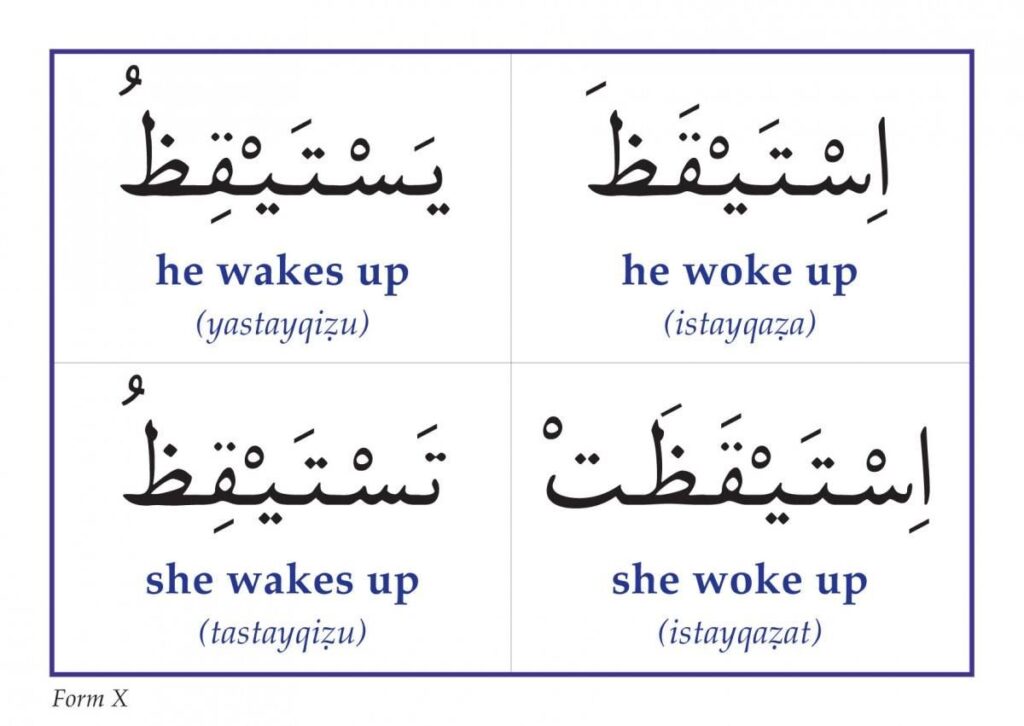
Arabic verbs change form depending on the gender, number, and person of the subject. This means the verb must agree with the person performing the action. Masculine is usually considered the default form, while feminine verbs are created by adding certain suffixes or prefixes.
In Arabic grammar, verbs are typically introduced in the third-person masculine singular form, which acts as the base form of the verb. For example:
- كَتَبَ (kataba) – he wrote
From this base form, other verb forms are created depending on whether the subject is masculine or feminine, as well as whether the action occurs in the past, present, or future.
Gender Agreement in Verbs
Just like adjectives, Arabic verbs must agree with the gender of the subject.
If the subject is masculine, the verb remains in its masculine form.
If the subject is feminine, the verb changes to reflect that gender.
Examples:
- حَضَرَ الوَلَدُ مُبَكِّرًا
ḥaḍara al-waladu mubakkiran
The boy came early. - حَضَرَتِ البِنْتُ مُبَكِّرَةً
ḥaḍarat al-bintu mubakkirah
The girl came early.
Here, the verb changes from حضر (he came) to حضرت (she came) to match the feminine subject.
In some cases, the verb must be feminine when the subject is feminine, especially when the subject appears before the verb in the sentence.
Examples in Present and Past Tense
Arabic verbs mark gender differently depending on the tense.
Past tense (الماضي) usually adds a suffix to show the feminine form.
Example:
- كَتَبَ – he wrote
- كَتَبَتْ – she wrote
Another example:
| Masculine | Feminine | Meaning |
|---|---|---|
| حَضَرَ | حَضَرَتْ | came |
| قَرَأَ | قَرَأَتْ | read |
| دَرَسَ | دَرَسَتْ | studied |
Present tense (المضارع) typically changes the prefix at the beginning of the verb.
Example:
- يَكْتُبُ – he writes
- تَكْتُبُ – she writes
Another example:
| Masculine | Feminine | Meaning |
|---|---|---|
| يَدْرُسُ | تَدْرُسُ | studies |
| يَجْلِسُ | تَجْلِسُ | sits |
| يَذْهَبُ | تَذْهَبُ | goes |
The prefix ي (y-) usually marks masculine third-person verbs, while ت (t-) often marks feminine forms.
How Gender Changes Verb Forms
Gender changes in Arabic verbs depend mainly on suffixes and prefixes.
1. Feminine in the past tense
The feminine form is commonly created by adding ـتْ (-at) to the verb.
Example:
- فَهِمَ – he understood
- فَهِمَتْ – she understood
2. Feminine in the present tense
The masculine prefix يـ (ya-) usually becomes تـ (ta-) for feminine subjects.
Example:
- يَكْتُبُ الطَّالِبُ – The male student writes.
- تَكْتُبُ الطَّالِبَةُ – The female student writes.
3. Addressing someone directly
Arabic verbs also change depending on whether you are speaking to a male or a female.
Example:
- تَجْلِسُ – you sit (masculine)
- تَجْلِسِينَ – you sit (feminine)
Understanding these patterns helps learners recognize how verb conjugation reflects gender in Arabic, allowing them to form grammatically correct sentences when speaking or writing.
Mastering verb agreement is essential for speaking Arabic correctly. If you want to improve your speaking skills as well, you can explore our guide on conversational Fusha Arabic to learn how Modern Standard Arabic is used in real conversations.
Common Mistakes When Learning Masculine and Feminine in Arabic

Learning masculine and feminine in Arabic can be challenging for beginners because gender affects nouns, adjectives, verbs, and pronouns. Since every noun in Arabic has a grammatical gender—even inanimate objects—many learners make mistakes when they first begin studying the language.
Understanding these common errors can help students avoid confusion and improve their accuracy when speaking or writing Arabic.
Forgetting Gender Agreement
One of the most common mistakes is forgetting that adjectives and verbs must agree with the noun’s gender. In Arabic, the words that describe or relate to a noun must match it in gender, number, and definiteness.
For example:
- طالبة جميلة
ṭālibah jamīlah – a beautiful female student
If the adjective جميلة were written as جميل, the sentence would be grammatically incorrect because the adjective would not match the feminine noun طالبة.
Another common issue occurs with non-human plural nouns. In Arabic, these plurals are treated as feminine singular when using adjectives.
Example:
- بيوت كبيرة
buyūt kabīrah – big houses
Although بيوت (houses) is plural, the adjective كبيرة appears in the feminine singular form.
Confusing Similar Word Forms
Learners often confuse words that look similar but represent different gender forms.
For example:
- هذا – this (masculine)
- هذه – this (feminine)
A common mistake would be saying:
- هذا سيارة ❌
The correct sentence is:
- هذه سيارة ✔
hādhihi sayyārah – This is a car.
Verb forms can also cause confusion. Arabic verbs change depending on the gender of the subject, which may be difficult for learners whose native language does not mark gender in verbs.
Example:
- تجلس – you sit (masculine)
- تجلسين – you sit (feminine)
Because English uses the same word “you” for both genders, learners sometimes mix these forms.
Misusing Feminine Endings
Another frequent mistake is misunderstanding the taa marbuta (ة) ending.
In many cases, the taa marbuta indicates that a word is feminine:
- سيارة – car
- مدرسة – school
- طالبة – female student
However, learners sometimes make two opposite mistakes:
- Ignoring the ending and assuming the noun is masculine.
- Assuming every word ending in ة must be feminine, even though a small number of words with this ending may function differently depending on context.
To avoid this confusion, it is helpful to learn nouns together with adjectives.
For example:
- سيارة سريعة – a fast car
- بيت كبير – a big house
Learning words in short phrases helps reinforce their correct gender and agreement patterns.
By recognizing these common mistakes and practicing correct agreement, learners can gradually become more comfortable with Arabic gender rules and use masculine and feminine forms more naturally.
Final Thoughts on Masculine and Feminine in Arabic
Understanding masculine and feminine in Arabic is an essential step toward mastering the language. Since gender affects nouns, adjectives, verbs, and pronouns, learning these patterns helps learners form grammatically correct sentences and communicate more naturally.
Although Arabic gender rules may seem complex at first, they become much easier with consistent practice and exposure. By learning common patterns—such as the taa marbuta (ة) for feminine nouns and adjectives, and gender agreement in verbs—students can quickly recognize and apply these rules in everyday communication.
With the right guidance and structured learning, mastering Arabic grammar becomes a smooth and enjoyable process.
Learn Masculine and Feminine in Arabic With Expert Teachers
Learning Arabic grammar is much easier when students receive guidance from experienced instructors. Structured lessons, interactive exercises, and practical examples help learners understand gender rules and apply them confidently in real conversations.
At Areeb Academy, students receive personalized support to build strong Arabic foundations while improving their speaking, reading, and writing skills.
- Structured Arabic Grammar Lessons
Our courses introduce Arabic grammar step by step, helping students clearly understand concepts like masculine and feminine forms, verb conjugation, and adjective agreement.
- Interactive Learning for Kids and Adults
We offer engaging lessons designed for both children and adult learners, using interactive teaching methods that make learning Arabic easier and more enjoyable.
- Start Your Arabic Journey With Areeb Academy
Whether you’re learning Arabic for Quran studies, communication, or academic goals, our experienced teachers are here to guide you at every step.
Book a FREE trial today and start your Arabic learning journey with Areeb Academy.
FAQs: Masculine and Feminine in Arabic
1. What is the basic rule for masculine and feminine nouns in Arabic?
Most Arabic nouns are either masculine or feminine. Masculine is usually the default form, while feminine nouns often end with a taa marbuta (ة) or follow specific patterns. Learning these markers helps you identify gender correctly.
2. How do adjectives agree with masculine and feminine nouns?
Adjectives must match the noun in gender, number, and definiteness. For example, a masculine noun uses the base adjective form, while a feminine noun often adds taa marbuta (ة) at the end.
3. Do verbs in Arabic change depending on gender?
Yes! Verbs must agree with the subject’s gender. Masculine is usually the default form, while feminine verbs are formed by changing prefixes or suffixes (e.g., كَتَبَ → كَتَبَتْ, يَكْتُبُ → تَكْتُبُ).
4. Are there feminine nouns without visible markers?
Yes, some nouns are naturally feminine without endings like ة, اء, or ى. Examples include شمس (sun), عين (eye), دار (house). Learners usually memorize these through exposure and practice.
5. Can learning gender help improve my Arabic speaking and writing?
Absolutely! Understanding masculine and feminine forms ensures correct sentence structure, verb conjugation, and adjective agreement, which helps you speak and write Arabic more naturally and confidently.