
Egyptian Ammeya Grammar is the foundation of how Egyptians communicate in real life—on the streets, in movies, songs, and everyday conversations. Unlike Classical Arabic (Fusha), Ammeya focuses on simplicity, flow, and meaning rather than strict grammatical rules. That’s why many learners find it easier and faster to pick up.
In this guide, you’ll discover how Egyptian Ammeya grammar actually works, why it sounds so natural, and how you can use it confidently in daily speech. Whether you’re learning Arabic for travel, culture, or real communication, understanding Ammeya grammar will help you sound more natural and connect with native Egyptians effortlessly.
What Is Egyptian Ammeya?

Egyptian Ammeya, or Colloquial Egyptian Arabic, is the way people speak in their everyday life in Egypt. It’s a natural and lively dialect, different from Modern Standard Arabic (MSA) that we learn in schools and use in formal writing and media. Ammeya is easier and faster for daily conversations and helps you communicate naturally with Egyptians.
Definition of Egyptian Ammeya (Masri Arabic)
Egyptian Ammeya is the set of rules that govern everyday spoken Arabic in Egypt. It’s not a formal language, but it’s how people understand each other easily in daily life. This dialect has simple and flexible rules, making it very different from MSA.
How Egyptian Ammeya Grammar Differs From Fusha
Ammeya grammar is simpler and lighter than MSA, which makes speaking faster and easier:
- Simplified Verbs: Verbs are easier and less complicated than in MSA.
- Word Order: The typical sentence structure is Subject-Verb-Object (SVO), like in English, but it can change a little for emphasis.
- Example: Ana baheb el-kahwa (I love coffee).
- The “b-” Prefix: Used to show ongoing or habitual actions.
- Example: Ana bakol (I eat / I’m eating).
- Negation with “ma…sh”: To make a verb negative, put “ma” before the verb and “sh” after it.
- Example: Ana ma bakolsh (I don’t eat).
- Pronoun Placement: Object pronouns are added at the end of the verb.
- Example: Hiya bitihibbni (She loves me), where “-ni” means “me.”
- No Dual Form: Unlike MSA, Ammeya usually uses the plural even for two items.
Why Egyptian Ammeya Is the Most Widely Understood Dialect
Ammeya is simple and flexible, which makes it easy for people to understand each other. It also includes words borrowed from other languages like Turkish, French, Italian, and English because of cultural exchanges over the years. That’s why Ammeya is widely used in movies, music, and everyday conversations, making it the most understood dialect in Egypt.
Why Learn Egyptian Ammeya Grammar?
Learning Egyptian Ammeya (Colloquial Egyptian Arabic/Masri) grammar is essential because it’s the language Egyptians actually speak every day. It’s used in social interactions, popular media, travel, and is widely understood across the Arab world. While Modern Standard Arabic (MSA or Fusha) is used in formal writing and news, it’s not the spoken language for daily conversation.
Speak Naturally With Native Egyptians By Learning Egyptian Ammeya Grammar

Egyptian Ammeya grammar allows you to communicate naturally in everyday life. For example, you’ll be able to chat with locals in markets, cafes, or public transport. Moreover, you can make friends and build rapport using correct expressions. As a result, you will avoid sounding “too formal” by relying only on MSA. In addition, your conversations will feel more fluid and authentic.
Understand Movies, Songs, and Daily Conversations

Egyptian media dominates Arabic entertainment. Learning the grammar helps you:
- Follow Egyptian movies, TV shows, and soap operas.
- Understand song lyrics, slang, jokes, and cultural references.
- Enjoy authentic content without relying on subtitles or translations.
Faster Communication Through Egyptian Ammeya Grammar

Using Ammeya grammar makes conversations quicker and smoother. It’s designed for clarity and speed in real-life situations, unlike MSA, which can be rigid and formal. This is especially useful when:
- Ordering food or haggling in markets.
- Asking for directions or shopping.
- Handling everyday professional and social interactions.
Connect Deeply With Egyptian Culture
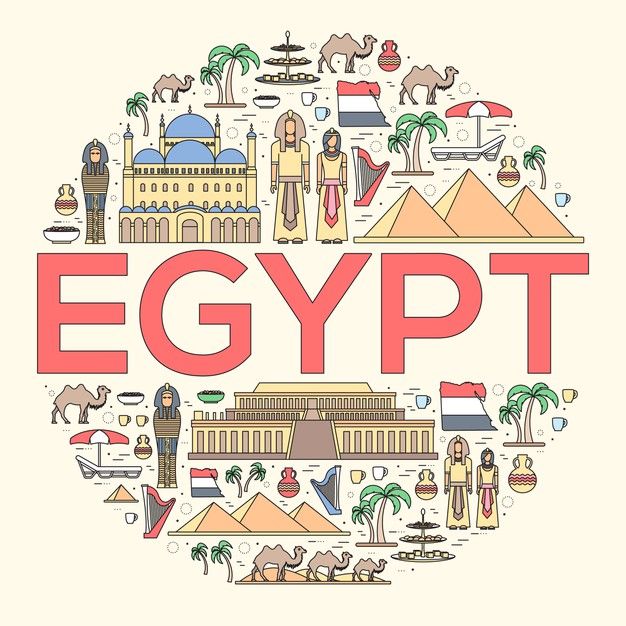
Egyptian Arabic reflects Egypt’s rich cultural heritage. Knowing its grammar and vocabulary:
- Lets you experience humor, storytelling, and traditions authentically.
- Helps you understand social nuances, gestures, and expressions.
- Makes your interactions more meaningful and immersive.
👉 If you want to expand your vocabulary even further, don’t miss our blog post:
Egyptian Colloquial Vocabulary: Must-Know Words with Examples,
where we break down essential everyday words with clear, real-life examples.
Widespread Understanding Across the Arab World

Thanks to Egypt’s influential cinema, music, and TV industries, Egyptian Arabic is the most widely understood dialect across the Arab world. Learning it:
- Acts as a “linguistic bridge” for communicating with speakers from other Arabic regions.
- Gives you a practical advantage if you travel, work, or study in other Arab countries.
Basic Sentence Structure in Egyptian Ammeya Grammar
Egyptian Ammeya (Masri) grammar is not only simpler but also more flexible than Modern Standard Arabic (MSA), which means it’s much easier to use in everyday conversation. In fact, learners often find that they can start speaking naturally after just a few lessons. Furthermore, because it reflects how Egyptians really communicate, you’ll understand jokes, expressions, and cultural nuances that MSA alone cannot convey. As a result, using Ammeya allows you to connect with locals more quickly and feel confident in real-life situations.
Word Order in Everyday Speech
The typical sentence structure in Egyptian Ammeya follows Subject-Verb-Object (SVO), which is similar to English. Consequently, learners often find it easier to construct sentences naturally. Moreover, this familiar structure allows you to focus on vocabulary and expressions without getting confused by complex grammar rules. In addition, because SVO mirrors everyday speech, you can start forming meaningful sentences from the very beginning, and gradually improve your fluency as you practice more with native speakers.
Example:
- Ana baheb el-kahwa – I love the coffee.
- Hiya betakol el-akl – She is eating the food.
While the structure is flexible for emphasis, most sentences stick to this simple order, which helps keep communication clear and efficient.
Dropping Case Endings and Simplification
Unlike MSA, Egyptian Ammeya does not use the complex case endings or strict grammatical markers. For example:
- In MSA: Kataba al-ṭālibu al-darsa – “The student wrote the lesson.”
- In Ammeya: El-ṭālib katab el-dars – “The student wrote the lesson.”
This simplification reduces the need to memorize long conjugations and endings, letting learners focus on speaking naturally.
How Meaning Is Still Clear Without Formal Grammar
Even without the formal rules of MSA, Egyptian Ammeya communicates meaning effectively because:
- Context matters: The situation, verbs, and nouns provide clarity.
- Prefixes and suffixes: Words like b- (present tense) and -ni (object pronoun) give essential grammatical information.
- Negation patterns: The ma…sh structure clearly marks negatives, e.g., Ana ma bakolsh – I don’t eat.
In essence, Egyptian Ammeya grammar is designed for speed, clarity, and everyday use, making it ideal for real-life communication, media, and social interactions.
Verbs in Egyptian Ammeya Grammar
In Egyptian Arabic (Masri), verbs are the backbone of communication. They tell us what is happening—for example, reading, walking, or writing. Unlike Modern Standard Arabic, in Egyptian Ammeya the consonants of a word give the general meaning, while vowels, prefixes, and suffixes modify it.
Example: The root letters ktb appear in many related words:
- katab – wrote
- yiktib – writes
- kitaaba – writing
- maktab – desk/office
- maktub – written
This system allows a single root to generate a family of related meanings, which makes the language both rich and flexible. As a result, learners can see how different words are connected, and this understanding helps in remembering vocabulary more easily. Furthermore, by recognizing these patterns, you can start forming new words and expressions naturally, therefore enhancing both comprehension and communication skills in everyday conversation.
Verb Tenses

1. Perfect (Past)
Used for completed actions.
| English | Egyptian | Example |
| I wrote | ‘ana katabt | أنا كتبت |
| He wrote | huwwa katab | هو كتب |
| They wrote | humma katabu | هم كتبوا |
2. Simple Imperfect
Used with modals like must (لازم), could, or with kaana (كان) for past habits, this structure helps convey necessity, possibility, or habitual actions in the past. For example, you can express what someone had to do, or describe routines that happened regularly. Additionally, combining it with different verbs allows you to add nuance to your sentences, thus making your speech sound more natural and expressive.
Example with “must” (لازم):
- I must write – ‘ana laazim ‘aktib – أنا لازم أكتب
- She must write – hiya laazim tiktib – هي لازم تكتب
3. Bi-imperfect (Present/Habitual)
Indicates actions happening now or regularly. Add bi- بـِ to the imperfect.
| English | Egyptian |
|---|---|
| I write | ‘ana baktib – أنا بكتب |
| He writes | huwwa biyiktib – هو بيكتب |
| They write | humma biyiktibu – هم بيكتبوا |
4. Ha-imperfect (Future)
Indicates future actions. Add ha- هـَ to the imperfect.
| English | Egyptian |
|---|---|
| I will write | ‘ana haktib – أنا هكتب |
| She will write | hiya hatiktib – هي هتكتب |
| They will write | humma hayiktibu – هم هيكتبوا |
5. Is/Was/Will Be
There is no word for “is” in Egyptian. Use:
- kaan كاَن – was
- haykoon هـَيكون – will be
Example:
- I was tired – kunt taAbaan ‘awi – كنت تعبان قوي
- The party was good – ilhafla kaanit kuwayisa – الحفلة كانت كويسة
- We will be ready – ihna hankoon gaahzin – إحنا هنكون جاهزين
Object & Indirect Pronouns (Attached to the Verb)
Object suffixes:
- me – -ni – ني
- him – -uh – ه
- her – -ha – ها
Indirect suffixes:
- to me – -li – لي
- to him – -lu – له
- to them – -luhum – لهم
Examples:
- I know him – ‘ana Aarfuh – أنا عارفه
- Give it to me – iddeehooli – اديهولي
- Ahmed saw her yesterday – ‘ahmad shafha ‘imbaarih – أحمد شافها إمبارح
Forming Direct Commands
To give a command:
- Start with the imperfect form of the verb.
- Remove the initial ي if present.
- For masculine commands, leave it as is; for feminine, add -i; for plural, add -u.
Examples:
| Verb | Command (m) | Command (f) | Command (pl) |
|---|---|---|---|
| يروح – to go | روح (ruuH) | روحي (ruuHi) | روحوا (ruuHu) |
| يشتغل – to work | اشتغل (ištaġil) | اشتغلي (ištaġli) | اشتغلوا (ištaġlu) |
| يأكل – to eat | كل (kol) | كلي (koli) | كلوا (kolu) |
Special Cases:
- Consonant cluster verbs need ا at the beginning:
- مشي → امشي
- فتح → افتح
Negative Commands
Form a negative command with: ما…ش around the second-person imperfect.
Examples:
| Verb | Negative (m) | Negative (f) | Negative (pl) |
|---|---|---|---|
| تعمل (do/make) | ماتعملش | ماتعمليش | ماتعملوش |
| تروح (go) | ماتروحش | ماتروحيش | ماتروحوش |
| تذاكر (study) | ماتذاكرش | ماتذاكريش | ماتذاكروا |
Other polite ways to tell someone not to do something:
- بلاش (balaash) – “Don’t / better not” (polite suggestion)
- Example: بلاش تستنى في الشارع، أحسن لك تقعد جوة – Don’t wait in the street, better sit inside.
- إوعى (ew3a) – “Watch out / don’t dare” (strong warning)
- Example: إوعى تنسي موبايلك – Don’t forget your phone.
- إياك (iiyyaak) – very strong prohibition
- Example: إياكي تاكلي من أكلي في التلاجة – Don’t eat my food in the fridge!
Polite/Indirect Requests
Use modals for politeness:
- لازم… laazim – must/have to
- المفروض… il-mafruuD – should
- أحسن… aHsan – it’d be better to
- ممكن…؟ mumkin – can you…?
Always add “please” for courtesy:
- من فضلك (min faDlak / min faDlik / min faDluku)
- لو سمحت (law samaHt / law samaHti / law samaHtu)
Examples:
- لازم تفكر في الموضوع قبل ما تاخد قرار – You should think about the issue before making a decision.
- ممكن توريني السكة؟ – Can you show me the way?
Pronouns in Egyptian Ammeya Grammar
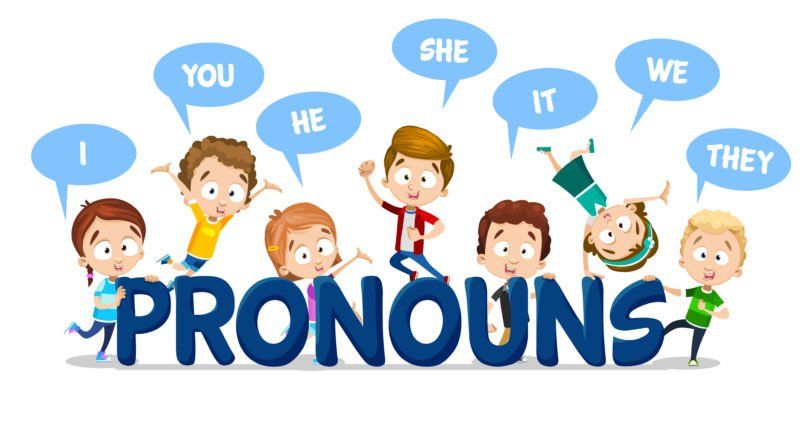
Pronouns are short words that replace nouns in speech. They make sentences shorter and clearer, especially when the noun has already been mentioned. For example:
English: Ahmed has a dog. He walks with it every day.
Egyptian Arabic: ‘ahmad Aanduh kalb wa huwwa biyitmashsha maAauh kul yoom
Arabic script: أحمد عنده كلب وهو بيتمشى معاه كل يوم
Egyptian Arabic pronouns are divided into personal, demonstrative, indefinite, and relative pronouns.
Subject Pronouns in Daily Use
Subject pronouns are used to show who is performing the action in a sentence. In Egyptian Arabic, they are often omitted because the verb itself indicates the subject, but they are commonly used for emphasis or clarity.
| English | Egyptian (Transliteration) |
|---|---|
| I | ‘ana |
| We | ‘ihna |
| You (m. sing.) | ‘inta |
| You (f. sing.) | ‘inti |
| You (pl.) | ‘intu |
| He/It (m.) | huwwa |
| She/It (f.) | hiya |
| They | humma |
Example sentences:
- I am eating → ‘ana bakol
- She is reading → hiya bit’ra
Object and Possessive Pronouns
Object pronouns show who is receiving the action of the verb. Possessive pronouns show ownership. In Egyptian Arabic, these are usually suffixes attached to verbs or nouns.
| English | Suffix (Transliteration) | Example in Egyptian Arabic | Meaning |
|---|---|---|---|
| me / my | -i | kitab-i | my book |
| us / our | -na | shuft-na | I saw us / we were seen |
| you (m.) | -ak | shuft-ak | I saw you (m.) |
| you (f.) | -ik | shuft-ik | I saw you (f.) |
| you (pl.) | -kum | shuft-kum | I saw you (pl.) |
| him / his | -u | shuft-u | I saw him |
| her / hers | -ha | shuft-ha | I saw her |
| them / theirs | -hum | shuft-hum | I saw them |
Examples:
- I love him → ana bahebbu
- This is my book → da kitab-i
Attached Pronouns With Verbs and Prepositions
In Egyptian Arabic, pronouns can also attach to verbs, prepositions, or conjunctions to indicate the object or possession.
With verbs (object pronouns):
- He saw her → huwwa shaf-ha
- I called you (f.) → ana it-taṣalt-ik
prepositions:
- With me → ma‘a-i
- For him → li-hu
With conjunctions:
- I think that you are wrong → ana ba‘tafkir innak ghaltan
Note: The attached pronouns make speech shorter and more natural, which is why they are very common in daily Egyptian Arabic.
Questions in Egyptian Ammeya Grammar
Egyptian Arabic (Ammeya) has its own rules for asking questions, which often differ from English and Modern Standard Arabic. Questions can be direct, indirect, yes/no, or rhetorical, and tone plays a big role.
Yes/No Questions Without Inversion
In Egyptian Arabic, you don’t need to invert the subject and verb to form a yes/no question. Instead, you can:
- Use intonation: Simply raise your voice at the end of the sentence.
- Example: inta gaay → inta gaay? (You’re coming? / Are you coming?)
- Add a question word like huwwa (هـُوَّ) or hall (هـَلّ):
- Huwwa gaay? (Is he coming?)
- Hall ‘inta raaDi ‘an af’aalak? (Are you satisfied with your actions?)
- Optional confirmation words at the end:
- Sahh? (Right?)
- Mish kida? (Isn’t that so?)
- Example: huwwa gaay, Sahh? (He’s coming, right?)
Tip: Egyptian Arabic often prefers simple forms with rising intonation over formal word order changes, unlike English.
Common Question Words Used by Egyptians
Egyptians use a variety of query words, usually at the end of the sentence, unlike English where they are at the start.
| English | Egyptian | Example |
|---|---|---|
| What | ‘ieeh إيه | inta ‘aayiz ‘ieeh? (What do you want?) |
| When | ‘imta إمتى | han-shufak ‘imta? (When will I see you?) |
| Where | feen فين | ilmahaTTa feen? (Where is the station?) |
| Where from | mineen مـِنين | ‘inta mineen? (Where are you from?) |
| How | ‘izzay إزّ َي | ‘izzayak? (How are you?) |
| Which | ‘anhw أنهو | Aaawiz il-kitaab ‘anhw? (Which book do you want?) |
| How many | kaam كام | kaam walad ‘indak? (How many children do you have?) |
| How much | ‘add ieeh قـَدّ ا ِيه | Aaawiz laban ‘add ieeh? (How much milk would you like?) |
| How much (money) | bi-kaam بـِكا َم | il-shanTa di bi-kaam? (How much is this bag?) |
| Why | leeh ليه | huwwa raayih leeh? (Why is he going?) |
Extra Notes:
- Kaam is always followed by a singular noun (unlike English “how many” + plural).
- For prices or amounts, use bi-kaam. For general quantity, use ‘add ieeh.
- Leih can also mean “for what reason?” or “why in particular?”
Negation Rules in Egyptian Ammeya Grammar
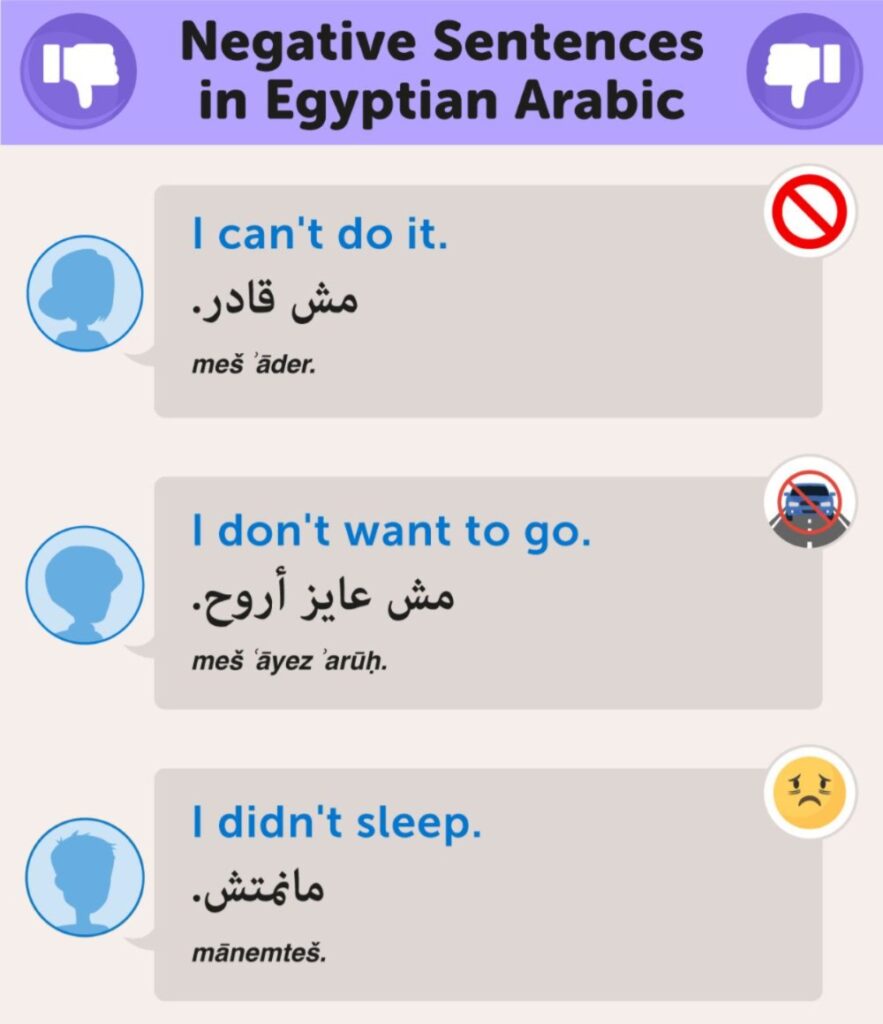
Negation in Egyptian Ammeya is one of its most distinctive features. Unlike English, which usually relies on words like not or don’t, Egyptian Arabic uses specific particles and patterns. For instance, the choice of particle changes depending on whether you’re negating a verb, a noun, or a whole phrase. Once you understand the core rules, negation becomes not only predictable but also easy to use in daily speech. Moreover, mastering these patterns allows you to express yourself naturally, therefore making conversations smoother and more authentic.
Using “Ma…sh” Correctly
The ma…sh structure is the most common way to negate verbs in Egyptian Ammeya.
How it works
- ma comes at the beginning of the verb
- -sh is added to the end
This creates a “sandwich” around the verb.
Examples
- ana ma-bahibb-sh el-samak
→ I don’t like fish - ana ma-shuft-sh Ahmed
→ I didn’t see Ahmed - ma-yaakul-sh
→ He must not eat
When to use it
- Present tense
- Past tense
- Commands (negative imperatives)
Example (command):
- ma-tigiish → Don’t come
This pattern is extremely common in everyday Egyptian speech and sounds very natural when used correctly.
Negating Verbs, Nouns, and Adjectives
Not all sentences use ma…sh. In many cases, Egyptians use mish (or mesh) instead.
Using mish
Mish is used to negate:
- Nouns
- Adjectives
- Participles
- Prepositional phrases
- Future tense verbs
It is placed before the word or phrase being negated.
Examples
- ana mish Aaarif
→ I don’t know - huwwa mish taAbaan
→ He’s not tired - ana mish Aandi flus
→ I don’t have money
Future tense negation
Instead of ma…sh, Egyptian Arabic uses mish before the future marker ha-:
- mish ha-ashteri el-kitaab
→ I won’t buy the book
Special negation words
Some expressions have fixed negative forms:
- mafeesh → there isn’t / there aren’t
- mafeesh mayaah → There’s no water
- ma-yenfaAsh → it’s not possible
- maAandeesh → I don’t have
These forms are very common and should be learned as complete expressions.
Common Mistakes Learners Make
Many learners struggle with negation at first, especially if they think in English. Here are some frequent mistakes to avoid:
1. Using mish with past verbs
❌ mish shuft Ahmed
✅ ma-shuft-sh Ahmed
Rule: Past and present verbs usually need ma…sh, not mish.
2. Forgetting the -sh
❌ ana ma-bahibb el-samak
✅ ana ma-bahibb-sh el-samak
Both parts are important for natural speech.
3. Negating future verbs with ma…sh
❌ ma-hashtiri-sh
✅ mish ha-ashtiri
Future tense is negated with mish, not the sandwich form.
4. Overthinking the rules
Native speakers often mix patterns naturally, and some forms don’t follow strict logic. Focus on common usage, not perfect grammar.
Final Tip
If you remember just three tools, you can negate almost anything in Egyptian Ammeya:
- ma…sh → for most verbs
- mish → for nouns, adjectives, and future tense
- mafeesh → for “there is/are not”
That’s why Egyptian Ammeya negation feels so natural in conversations, movies, and everyday life.
Adjectives and Agreement in Egyptian Ammeya
Adjectives in Egyptian Ammeya are much simpler than in Classical Arabic. While agreement still exists, the rules are more flexible and natural in everyday speech. In fact, Egyptians focus more on clarity and flow than strict grammatical accuracy, which means adjectives are easier to learn and use. Furthermore, this flexibility allows learners to describe people, places, and things without worrying too much about complex endings or formal structures. As a result, using adjectives in conversation becomes more intuitive and enjoyable.
Masculine and Feminine Forms
In most cases, adjectives agree with the noun in gender.
- Masculine adjectives usually appear in their basic form.
- Feminine adjectives are often formed by adding -a (ـة sound) at the end.
Examples:
- walad kwayyis → a good boy
- bint kwayyisa → a good girl
- ragel taweel → a tall man
- sitt taweela → a tall woman
Some adjectives have fixed forms and don’t change much, but this pattern covers the majority of everyday adjectives.
Plural Forms in Spoken Egyptian
Plural agreement in Egyptian Ammeya is much more relaxed than in Formal Arabic.
- Very often, the adjective stays singular, even when describing a plural noun.
- Using the masculine singular form is extremely common and completely natural.
Examples:
- nas kwayyisa → good people
- awlaad shatra → smart kids
In some cases, especially in careful or slightly more formal speech, speakers may use plural adjective forms—but this is optional, not required.
The key rule: If it sounds natural, it’s correct.
Position of Adjectives in a Sentence
In Egyptian Ammeya, adjectives almost always come after the noun they describe.
Examples:
- el-bet el-kibiir → the big house
- el-kitaab el-gamiil → the beautiful book
When using the verb to be in the present tense, it is usually dropped, and the adjective completes the sentence:
- el-film helw → the movie is nice
- el-akl sa5en → the food is hot
For emphasis, Egyptians rely more on tone and repetition than changing word order.
Why This Makes Ammeya Easier
Because adjective agreement is flexible and forgiving, learners can start speaking confidently right away without memorizing complex tables. Moreover, even if the agreement isn’t perfect, native speakers will still understand you, which is why Egyptian Ammeya feels so natural in real-life conversations. In addition, this forgiving nature reduces anxiety for beginners, allowing them to focus on communication rather than perfection. Consequently, learners gain confidence faster and enjoy practicing the language in everyday situations.
Final Thoughts on Egyptian Ammeya Grammar
Egyptian Ammeya grammar is not about memorizing complex rules—it’s about understanding how Egyptians actually speak every day. Its simplicity, flexibility, and natural flow make it one of the easiest Arabic dialects to learn and use in real-life situations. By focusing on listening, exposure, and practice, learners can quickly gain confidence and start communicating naturally with native speakers.
Learn Egyptian Ammeya Grammar at Areeb Academy
At Areeb Academy, you learn Egyptian Ammeya the way it’s truly spoken.
Our teachers are native Egyptian speakers who are also fluent in English, so explanations are clear, simple, and easy to understand—no confusion, no pressure. Lessons are practical, interactive, and focused on real conversations
Whether you’re a complete beginner or looking to sound more natural, we guide you step by step in a smooth and supportive learning environment.
👉 Book your free trial now and start speaking Egyptian Ammeya with confidence from day one.